Moore's Creek Bridge: 1776 Perspectives Lesson Plan
A lesson plan for use in middle and high school classrooms.
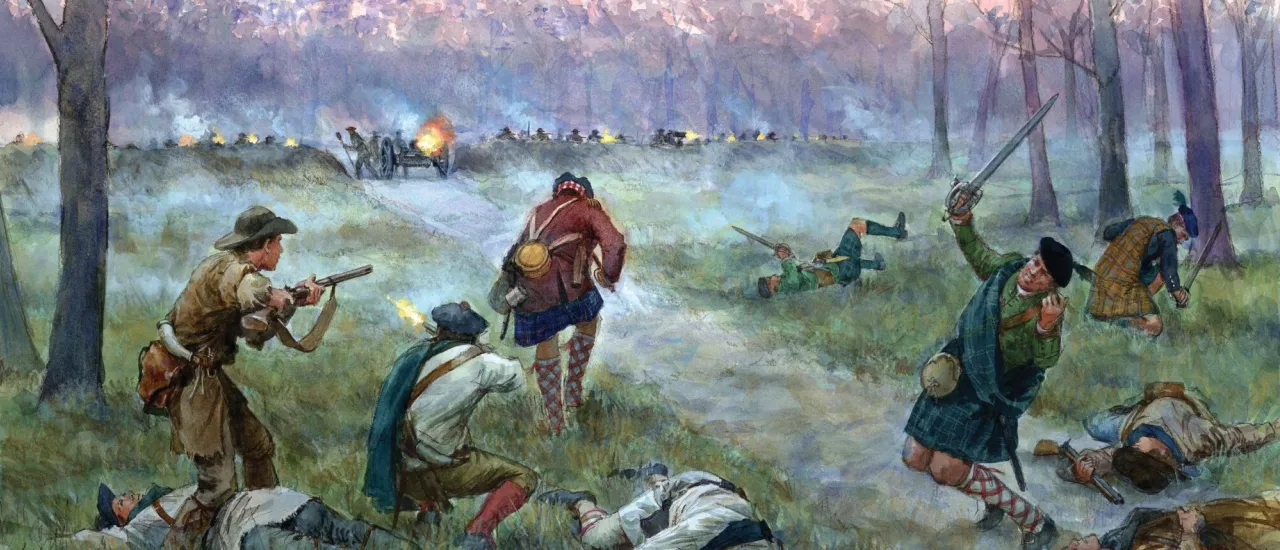
The Battle of Moores Creek Bridge was fought between Patriot and Loyalist forces in North Carolina on February 27, 1776. Loyalist forces, anticipating support from a British army, rallied and marched toward the coast. Patriot militia blocked the Loyalists at Moores Creek Bridge and a brief fight occurred. The Patriots achieved a victory that solidified their control of North Carolina and encouraged North Carolina delegates to vote for independence. Additionally, the victory served as a major deterrent for Loyalist support until the opening of the Southern Campaign four years later.
This Lesson Plan can be used as a prepared resource by following this curriculum plan which aligns to NCSS and Common Core Standards.
This Lesson Plan's assets can also be used on their own as supplemental resources. The display format is prepared for easy access, exploring, and learning.
North Carolina & The American Revolution Lesson Plans
Upon completion of this lesson, the students will be able to:
1. Knowledge
- Briefly explain the outcome of the Battle of Moores Creek Bridge and describe what some eyewitnesses or participants experienced.
2. Comprehension/Application/Analysis
- Examine multiple primary sources to gain perspectives on the battle and its outcomes.
3. Evaluation
- Discuss findings from primary sources and how the Battle of Moores Creek Bridge influenced the American Revolution.
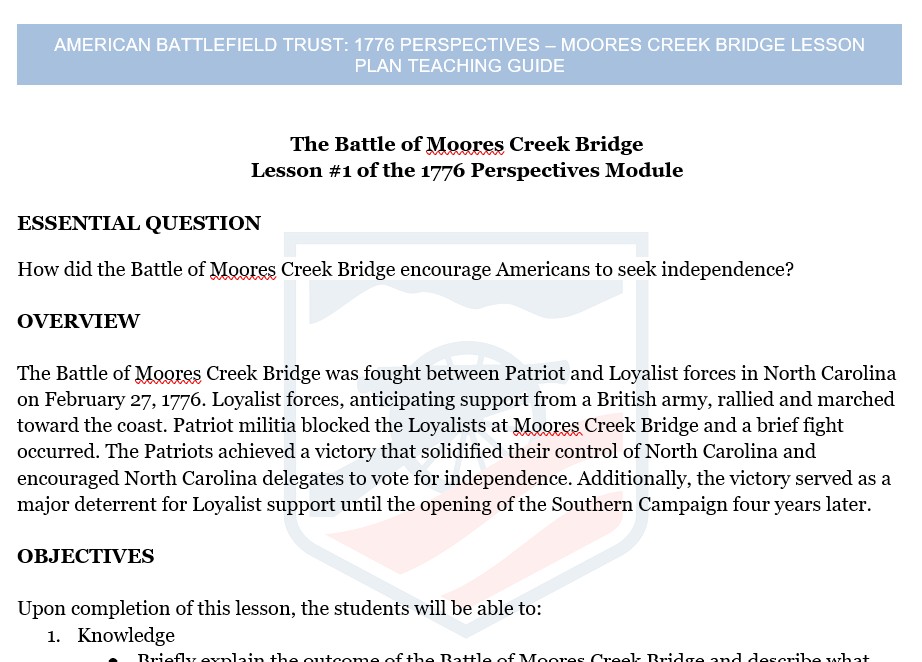
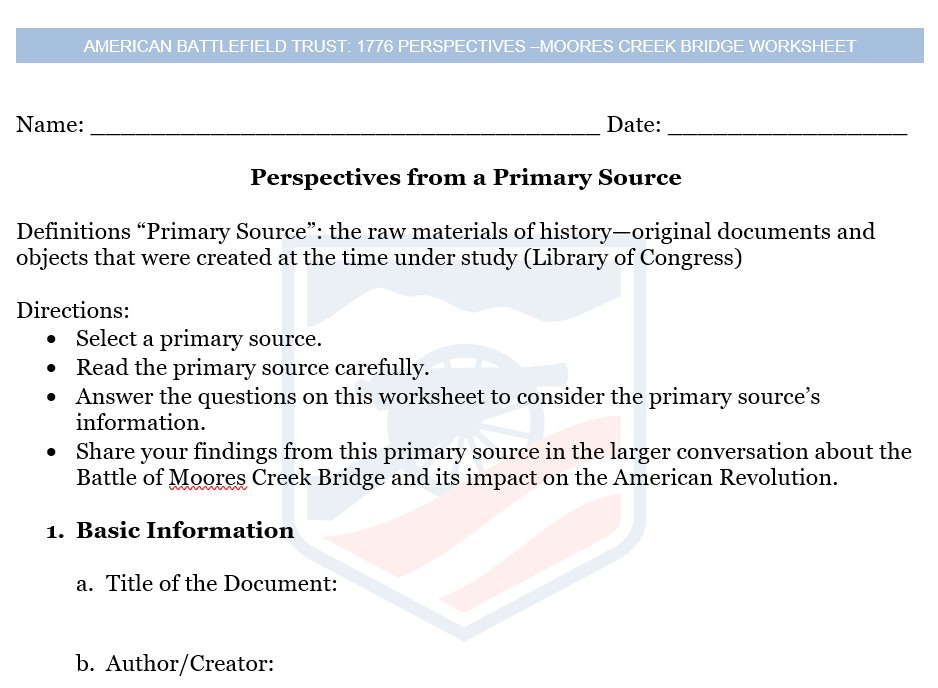

Check out the Lesson Plan Teaching Guide for more instructions on using the prepared Lesson Plan.
Lesson Plan Primary Source Activity:
- Use the Lesson’s PowerPoint to explore the context and history; the PowerPoint introduces context and foundational knowledge of the Battle of Moores Creek Bridge.
- The primary sources for this perspectives lesson plan offer multiple perspectives from different people who fought or observed the battle; students can be divided into groups to read and fill out the worksheet.
Loyalist (British) 1776: A Proclamation by Governor Martin Loyalist (British) 1776: "There Are Troublesome Times Ahead"
Loyalist (British) 1776: Narrative of the Proceedings of a Body of Loyalists in North Carolina Whig (Patriot) 1776: "Freemen Contending for their Dearest Privileges" Whig (Patriot) 1776: "Doing Credit to their Country" After the Battle 1776: "Taken Prisoner at the Battle near Moores Creek Bridge" After the Battle 1857: "Address Delivered at the Celebration of the Battle of Moore's Creek Bridge" - Distribute the lesson’s worksheet.
- Students will read a primary source and fill out the worksheet which will guide them through exploring the document.
- Encourage a class discussion from the worksheet, draw group conclusions, answering the questions:
- Who won the Battle of Moores Creek Bridge? Depending on who wrote a particular document, what reasons were given for the outcome of the battle?
- What were some reactions to the Battle of Moores Creek Bridge in these primary sources?
- What did people think would happen next after the Battle of Moores Creek Bridge?
- What have you heard about the Battle of Moores Creek Bridge? Do you think it should be a better-known event from the American Revolution? Why or why not?
OPTIONAL HOMEWORK/ASSESSMENT/ADDITIONAL ACTIVITIES:
Option 1: Scottish Highlanders
Many of the Loyalists who fought at Moores Creek Bridge were Scottish Highlanders. The battle is remembered in military history as the last broadsword charge of the Highlanders. Learn more about the Scottish communities in North Carolina and some of their leaders in 1776.
- From Culloden to the Colonies: Revolutionary Scots
- Donald MacDonald
- Flora MacDonald
- Alexander McLean
- 1776: "There Are Troublesome Times Ahead"
- 1776: "Taken Prisoner at the Battle near Moores Creek Bridge"
Brainstorm a list of material culture artifacts relating to the Scots at Moores Creek Bridge (like broadsword, dirk, musket, clothing items, tartan patterns, portraits or primary sources). Have students research an object and collectively create a museum display using artifact photos and descriptions to tell this unique story.
Option 2: Create a Timeline
The Battle of Moores Creek Bridge was a small fight with larger impact. Using these articles and timeline create a comprehensive timeline to place Moores Creek Bridge in the larger scene of early 1776. Explore how this Patriot victory ties into the other events and defeats/victories or long sieges happening at the same time.
Common Core State Standards- ELA & History/Social Studies
Grades 6-8
- Key Ideas and Details:
- CCSS.ELA-LITERACY.RH.6-8.1
- Cite specific textual evidence to support analysis of primary and secondary sources.
- CCSS.ELA-LITERACY.RH.6-8.2
- Determine the central ideas or information of a primary or secondary source; provide an accurate summary of the source distinct from prior knowledge or opinions.
- CCSS.ELA-LITERACY.RH.6-8.1
- Craft and Structure:
- CCSS.ELA-LITERACY.RH.6-8.6
- Identify aspects of a text that reveal an author's point of view or purpose (e.g., loaded language, inclusion or avoidance of particular facts).
- CCSS.ELA-LITERACY.RH.6-8.6
- Integration of Knowledge and Ideas:
- CCSS.ELA-LITERACY.RH.6-8.8
- Distinguish among fact, opinion, and reasoned judgment in a text.
- CCSS.ELA-LITERACY.RH.6-8.8
Grades 9-10
- Key Ideas and Details:
- CCSS.ELA-LITERACY.RH.9-10.1
- Cite specific textual evidence to support analysis of primary and secondary sources, attending to such features as the date and origin of the information.
- CCSS.ELA-LITERACY.RH.9-10.2
- Determine the central ideas or information of a primary or secondary source; provide an accurate summary of how key events or ideas develop over the course of the text.
- CCSS.ELA-LITERACY.RH.9-10.3
- Analyze in detail a series of events described in a text; determine whether earlier events caused later ones or simply preceded them.
- CCSS.ELA-LITERACY.RH.9-10.1
- Craft and Structure:
- CCSS.ELA-LITERACY.RH.9-10.5
- Analyze how a text uses structure to emphasize key points or advance an explanation or analysis.
- CCSS.ELA-LITERACY.RH.9-10.6
- Compare the point of view of two or more authors for how they treat the same or similar topics, including which details they include and emphasize in their respective accounts.
- CCSS.ELA-LITERACY.RH.9-10.5
- Integration of Knowledge and Ideas:
- CCSS.ELA-LITERACY.RH.9-10.8
- Assess the extent to which the reasoning and evidence in a text support the author's claims.
- CCSS.ELA-LITERACY.RH.9-10.9
- Compare and contrast treatments of the same topic in several primary and secondary sources.
- CCSS.ELA-LITERACY.RH.9-10.8
Grades 11-12
- Key Ideas and Details:
- CCSS.ELA-LITERACY.RH.11-12.1
- Cite specific textual evidence to support analysis of primary and secondary sources, connecting insights gained from specific details to an understanding of the text as a whole.
- CCSS.ELA-LITERACY.RH.11-12.2
- Determine the central ideas or information of a primary or secondary source; provide an accurate summary that makes clear the relationships among the key details and ideas.
- CCSS.ELA-LITERACY.RH.11-12.3
- Evaluate various explanations for actions or events and determine which explanation best accords with textual evidence, acknowledging where the text leaves matters uncertain.
Craft and Structure:
- Evaluate various explanations for actions or events and determine which explanation best accords with textual evidence, acknowledging where the text leaves matters uncertain.
- CCSS.ELA-LITERACY.RH.11-12.6
- Evaluate authors' differing points of view on the same historical event or issue by assessing the authors' claims, reasoning, and evidence.
- CCSS.ELA-LITERACY.RH.11-12.1
- Integration of Knowledge and Ideas:
- CCSS.ELA-LITERACY.RH.11-12.8
- Evaluate an author's premises, claims, and evidence by corroborating or challenging them with other information.
- CCSS.ELA-LITERACY.RH.11-12.9
- Integrate information from diverse sources, both primary and secondary, into a coherent understanding of an idea or event, noting discrepancies among sources.
- CCSS.ELA-LITERACY.RH.11-12.8
Social Studies - National Council for the Social Studies
- Theme 2: Time, Continuity, and Change
- Theme 3: People, Places, and Environments
- Theme 5: Individuals, Groups, and Institutions
- Theme 6: Power, Authority, and Governance
- Theme 9: Global Connections
This Lesson plan
contains the following:
3 Activities | 24 Resources
Audience: Middle school | High school