Josiah Martin
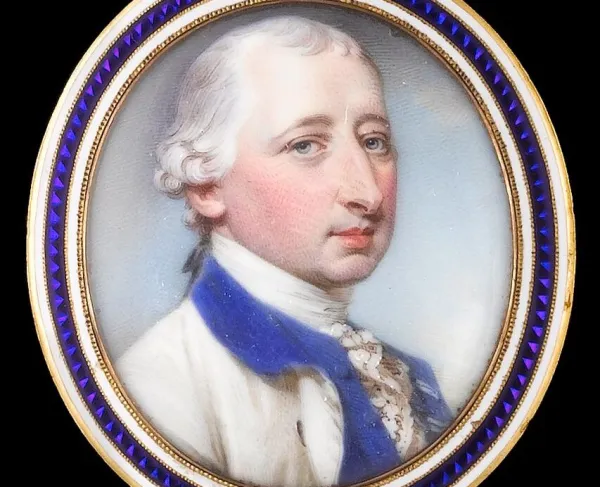
Josiah Martin was born in April 1737 in Dublin, Ireland, into a family with connections to the New World and an ancestral history of supporting the British crown. His father, Colonel Samuel Martin, owned plantations on the island of Antigua, a British colony in the Caribbean. His mother, Sarah Wyke Irish, had six children who survived childhood, including Josiah who was the third son. Young Josiah had an older half-brother, Samuel Martin, Jr., who influenced his career steps.
In his youth, Josiah Martin lived in Ireland, England and Antigua. He was educated by a private tutor. By age fifteen, Martin longed for a military life. Two years later, he joined the 4th Foot Regiment as an ensign, with his half-brother’s assistance. The following year (1758), Martin commissioned as a first lieutenant, hoping that a military career would provide financial security.
Fought between 1756-1763, the Seven Years War—called the French and Indian War in the North American colonies—pitted European powers against each other and spread to colonial territories in a quest for power and land. Martin took part in the British “reduction of Canada”, as he described the colonial conquest. His regiment rebuilt fortifications at Crown Point along Lake Champlain.
While in New York, he connected with extended family who lived in the colony, and his uncle appointed him to New York’s royal council, offering a chance to take part in colonial governance. In 1761, Martin married his cousin, Elizabeth, and in time, the couple had six children. Martin commissioned as a major in the 103rd Regiment, serving alongside Charles Lee. Later, in 1762, Martin became the lieutenant colonel of the 22nd Regiment of Foot.
In the mid-1760s, Martin tried to settle his family in Antigua but regularly struggled with debts, even as he served in the royal council of the colony. The Stamp Act in 1765 provoked reactions throughout the British colonies, including in the Caribbean. Martin forcefully wrote and spoke his own support for the Parliamentary tax. He believed Parliament’s concession repeal of the unpopular act would lead to future colonial disputes. Ahead of his time by a few years, Martin advocated for coercive laws to force the colonists to submit. Martin increasingly looked for ways to leave the military, though worried how to financially support his family. He considered selling his officer commission (a common practice) and seeking a collector’s post in a port city of the thirteen colonies. With his brother's assistance, Martin relocated his family to New York in 1767. The next years consisted of health struggles and voyages between New York, Antigua and England, trying to find a position of employment outside of military service.
While in England in 1771, Martin heard he would be appointed as the royal governor of North Carolina. Ill health delayed his return to the colonies, but he corresponded with Governor Tryon and tried to understand the Regulator War surging through that colony. In private correspondence, Martin recognized that military force should be used with great caution in civil disputes, though he continued to advocate for coercive taxes.
Josiah Martin arrived in North Carolina, presented his appointment to the council chamber on August 12, 1771, and took office. An influential colonist noted, “We are in daily expectation of Mr. Martin our new Govr. And as we hear a very amiable Character of him are not uneasy at the approaching change most among us….” Still, Martin faced steep problems, including the aftermath of the Regulators War, disputes over the border between North Carolina and South Carolina, lack of representation in Parliament and conflicts between the colonial assembly and the crown’s appointment of civil officers.
There were also new challenges for the royal governor. North Carolinians assembled a Provincial Congress in 1774 and then sent delegates to the First Continental Congress. Angered by this move against Parliament and a unified effort with other colonies, Martin convened the Colonial Assembly in April 1775. Meanwhile, a Second Provincial Congress met, and Martin ordered them to disband. News of the battles at Lexington and Concord, Massachusetts, arrived in the south. When the New Bern Committee of Safety threatened, Martin sent his family to New York and then retreated to Fort Johnston, along the coast near Wilmington.
Martin’s location changed when militiamen burned Fort Johnston in July 1775, forcing the governor to take refuge on the British warship, Cruzier. From this executive post floating on the Cape Fear River, he corresponded with the king’s ministers in England. Martin advanced the idea that the British could reestablish control of the southern colonies easily if the Loyalists rallied and had British military support. In time, this theory—supported by other Loyalist leaders—would heavily influence British strategy toward the end of the Revolutionary War.
Martin received assurances of British army and navy forces heading toward North Carolina. He issued a proclamation in January 1776, ordering Loyalists to assemble and prepare to march to Wilmington to join with the arriving British troops. The Loyalists, including hundreds of Scot settlers, were halted and scattered at the Battle of Moores Creek Bridge on February 27, 1776. North Carolina Loyalists were not able to reassemble in significant numbers; the British reinforcements headed toward Charleston, South Carolina, and suffered defeat in the fight at Sullivan's Island.
Josiah Martin was the last British governor of North Carolina. He did not regain control of the colony, and North Carolina led the calls for independence from England. Martin continued to support the Crown, remained in contact with Loyalist supporters and firmly believed that the Loyalist could and would retake the state. When Cornwallis’s British Army arrived in Charleston, South Carolina, in 1780, Martin joined it and took part in the southern campaigns. Cornwallis reached Charlotte, North Carolina, in September 1780, and reinstated Martin as governor. In March 1781, Martin was present at the Battle of Guilford Courthouse, witnessing a British military defeat. The following month he left North Carolina and joined his family in New York. Tragically, Elizabeth Martin had died while he was with the military, and Josiah Martin arranged to move his children to England.
In 1783, the Treaty of Paris ended the Revolutionary War and secured the independence of the United States. Josiah Martin lived three years beyond the end of the conflict that abruptly ended his governorship. He died in England on April 13, 1786, and was buried in St. George’s Hanover Square in London.

Related Battles
2
50


_(cropped).jpg)