Mary Slocumb
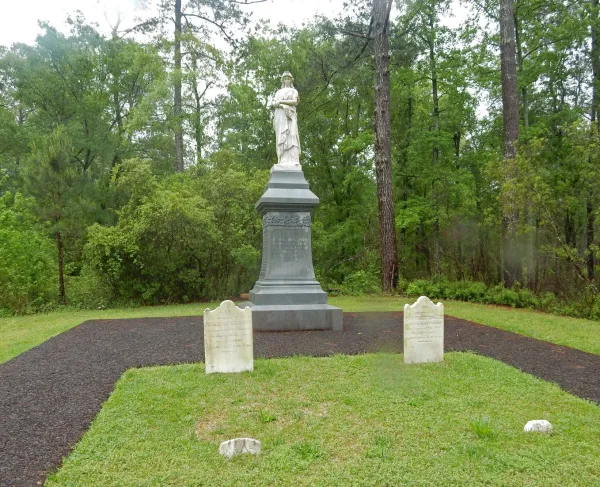
According to a monument added at Moores Creek Bridge Battlefield in 1907, Mary (Polly) Slocumb is the “most honored of the names.” The monument text explains that she was the “wife of Lieutenant Slocumb” and rode alone at night “65 miles to succor [aid] the wounded on this battlefield.” But did she really? The myths and stories around Mary Slocumb make it difficult to untangle the realities of her life from legend.
Elizabeth Ellet wrote down Slocumb’s story after hearing it from a friend of Mrs. Slocumb, and it appears to have been first published in the 1840s. Slocumb supposedly had a vision that her husband would be wounded or killed in battle. She left her young child with a servant or enslaved woman and set out on a long horseback ride. Reportedly, she heard cannon around mid-morning. Slocumb arrived at Moores Creek Bridge battlefield. She saw a figure wrapped in her husband’s cloak, like in her vision, but when she hesitatingly investigated, she found a neighbor, Frank Cogdell. He was wounded, and she bandaged his injuries, then helped others lying nearby. Slocumb met Colonel Richard Caswell and asked if he had seen her husband. Soon, Slocumb’s husband appeared, returning from pursuing the Loyalists; he was surprised to see her. Later, seeing the Loyalist prisoners, Mrs. Slocumb begged Caswell to be kind and lenient to them. That evening she rode back home, thankful that her husband was safe and eager to return to her baby.
It is not clear when Mary Slocumb was born. Her husband, Ezekiel Slocumb, was born in 1760. If he fought at Moores Creek Bridge in 1776, he would have been sixteen; perhaps Mary was also in her teens, married and with a child?
One of the difficulties in the historical record is that Ezekiel Slocumb is not in the lists of soldiers who fought at Moores Creek on February 27, 1776. He was an American soldier, but his pension record says he served from 1780 to 1781 and the only battle he mentioned was Camden. Also, no one named Frank Cogdell is on the muster lists for the troops at Moores Creek Bridge. Other discrepancies appear in the story—the fight at Moores Creek happened in early morning before or at dawn and was over in minutes, making it unlikely to hear cannon fire mid-morning. Also, Slocumb claimed there were about 20 wounded Americans, but at Moores Creek Bridge, just two Americans were injured according to officers’ reports.
It is very possible that Mary Slocumb’s story of a dream, ride across the countryside, tending to the wounded, and finding her husband alive happened. However, it’s likely that it happened at a different battle and probably later in the war. There are just so many facts about Moores Creek Bridge that do not match her story.
Mary Slocumb died in 1836. Her story and memories may have changed as time passed. Her friend who spoke to Elizabeth Ellet may have mixed up details or simply misremembered. Or Elizabeth Ellet may have tried to make “corrections” or additions to the story when she recorded it.
In 1929, Mary and Ezekiel Slocumb’s remains were removed from a family cemetery and reburied at Moores Creek Bridge Battlefield. At the time, this was seen as a way to honor a historic person’s life and memory. This may have been controversial, and documents in the National Park’s archive suggest that historians had their doubts about the legend and its connection to Moores Creek even at that time.
Today, Mary Slocumb is remembered in North Carolina’s Revolutionary War history. Her name is on the monument to Revolutionary Women that stands on the battlefield. Whether or not she actually arrived at Moores Creek Bridge on February 27, 1776, or took care of wounded after another fight, her story is a reminder of the courage of women during the American Revolution and how war threatened their homes and loved ones. As the monument inscription says women’s “heroism and self-sacrifice place her high on the pages of history….” and this is certainly exemplified in Slocumb’s story.

Related Battles
2
50