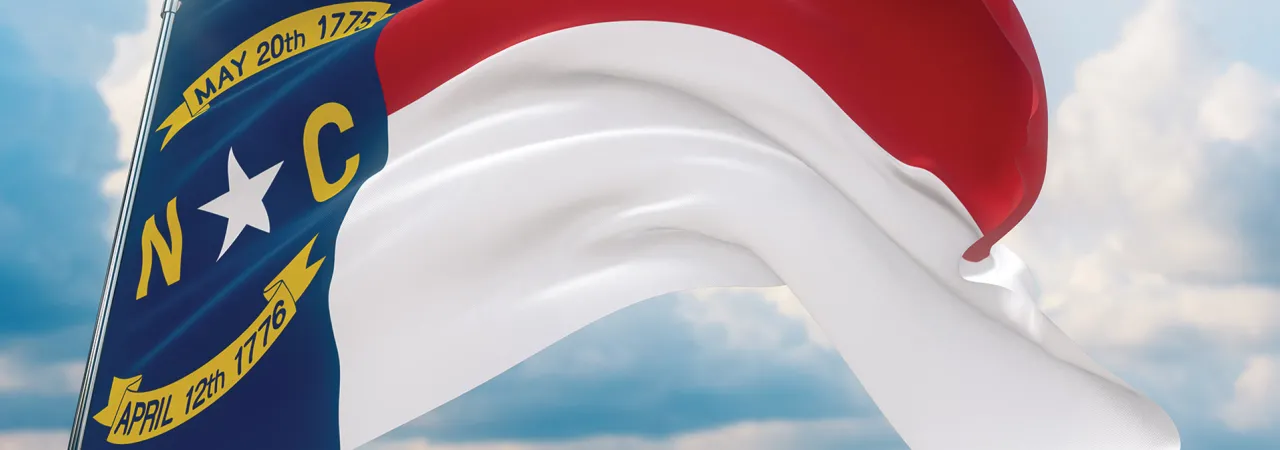
The state flag of North Carolina.
North Carolina, the “Tar Heel State.” While there are debates about the exact origin of that moniker, it reflects the economically successful industries of tar making and lumbering that supported the naval and maritime fleets of the 18th and 19th Centuries. Another North Carolina nickname—“The Old North State”—reflects the division of the Carolina Colony in 1710. For the majority of the 1700s, North Carolina was a British colony. That changed in 1776 when delegates from the “Tar Heel State” were authorized to vote for independence and then North Carolina transformed itself into a state and defended its political freedom.
The American Revolution (1775-1783) brought conflict to North Carolina. Most histories focus on the Southern Campaigns in 1780 and 1781 when large battles and quick movements burst into the timeline. However, the earlier years of the Revolution in North Carolina were altered colony to state, resistance to independence, localized conflict to war.
North Carolina’s geographical regions have influenced economic endeavors and social and political changes. The Coastal Plain region along the seaboard to the east was the first area settled by colonists. The Piedmont region sits in the central section, and the Mountain region in the west was still frontier in the mid-18th Century. Rivers were useful for commerce and sending crops or lumber to the coastal cities for export.
During the French and Indian War (1754-1763), several hundred North Carolina militiamen responded to the Virginia governor’s request for reinforcements. Meanwhile, the frontier settlements in the Piedmont region organized for defense. Militia constructed and garrisoned Fort Dobbs on the frontier. By 1759, the Cherokee declared war on the British, and in the following months, attacked towns and Fort Dobbs. The end of the war signaled the opening of more frontier land since the Cherokee had been forced further west.
Settlers in the Piedmont region and heading further west hoped to own land for small farms, but speculators and corrupt officials rigged a system that often put new farmers in debt. The colony’s tax system also fell unequally on the low and middle class, adding to the burden of Piedmont settlers. The Regulator War was a response to the economic hardship and unequal taxes within North Carolina. In 1766, residents of Orange County formed the Sandy Creek Association and petitioned for reforms. It had little effect. By 1768, a new movement emerged across multiple counties in the Piedmont. Calling themselves “Regulators”, an English political term referring to someone appointed to address abuses of power, they wanted redress for their grievances—not an overthrow of the colonial government. Their petitions, lawsuits and meetings failed to bring change, so the Regulators refused to pay their taxes. Eventually Governor William Tryon called out the colonial militia and defeated the Regulators at the Battle of Alamance in 1771.
This conflict within North Carolina unfolded against the backdrop of rising tensions between Britian and its North American colonies. Whigs took their name from a British political party and petitioned and protested against Parliament’s taxes without representation. North Carolinians formed their own Sons of Liberty groups, signed agreements against importing British goods, and joined the committees of correspondence which shared information throughout the colonies. In 1774, North Carolinians formed a Provincial Congress to formally discuss the grievances over British taxation. They also sent delegates to the First Continental Congress which brought men from most of the colonies together to seek ideas and stronger petitions to the British crown.
In April 1775, royal governor Josiah Martin dissolved the colony’s General Assembly after they tried to hold a Second Provincial Congress. Weeks later on May 6, 1775, news of the Battles of Lexington and Concord in Massachusetts reach North Carolina, and Whig militias readied for conflict closer to home. Governor Martin was forced to leave, eventually seeking refuge aboard a British warship on the Cape Fear River. Loyalists—those who supported the governor and the king—debated and squabbled with their neighbor Whigs.
The Third Provincial Congress met in August 1775, aware that the northern colonies were in armed conflict against British troops. North Carolina’s formal response included the agreement to officially enlist soldiers into Continental Army regiment which would head north to join General George Washington’s force. Meanwhile, in North Carolina, a thirteen member Council of Safety organized to coordinate the colony’s resistance, and six military districts made it easier to rally the Whig militias and represent the people in the provincial congress.
Governor Martin rallied Loyalist militia and Scottish Highlanders settled in North Carolina to form an army in January and February 1776. He hoped that a significant military force would march to the coast and join with an expected British fleet and army to retake North Carolina and reestablish British colonial rule. However, the Loyalist force was defeated at the Battle of Moores Creek Bridge on February 27, 1776. The victory at Moores Creek boosted American morale throughout the colonies and inspired an unprecedented political discussion.
The Fourth Provincial Congress passed the Halifax Resolves on April 12, 1776, officially authorizing North Carolina delegates to vote in favor of independence from Britain. Prior to the Halifax Resolves, most efforts in the provincial congress and Continental Congress had centered on petitioning the king and seek reconciliation. On May 27, North Carolina delegates in the Second Continental Congress signaled their willingness to vote for independence, helping to lead discussions toward that goal. The Declaration of Independence was announced on July 4, 1776, in Philadelphia, Pennsylvania, and three delegates from the Tar Heel State signed it: William Hooper, Joseph Hewes, and John Penn.
The autumn of 1776 saw a combined movement of North Carolina and South Carolina militia against the Cherokee. The Continental Congress sanctioned this campaign as retaliation for Native Americans’ attacks along the frontier which were believed to be coordinated to help the British. However, some believed it was an excuse to seize more frontier land for settlement and ignore old boundary lines established by British treaties.
In the home state, Loyalist resistance had been limited by the Battle of Moores Creek Bridge. Although tensions and neighborhood hostilities broke out occasionally, most of the state did not have significant war experiences until 1780 and 1781 during the Southern Campaigns. However, North Carolina supported the Patriot war effort in a variety of ways. The state sent hundreds of soldiers to serve in Washington’s Army. The North Carolina Continental Brigade fought in many of the battles in the north and sustain heavy losses, a testament to their bravery and reliability. The coastal towns of New Bern and Edenton organized fleets of privateers to attack British ships, and North Carolina admiralty courts used the sale of the captured goods to benefit the state’s citizens.
By 1780 with British General Cornwallis’s army in South Carolina and then turning northward, North Carolina came into the crosshairs of the Revolutionary War. The Tarheel State’s early war experience had set the stage for independence, quickly neutralized Loyalist uprisings and the comparative quiet had allowed North Carolina soldiers to battle in the ranks of Washington’s Army. Eventually, some of the deciding campaigns of the American Revolution took place in North Carolina, making it a battleground state in the later years of war.
Further Reading:
Related Battles
2
50