John Grady
The Battle of Moores Creek Bridge, fought on February 27, 1776, resulted in heavy losses for the Loyalists but only two recorded casualties for the Americans. One of those wounded—John Grady—died of his injuries and is remembered in the historical records as the first North Carolinian to fall in the American Revolution.
Little is known about John Grady. He was twenty years old in February 1776, and he had probably lived in Duplin County in eastern North Carolina.
By the beginning of January 1776, North Carolinian “rebels” had forced the British governor out of the colony and to a ship on the Cape Fear River. North Carolina towns had formed committees of safety, and local militia units drilled. Past conflicts and sides from the Regulators War re-emerged. The governor issued a proclamation, calling Loyalists to rally and march to Wilmington. Whigs—also called Americans or Patriots in the history books—organized to oppose the Loyalists’ march. Militia regiments and minutemen units formed an army whose officers strategized to use North Carolina waterways to their advantage in slowing or defeating the Loyalist advance toward the coast.
In Duplin County, Colonel James Kenan led the county’s militia regiment which was formed of ten known companies. John Grady had enlisted, probably drilled, and now marched out in one of the companies of the Duplin County Regiment of Militia.
Toward the end of February, North Carolina Whig militia took position along Widow Moore’s Creek, near a bridge. Planks of the bridge were removed, earthworks dug, and some small cannons positioned. In the early, dark morning hours of February 27, 1776, Loyalists approached the bridge and rushed to attack. Whigs opened fire from the protection of their prepared position. Private John Grady was on the battle line, firing on the advancing Loyalists. When the short, sharp fight ended, the Whigs had won the morning with the Loyalists scattered, leaving 30 dead and others wounded.
One Whig soldier later wrote, “There was but one our men killed and he was unfortunately shot in the back of the head.” Historians have speculated that Grady was wounded while standing above the earthworks for a better view while aiming his musket. He may have been kept on or near the battlefield for medical treatment or transported with the army, or he may have been taken to Wilmington. John Grady died on March 2, 1776. An officer later recalled that Grady had been buried with a sword, but the exact location of his original burial or details of the sword have been lost to the historical record over time. It is possible he was buried on the battlefield at Moore’s Creek Bridge, at Long Creek where the army was on March 2, or in Wilmington if he had been taken there for additional medical care.
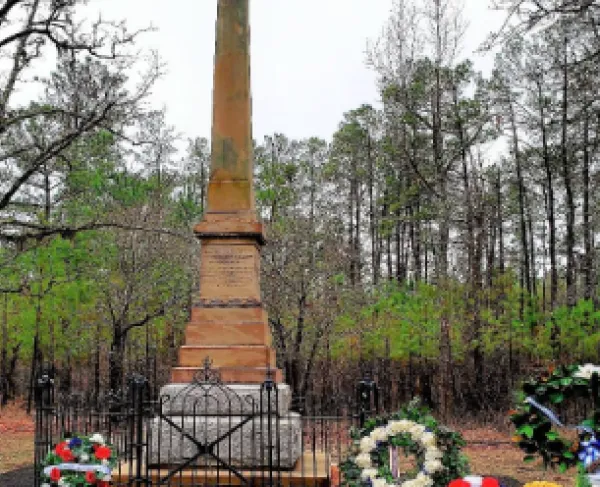
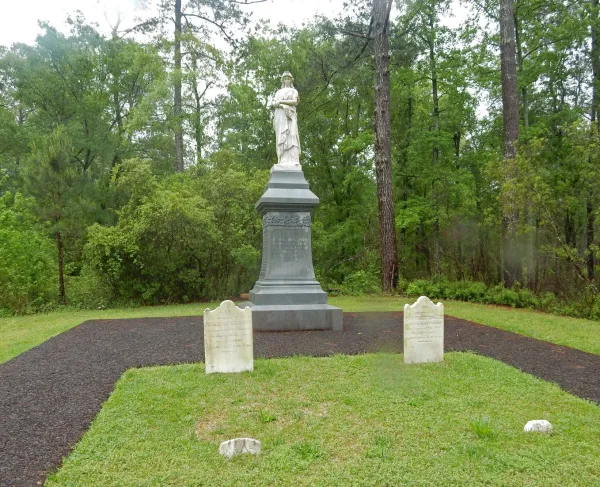
John Grady has been remembered throughout North Carolina’s history as the first soldier from the state to fall in the American Revolution. In 1857, a monument was placed at Moore’s Creek Bridge Battlefield and it is known as the Grady Monument or the Patriot Monument. There is on-gong speculation whether Grady’s remains were buried at the monument’s location in the 19th Century. Some believe the monument marks the location where he fell but is not his grave.
In 1925, Judge Henry A. Grady, a distant relative of John Grady, spoke at the battlefield, remembering the fight and the ancestor in his family tree. “We turn again to the scene of Battle; there is a party of four, bearing a ghastly burden on a hasty bier; the soldiers gather around to pay their respects to one who has fought bravely and died with honor—the only sacrifice of the day. Ezekiel Slocumb wraps his favorite coat about the body, and Capt. Love lays his sword across the honored breast. It is Private John Grady, of the Duplin Rangers, rigid in death, but covered with glory!”


Related Battles
2
50