James Moore
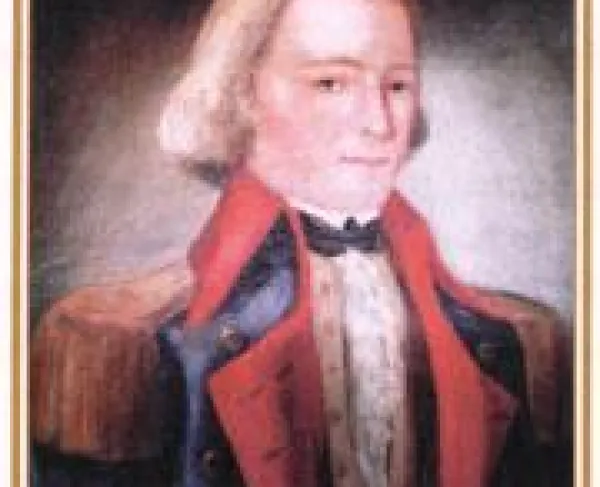
Though there are some discrepancies over the year that James Moore was born, most accounts point to 1737. His family had been in the North Carolina colony for decades, and his grandfather had served as the colonial governor in 1700 and 1719. His father, Maurice Moore, served as a militia officer and owned a plantation near Rocky Point where young James grew up, surrounded by extended family in the local region.
During the French and Indian War, James Moore commanded a company of militia. The governor praised him, noting, “Captain James Moore, who was a young gentleman of one of the best families of the province, and who for one year commanded in Fort Johnston, who was expert in military discipline and well beloved in the province.” He also took troops to South Carolina when that neighboring colony needed additional military assistance in the conflict.
He married Anna Ivey and the couple had four children, two daughters and two sons. (One of his sons, James Moore Jr., fought at the Battle of Eutaw Springs during the Revolutionary War.) Following the French and Indian War, Moore regularly served in the colonial legislature and assemblies, representing New Hanover County.
During the Regulator War, Moore sided with the colonial government, and Governor Tryon placed him in command of the artillery. He fought at the Battle of Alamance which ended much of the armed civil war within the colony.
Responding to the news of the Coercive Acts and the closure of Boston Harbor in Massachusetts, Moore joined with other influential men to urge North Carolinians to form a Provincial Congress to respond to Britian’s increasing attempts to control and tax the colonies. At the gathering of the First Provincial Congress in August 1774, North Carolinians discussed the idea that power belonged to the people, a revolutionary turn of conversation. Moore helped to organize a Committee of Safety for New Hanover.
The Third Provincial Congress met in August 1775 months after shots were fired in Massachusetts and British forces were trapped and sieged in Boston. The North Carolinians voted to recruit two Continental Regiments, formally signally that they would take part in the armed conflict alongside the other colonies. On September 1, 1775, Moore received a commission as Colonel of the 1st North Carolina Regiment. He spent the next months organizing the regiment, preparing to defend against British warships off Cape Fear, and monitoring the Cape Fear River where British Governor Josiah Martin had his headquarters aboard a ship.
In January 1776, Governor Martin issued a proclamation, calling on the Loyalists to assemble and march to Wilmington to join expected reinforcements arriving by sea. Moore coordinated with Richard Caswell to ensure that Whig militia, Continental regiments, and North Carolina minutemen opposed the Loyalists’ advance toward the coast. Moore concentrated troops first along Cross Creek, then along Moore’s Creek, maneuvering to block the Loyalists. Although he did not directly participate in the battle on February 27, 1776, the American victory at Moores Creek Bridge is partially to his credit for directing Caswell and Lillington to the area and his later leading role in the pursuit of the remaining Loyalists.
In recognition of the victory, the Continental Congress promoted Moore to brigadier general and gave him command of all American troops in North Carolina. A few months later in June 1776, he led the North Carolina Brigade to support the South Carolinians near threatened Charleston then attempted launched a summer invasion of Florida territory before returning to his home state.
In mid-September, Moore received orders to bring troops northward and join Washington’s Army in New York state, but those orders were countermanded as North Carolina hesitated that a British advance was imminent there. Moore spent the winter of 1776-1777 in the Carolinas, continuing with military duties and organizing. Orders to march north came again on March 15, 1777. However, before Moore could leave North Carolina and join General Washington, he fell ill. Brigadier General James Moore died in Wilmington on April 15, 1777.
In the early 20th Century, a state biographical book remembered him. “As distinguished and illustrious as were the statesmen of North Carolina during the Revolutionary period, her sons also excelled in the field of military operations; and among her contributions to the cause of independence, none was more brilliant than James Moore. . . .”

Related Battles
2
50