Santa Anna
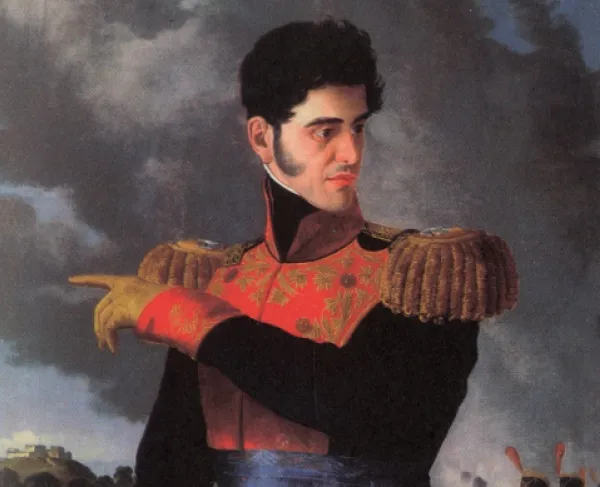
Antonio López de Santa Anna was a general and eleven-time president of Mexico. In his forty years of service, he was involved in many military and political confrontations that defined relations with the United States in the mid-19th century, including the Texas Revolution and Mexican-American War.
Santa Anna was born on February 21, 1794, in Xalapa, a city near Veracruz, in the Spanish colony of Nueva Espana. He joined the Spanish army at sixteen-years-old in June 1810, three months before the Mexican Revolution erupted. Initially fighting against the insurgents, Santa Anna became a first lieutenant by the end of 1812, but he defected alongside Augustin Iturbide to the Mexican cause nine years later. By the end of 1821, Mexico won its independence and Augustin became its emperor. Santa Anna revolted against Augustin the following year, a movement that inspired greater rebellions throughout the country. Forced to abdicate, Augustin left office and the rebels created the Mexican Federal Republic under the Constitution of 1824. In 1825, he married Veracruz socialite Ines Garcia, and the couple had four children (Santa Anna also fathered seven other children out of wedlock).
When the conservatives won the 1828 election, Santa Anna started another rebellion to nullify the results and successfully give power to the liberals. A victory against a Spanish expedition to reconquer Mexico the following year made Santa Anna a national hero, and when the government collapsed once again, Santa Anna was elected president in 1833. He shared power with his vice president, allowing Santa Anna to avoid blame for the administration’s most controversial decisions. In June 1834, Santa Anna adopted the Plan of Cuernavaca which overturned the 1824 Constitution and turned Mexico into a centralist, Catholic state. This decision sparked many revolts throughout the country, including in the northern province of Tejas y Coahuila. Fighting broke out at Gonzales on October 2, 1835, opening the Texas Revolution. Texas forces later marched on and captured the Alamo in San Antonio in December.
Santa Anna arrived in San Antonio with an army on February 23, 1836. Over the course of thirteen days, the Mexican troops laid siege to the Alamo. On March 6, the Mexicans stormed the Alamo, killing all its defenders. After Colonel James Fannin’s forces surrendered at Coleto Creek, they were taken to Goliad as prisoners of war. Santa Anna ordered their execution in what became known as the Goliad Massacre. Trying to cut off the last Texian forces under Sam Houston, Santa Anna pushed ahead with only 700 troops. Recognizing an opportunity, Houston confronted and decisively defeated Santa Anna on April 21 at San Jacinto. The following day, the Texans captured Santa Anna while he was attempting to escape. After 3 weeks in captivity, Santa Anna signed the Treaty of Velasco, granting Texas its independence.
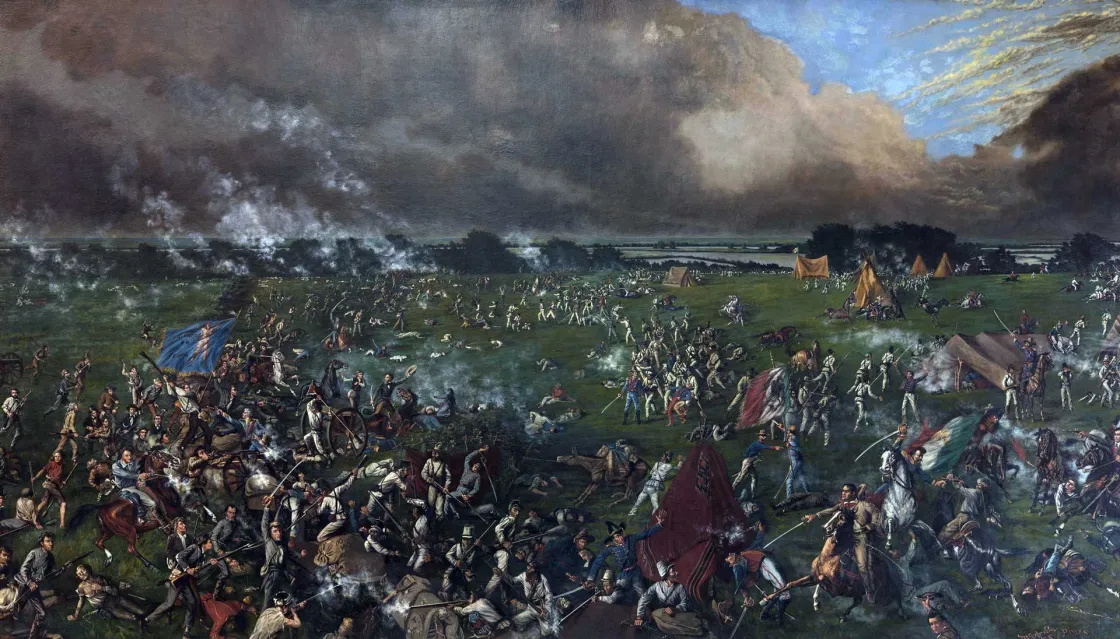
The Battle of San Jacinto, oil on canvas by Henry McArdle, 1895
Texas State Library and Archives Commission
Returning to Mexico, Santa Anna quickly redeemed himself after standing up to French aggression during the Pastry War. When the Mexicans refused to financially compensate them in 1838, the French staged an invasion of Veracruz. Despite losing the battle, Santa Anna’s heroic defense and severe wounds (he had to get his left leg amputated) reestablished his character. He became president again in 1839, 1842, 1843, and 1844, each for the span of a few months. Two months after his wife died in 1844, Santa Anna remarried 16-year-old Maria de los Dolores de Tosta. During these presidencies, he jailed dissidents and raised taxes, two moves that fueled revolts against him. In December 1844, Santa Anna was forced to step down and was exiled to Cuba.
The Mexican-American War allowed for his return. After early defeats at Palo Alto and Resaca de la Palma, Santa Anna was asked to return to lead the nation and restore the 1824 Constitution. He came back to Mexico on Aug 6, 1846, took charge of the Mexican Army with its 20,000 troops, and quickly marched north to confront Zachary Taylor’s Army of Occupation. On February 22, after Taylor refused to surrender, Santa Anna began his attack. While entrenched, the much smaller American army could not have held long against the Mexicans but the following day, Santa Anna decided to withdraw. The Battle of Buena Vista ended in both sides claiming victory, and Santa Anna quickly moved his troops south to confront Winfield Scott who had just landed at Veracruz.
Santa Anna thought Veracruz’s mountainous terrain and yellow fever conditions would weaken Scott’s troops, so he set up an ambush at Cerro Gordo and allowed the Americans to march inland. With 9,000 troops and artillery aimed at the central road, Santa Anna waited for Scott. American forces, however, aware of Mexican positions, outflanked Santa Anna and delt him a massive defeat. For the next few months, Scott continued dealing defeats to Santa Anna as he edged closer to Mexico City. Contreras, Churubusco, Molino del Rey, and Chapultepec all ended in American victory. Finally, on September 15, 1847, Scott took Mexico City and forced Mexico to negotiate the Treaty of Guadalupe Hidalgo.
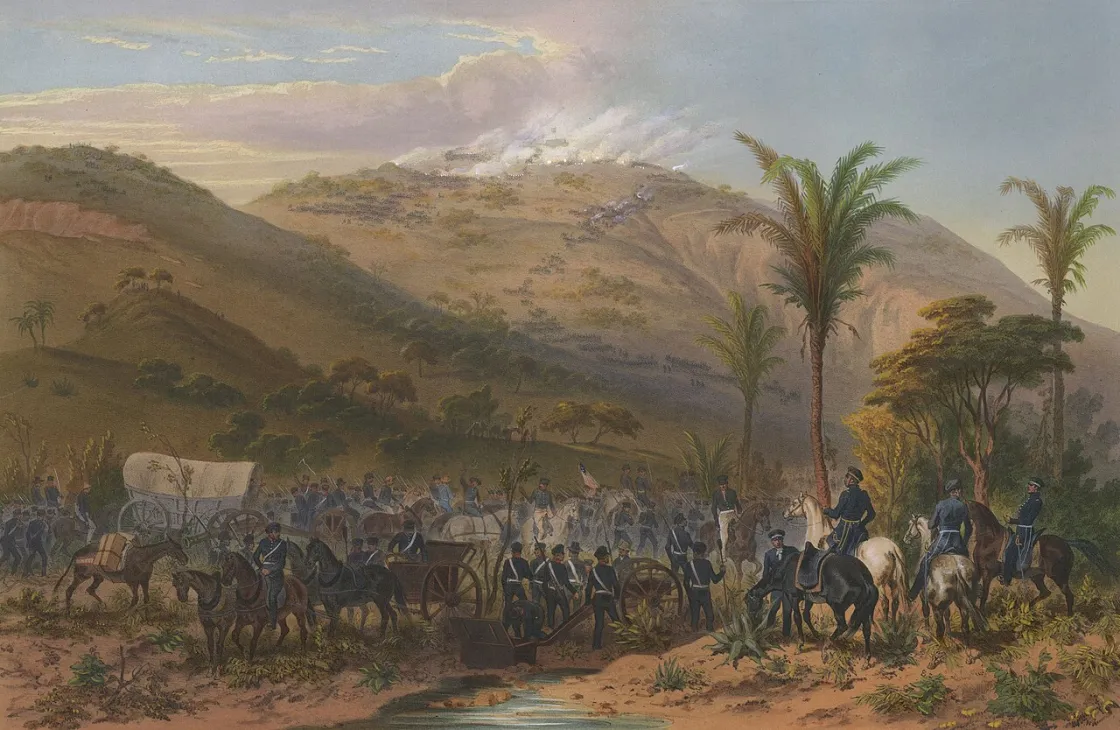
Battle of Cerro Gordo (April 18, 1847), 1851. Hand-colored lithograph by Adolphe Jean-Baptiste Bayot after a drawing by Carl Nebel. Originally published in The War Between the United States and Mexico Illustrated.
Public DomainAfter the war’s conclusion in 1848, Santa Anna returned to exile in Kingston, Jamaica and two years later in Turbaco, New Granada (today’s Colombia). In April 1853, with Mexico once again in a political crisis, Santa Anna was invited back to be the nation’s president. With the help of the Catholic church and the conservatives, he declared himself dictator-for-life. His decision to sell more land to the United States, in what became known as the Gadsden Purchase, made him highly unpopular. The liberal party overthrew him in August 1855, and Santa Anna was exiled once again. He moved to New York City, where he inadvertently introduced chewing gum to the United States. His attempts to return to Mexico to help with the Reform War and 1865 French invasion both failed, and he would remain in New York until his pardon in 1874. Back in Mexico City, Santa Anna fell ill and died at the age of 82 on June 21, 1876.
Santa Anna is controversial in both Mexico and the United States. His constant rebellion and eleven different presidencies earned him the reputation as a destabilizing force in Mexico, and he is remembered as one of the nation’s most controversial leaders. His acute violence at the Alamo and Goliad have also made him unpopular in the United States.




.jpg)