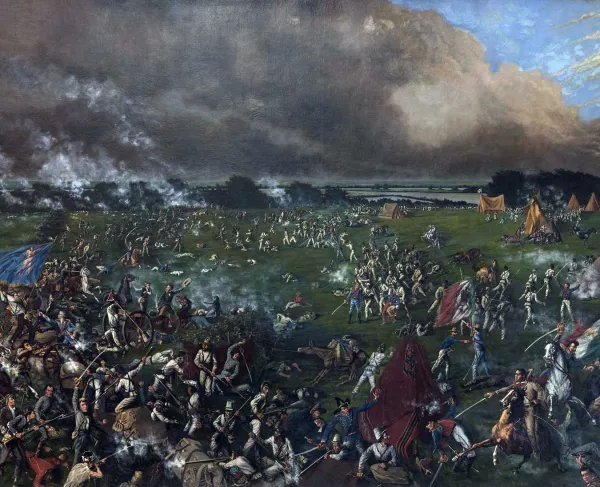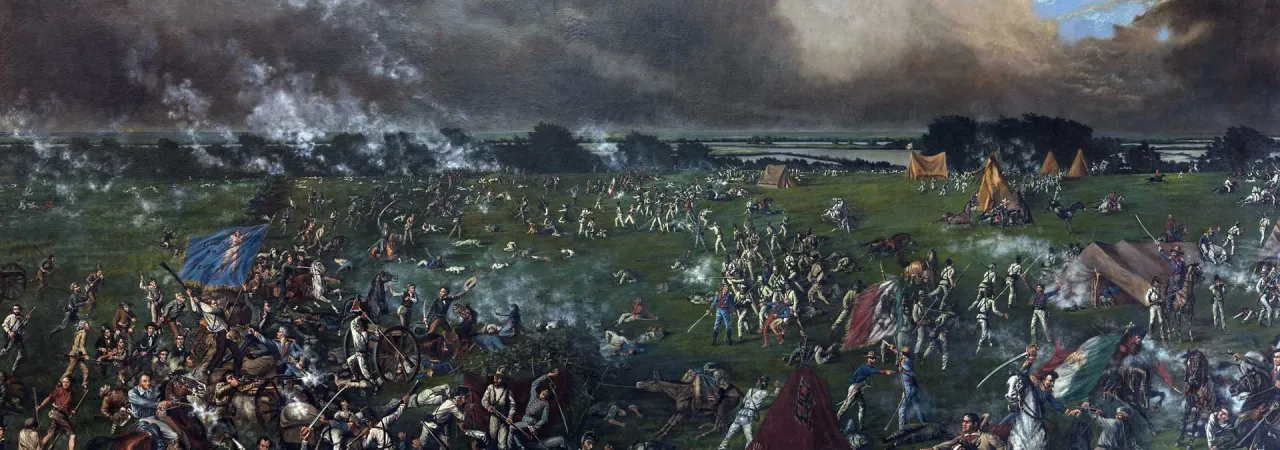
The Battle of San Jacinto, oil on canvas by Henry McArdle, 1895
In the early morning hours of March 6, 1836–just four days after the birth of the Republic of Texas–the besieged Alamo mission in San Antonio fell to Mexican forces under General Antonio López de Santa Anna. By March 11, word of the fall of the Alamo garrison had reached the General-in-Chief of the Texian army, Sam Houston, in Gonzales, about 70 miles from San Antonio. Various regiments had rendezvoused there in the hopes of marching to the Alamo. While most Texians wanted to engage the Mexican army immediately to avenge their brethren, Houston wisely decided to retreat eastward in the face of a superior Mexican force.
Following the Battle of the Alamo, Santa Anna began a sweep of the East Texas colonies. Dividing his army into three columns, he hoped to expel all Anglo settlers of Mexican Texas from the region. As it appeared that the Texian colonies lay at the mercy of the Mexican army, tens of thousands of Texians fled across the Sabine River into the United States in what became known as the “Runaway Scrape”. With the massacre of Colonel James Fannin’s troops at Goliad at the end of March, only Sam Houston stood in the path of Santa Anna and the U.S. border. Over the course of the next month, Houston continued his retreat to the frustration of many of his soldiers under his command.
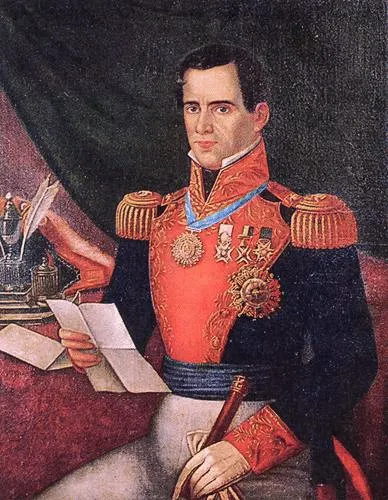
Antonio López de Santa Anna in his military uniform
Wikimedia CommonsAs frustration grew, Sam Houston’s army–swelling to over a thousand men with newly arrived volunteers from the United States–arrived at the banks of the Trinity River by mid-April. By this point, Santa Anna–leading the central column–had dashed ahead of much of his army with roughly 700 men to attempt to capture the Texian cabinet that was fleeing to Galveston Island via New Washington. Santa Anna’s dragoons sent to capture these Texian officials ultimately failed by a mere few hundred yards.
With the Texian government isolated on Galveston Island, Santa Anna now believed that all he needed to do was cut off Houston’s retreat to the Sabine and the rebellion would be crushed. Houston, however, had achieved an intelligence coup. Texan scouts had captured a Mexican courier who carried dispatches that Santa Anna had split off from the main body of his army and was isolated. Recognizing an opportunity, Houston turned his army south to confront Santa Anna in the vicinity of Harrisburg.
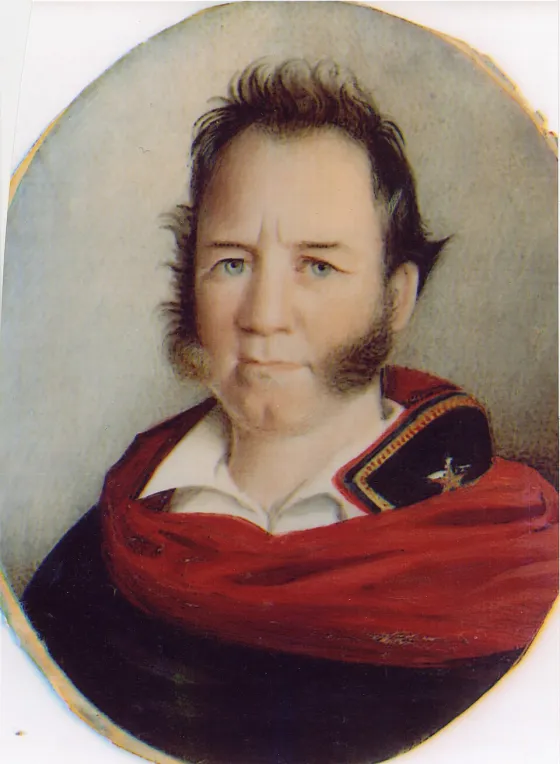
Sam Houston, 1836
Tennessee Historical SocietyBy the afternoon of April 20, the two armies occupied the same field at the junction of Buffalo Bayou and the San Jacinto River near Lynch’s Ferry. With the Texian army concealed within a wood grove along the banks of Buffalo Bayou, Santa Anna sent a probe to draw out Houston’s army. After a short exchange of artillery fire from both sides, Colonel Sidney Sherman–frustrated by Houston’s lack of initiative–demanded that he lead the Texian cavalry in a charge to break Santa Anna’s forces. Houston believed this was shortsighted and only allowed Sherman to lead a reconnaissance against Santa Anna’s position. In the cumbersome skirmish that followed, the Texian Secretary of War Thomas Jefferson Rusk, who had joined Houston’s army, was nearly captured during the melee. Ultimately, through the actions of a newly arrived private from Georgia, Mirabeau B. Lamar, Rusk fled back to Texian lines. With Sherman’s force in trouble, Captain Jesse Billingsley ordered his company to aid Sherman despite Houston’s orders to the infantry not to engage. An act that demonstrated the near state of mutiny present in the Texian army occurred when Houston ordered Billingsley’s men to countermarch and return to their lines; they simply shouted back that Houston should countermarch himself. However, the skirmish accomplished little and the small Texian force under Sherman withdrew. Santa Anna camped on rolling terrain opposite Houston and on ground poorly suited for defense. As a result, many of his men worked throughout the night to construct a barricade of brush and pack saddles.
The next morning both Houston and Santa Anna understood that the day would produce a fight. Houston, after hearing discouraging information that General Martín Perfecto de Cos arrived that morning with over 500 troops to reinforce Santa Anna, he ordered Erastus “Deaf” Smith to destroy Vince’s Bridge five miles away to prevent further Mexican reinforcements. By mid-morning, roughly 930 Texian troops faced over 1,200 Mexican soldiers with each army expecting the other to attack. Believing that no attack was to come, Santa Anna ordered his weary troops to stand down and get some rest.
By the early afternoon, after convening in a tense council of war, Houston gave the order for an attack against the Mexican position. The battle line placed the Texian cavalry, under the newly promoted Colonel Mirabeau Lamar, on the right, followed by regulars under Lieutenant Colonel Henry Millard, then the artillery under Colonel George W. Hockley in the center, the 1st Texas Regiment led by Col. Edward Burleson while Colonel Sherman’s 2nd Regiment held the left.
Although Houston never revealed his tactical intent, it is likely he planned the battle from the only other he had participated in, Horseshoe Bend during the Creek War. While his infantry struck the Mexican center, Lamar’s cavalry would swing around Santa Anna’s left and attack the rear of the camp.
The Texians began their assault on the Mexican position around 4:30pm. Shielded by a slight rise in the center of the battlefield, the Mexican forces were unaware of the approaching Texian army. The Texian artillery–the famed Twin Sisters, two six pounders—had arrived just in time on April 11, and positioned at the right of Burleson’s regiment. The cannons opened the battle with two shots of grapeshot upon the Mexican lines. Sherman’s regiment made first contact, striking preferred companies commanded by Cos on the Mexican left. Resistance quickly crumbled and Sherman’s regiment began to roll up the Mexican line.
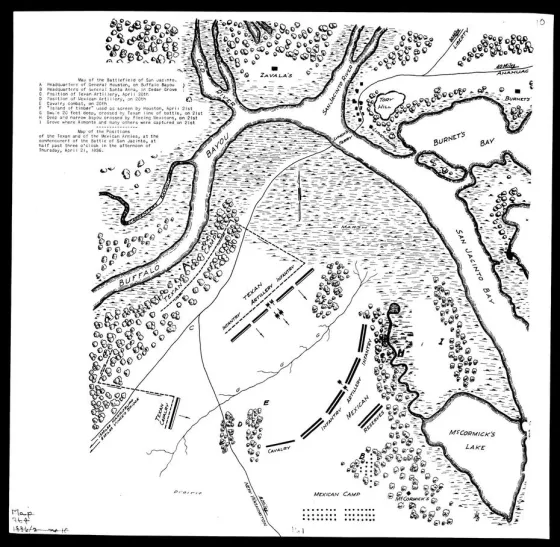
Military Maps of the Texas Revolution, Anson Jones Press, 1938
Public DomainThe remainder of the Texian infantry, including the artillery, continued to move forward, dressed their ranks, and ordered a volley fired into the Mexican line. With the field shrouded in smoke, a fifer and drummer playing “Will You Come to the Bower?” the Texian troops, finally given their opportunity for revenge, charged the Mexican line shouting “Remember the Alamo!” and “Remember Goliad!”.
As Burleson and Millard slammed into the Aldama and Matamoros Battalions in the center of the line, the Mexican infantry collapsed, and the situation deteriorated into a rout. Lamar cut off the only escape route on the Mexican left flank, forcing the bulk of Santa Anna’s army retreated to their rear into the marshy Peggy Lake. Armed resistance lasted eighteen minutes, but the slaughter that followed lasted nearly three hours. Having lost full cohesion as a fighting force, the Texian army was unrestrained by their officers and showed no mercy towards the surrendering Mexican troops. By day's end, with approximately nine Texians having been killed and thirty wounded, including Sam Houston who was wounded in the leg. The Mexican army saw over 600 soldiers killed in the marshes around the battleground. Eventually, order was restored, and the Texians began to take prisoners.
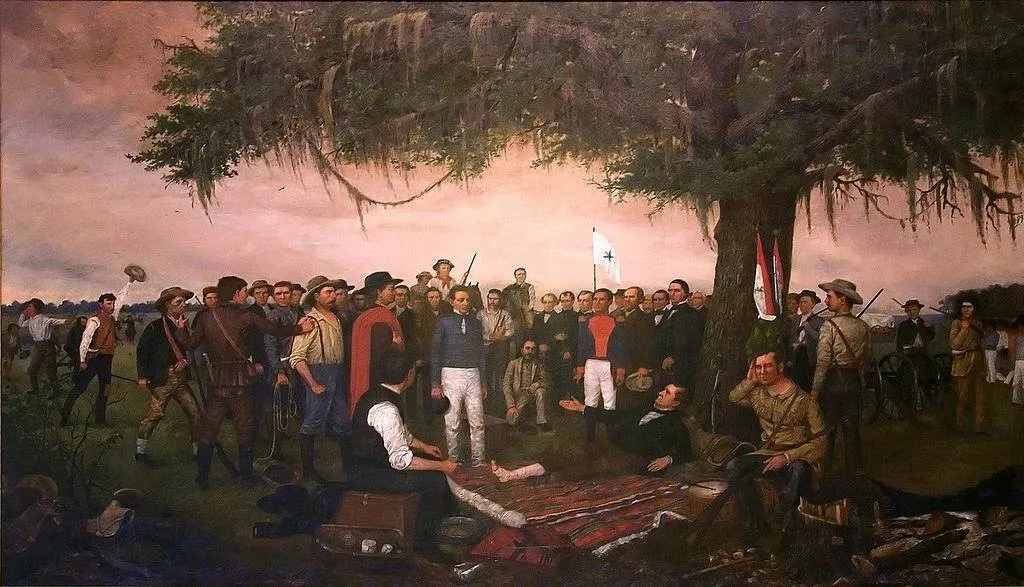
Surrender of Santa Anna, William Henry Huddle’s 1886 depiction of Mexican Gen. Antonio López de Santa Anna surrendering to the wounded Sam Houston following the Battle of San Jacinto in 1836.
Texas State CapitolOver the course of the next two days, more than 700 Mexican troops surrendered. Among them, attempting to disguise himself, was General Santa Anna. Many of the Texian troops expressed their desire to execute the Mexican general for his actions at the Alamo and his orders to massacre the Goliad garrison. However, Sam Houston recognized that with the Texian army still outnumber by the remaining Mexican forces in Texas and realized the the importance of keeping Santa Anna as a prisoner. In exchange for his life, Santa Anna issued orders for the remainder of the army to withdraw to Mexico. With the signing of the Treaty of Velasco in May 1836, Texas became an independent republic. Nine years later, Texas joined the United States.
Further Readings:
- Texian Iliad: A Military History of the Texas Revolution, by Stephen L. Hardin.
- Eighteen Minutes: The Battle of San Jacinto and the Texas Independence Campaign by Stephen L. Moore
- Sea of Mud: The Retreat of the Mexican Army after San Jacinto, An Archeological Investigation, by Gregg J. Dimmick.