Goliad Executions on March 27, 1836
In the early morning of October 10, 1835, men of the newly created Texas militia stormed the Presidio La Bahía in Goliad. Armed with muskets and axes, the group of roughly 125 militiamen snuck up to the entrances of the presidio and began to chop through the complex’s wooden doors. Alerted by the noise of the Texians, who now occupied the courtyard, Mexican forces opened fire, wounding Samuel McCulloch Jr., a formerly enslaved man. Historians often consider McCulloch the first Texian casualty of the revolution.
In the exchange of gunfire, the Texians killed 1-3 Mexican soldiers while wounding a further 3-7. The militia severely outnumbered the roughly 50 Mexican occupants, who quickly surrendered their arms. In response to the growing revolt, José María de Tornel y Mendívil, Mexico's Minister of War, issued a decree on December 30, 1835. The Tornel Decree laid out harsh punishment against foreign fighters, largely from the United States, who took up arms against Mexico in the fight for Texian independence. One such group of fighters, the Texas Provisional Regiment of Volunteers, would soon be caught up in one of the darkest events of the Texas Revolution.
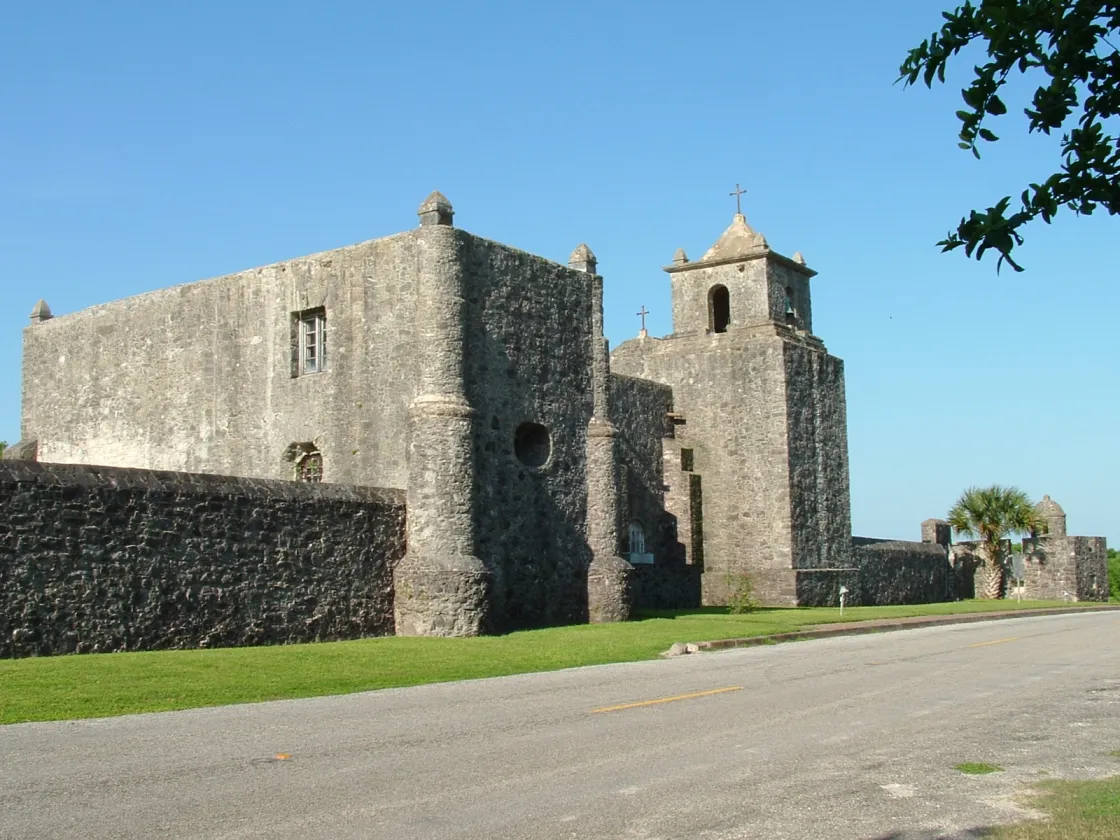
Presidio La Bahía (Fort Defiance), Goliad, Texas
Ernest MettendorfThe Texas Provisional Regiment of Volunteers were under the leadership of Colonel James W. Fannin Jr. Fannin, a dropout of West Point, settled in Texas in 1834, where he owned a plantation and was active in the slave trade. As tensions between Anglo-American settlers and the Mexican government grew, James Fannin became heavily active in the movement for Texian independence where he attempted to use his influence in the United States to fund its military. In early 1836, Fannin began recruiting soldiers for an expected offensive into Mexico. During the so-called Matamoros Expedition, rebel forces attempted to push south and capture the Mexican port city of Matamoros. Recognizing that this campaign was far too ambitious, General Sam Houston convinced most of the Texian leadership to hold back. Fannin hesitantly returned to Goliad around February 12, 1836. The men under Colonel Fannin’s command began to build up defenses within Presidio La Bahía, which they quickly renamed Fort Defiance.
Despite these efforts, Fort Defiance, like the Alamo, faced serious deficits of food, ammunition, and men. The Texian command structure also experienced frequent communication breakdowns which delayed the relay of Mexican troop movements. By mid-February, portions of leadership anticipated a reinforcement of Mexican units into Matamoros.
Unbeknownst to the Texians, the Mexican army in Matamoros, under the command of General José Urrea, had been planning an offensive of its own. On February 18, 1836, the Goliad Campaign commenced as roughly 400 Mexican troops entered Texas. Nine days later, on the 27th, Urrea encountered Texian Colonel Frank W. Johnson and his contingent of troops at San Patricio. The Mexican army trounced the defenders at the Battle of San Patricio dashing the last remnants of the Matamoros Expedition. As Colonel Johnson retreated, General Urrea continued northward, destined for Goliad.
Just as Urrea’s forces were moving up the Gulf Coast, a separate army led by General Antonio López de Santa Anna stormed the Alamo in Béxar on March 6, 1836. Colonel James Fannin attempted to organize a rescue mission for the defenders of the Alamo but made very little progress and Fannin decided to remain at Goliad. When General Santa Anna destroyed the Alamo garrison in Béxar, General Sam Houston ordered Fannin’s detachment to retreat to Victoria.
Despite the orders from Houston, Colonel Fannin sent a force of around 150 men, under the command of Captain Amon B. King and Lieutenant Colonel William Ward, to Refugio to evacuate civilians, thus delaying the withdrawal from Goliad. Fannin finally received the news of King and Ward’s defeat at the Battle of Refugio around St. Patrick's Day. He abandoned Fort Defiance on the morning of March 19, 1836, but did so without much urgency, leaving essential resources like food and water behind.
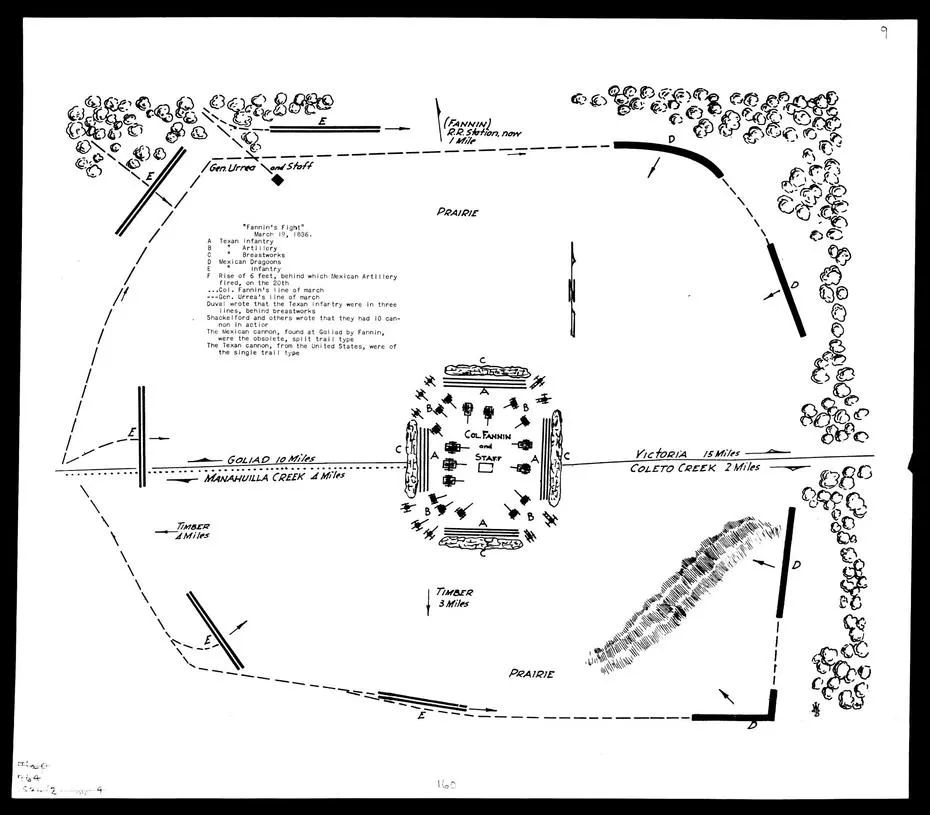
That afternoon, Urrea was already close on the heels of Fannin's entered Goliad. Hoping to catch Fannin, Urrea left his artillery at Presidio La Bahía and took off in pursuit of the Texians. Fannin remained unaware that the Mexican forces were pursuing him, believing they would remain in Goliad. The retreating men failed to reach the safety of the woods near Coleto Creek before they were caught in the open by elements of the Mexican cavalry.
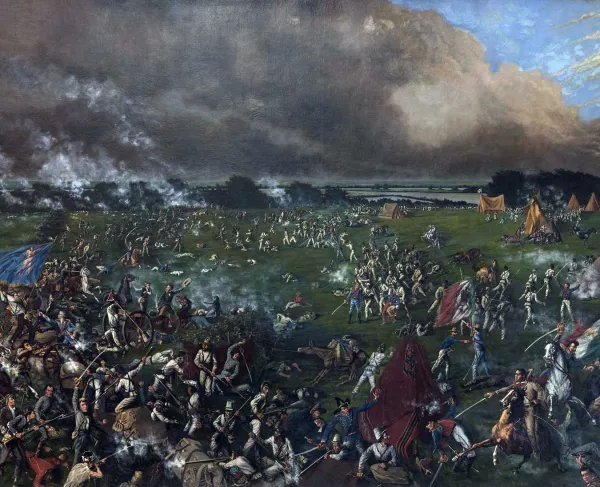
Battle of Coleto, by Andrew Jackson Houston, 1938.
Public DomainThe 300 Texians took defensive positions in the field with a square-shaped formation, a tactic often used by infantry in the open field against cavalry, and repulsed three separate assaults by 80 Mexican cavalry and 260 infantrymen. As the Mexican ammunition began to run low, Urrea pulled back his force but kept the rebels surrounded with harassing sniper fire. By the end of the first night seven Texians lay dead with another 50 wounded, including Fannin. Despite outnumbering the Texian contingent, Urrea had sustained high casualties during the engagement. Although Fannin's men had dealt severe punishment on the attackers, they were still surrounded and running desperately low on ammunition, food, and water. Further compounding the dire situation, a Mexican reinforcement of 400-500 men arrived during the night.
"Colonel Fannin had committed a grievous error in suffering us to stop in the prairie at all. We ought to have moved on at all hazards, and all cost until we reach the timber." -Joseph H. Barnard
As the sun rose on March 20, 1836, the Texians concluded that they could no longer put up a fight. Colonel Fannin surrendered his force to General Urrea that morning, believing that his men would be treated honorably as prisoners of war. The soldiers at Coleto Creek were marched back to Goliad where they were held inside Presidio La Bahía. Contrary to Fannin’s belief, the Tornel Decree was being enforced by General Santa Anna, though General Urrea petitioned for clemency for the Texians. Unfortunately for the men in Goliad, Urrea was no longer in charge of the prisoners, with control resting with Lieutenant Colonel Jose Nicolas de la Portilla.
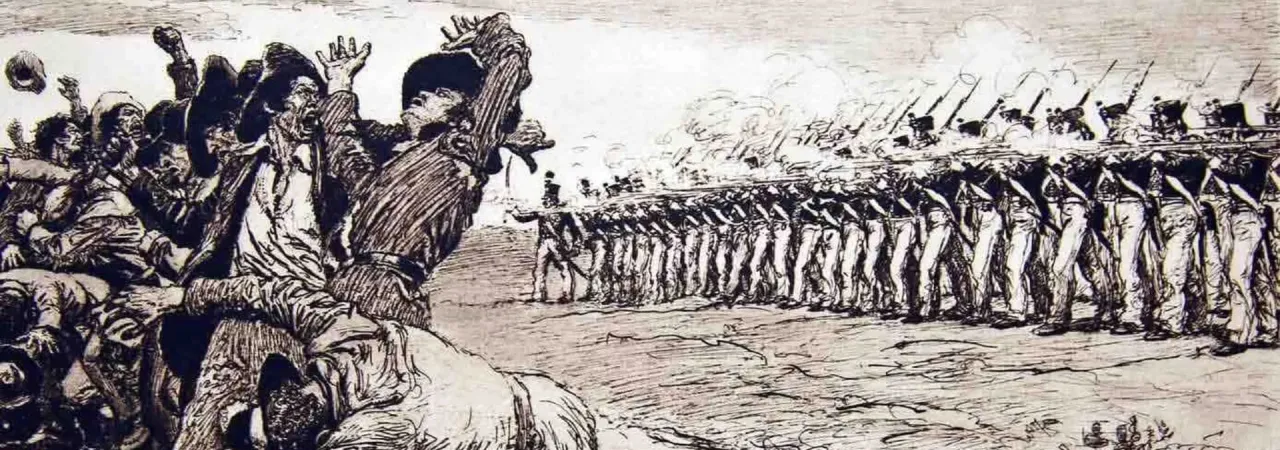
On March 27, 1836, Palm Sunday, the Texian prisoners at Goliad were marched out of Presidio La Bahía, unaware that they were marked for death. The men were separated into three columns flanked by Mexican soldiers on each side. After a short period of marching, Portilla's officers ordered the columns to halt and kneel. Suddenly the Mexican guards lowered their muskets and opened fire on the unarmed prisoners. Simultaneously, the wounded men who remained in the chapel of the presidio were also executed. Amidst the gun smoke and ensuing chaos, 28 Texians were able to escape captivity. Fannin, himself was dragged into the courtyard and shot.
"We marched in silence… There was something, however, in the profound silence of the Mexican soldiers, who are usually unceasing chatters, that inspired me with a feeling of uneasiness and anxiety. It was like a funeral march, and truly might it be so called… I was seized with a presentiment of evil… suddenly the command was given in Spanish to wheel to the left, leaving the road… We were marched along the side of the hedge towards the stream, and suddenly the thought flashed across us, "Why are they taking us in this direction?" The word was soon given to halt. It came like a sentence of death; for at the same moment it was uttered, the sound of a volley of musketry echoed across the prairie… "Kneel down!" Now burst in harsh accents from the lips of the Mexican commander… The Mexican soldiers… leveled their muskets at our breasts… The sound of a second volley... reached our ears, and was followed by a confused cry, as if those at whom it had been aimed, had not all been immediately killed… The blood of our lieutenant was on my clothes, and around me lay my friends convulsed with their last agony… Unhurt myself, I sprang up and, concealed by the thick smoke, fled along the hedge in the direction of the river..." -Herman Ehrenberg
The Mexican army killed upwards of 350 Texian prisoners during the Goliad Massacre, though 95 men were spared. 20 of those were protected by Francita Alavez, who later earned the nickname the Angel of Goliad. The fate of Fannin and his men was largely unknown until word of the massacre reached David G. Burnet, president of the provisional Texian government, on April 7th, 1836. The events at Goliad, combined with the massacre at the Alamo, sparked the Runaway Scrape, which saw widespread panic and retreat across the Texas frontier. Despite the tragedy, Goliad and the Alamo became turning points in the Texas Revolution as iconic symbols of bravery and resistance. “Remember the Alamo!” and “Remember Goliad!” became the unofficial battle cry of Texian Independence.
Further Reading:
- Slaughter at Goliad: The Mexican Massacre of 400 Texas Volunteers: Jay A. Stout
- Remember Goliad!: Craig H. Roell
- Texian Iliad: A Military History of the Texas Revolution, 1835-1836: Stephen L. Hardin
- Inside the Texas Revolution: The Enigmatic Memoir of Herman Ehrenberg: Herman Ehrenberg & James E. Crisp
- Lone Star Rising: The Revolutionary Birth of the Texas Republic: William C. Davis
- Hesitant Martyr of the Texas Revolution: James Walker Fannin: Gary Brown