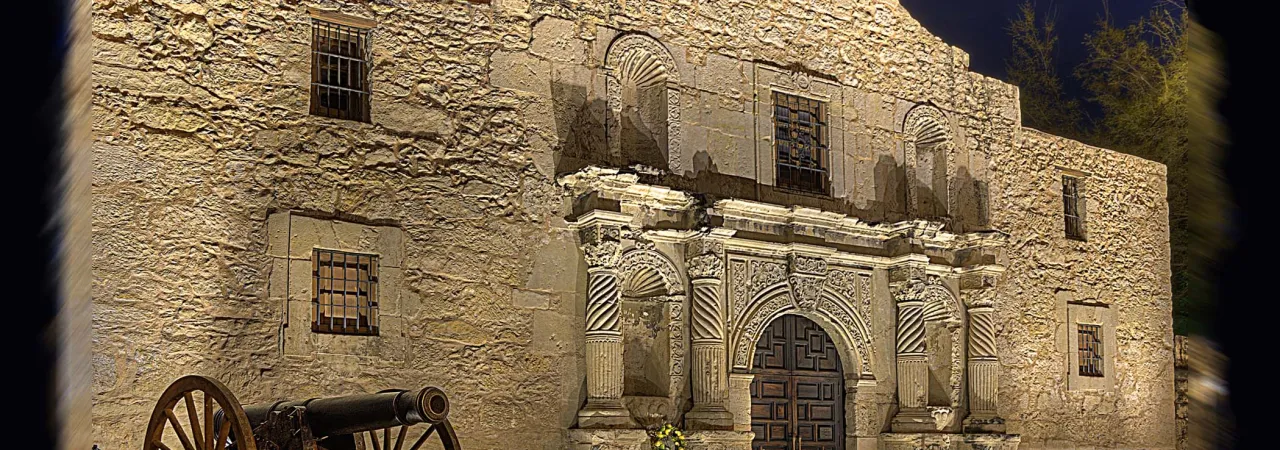
The Alamo, San Antonio, Texas
Built in 1718, the Misión San Antonio de Valero, better known as the Alamo, was established as a Spanish Mission in the town of San Antonio. While initially intended to convert the indigenous population of the region, the mission would ultimately be transformed into a fort in which it would house Spanish, Mexican, and later Texian forces.
With the outbreak of hostilities between Texas settlers and the Mexican government in October 1835, the Alamo became a major area of contention for the two contending armies. In the initial phase of the conflict, Mexican forces with General Martín Perfecto de Cos controlled the Alamo and San Antonio. However, following Cos' defeat at the hands of the Texians in early December of 1835, the Alamo was surrendered to the Texians.
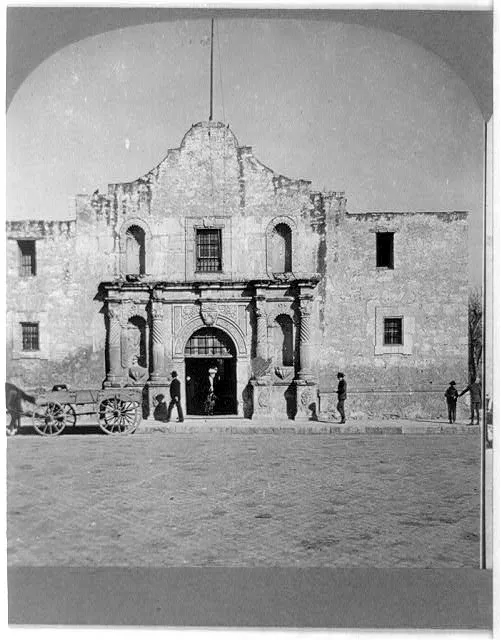
The Alamo, San Antonio, Texas, published by Stereo-Travel Co., 1909. The photograph shows the historic mission and site of the 1836 Battle of the Alamo.
Library of CongressBy January of 1836, Lieutenant Colonel James C. Neill was in command of the roughly one hundred remaining men in San Antonio. Understanding that this small force would be incapable of defending the entire town, Neill began to reinforce the Alamo mission. With the adobe walls of the garrison and the make-shift fortifications Neill made to the mission complex, the Alamo looked like a formidable position. However, the Commander-in-Chief of Texian forces, General Sam Houston, was unimpressed when he visited in mid-January. He ordered Colonel James Bowie to go to San Antonio, remove the munitions and abandon the town. Neill convinced Bowie of the importance of maintaining the Texian positions at the Alamo, despite Houston's instructions. “The salvation of Texas depends in great measure in keeping Bejar out of the hands of the enemy,” Bowie wrote. “It serves as the frontier picquet [sp] and if it were in the possession of Santa Anna there is no strong hold from which to repell [sp] him.”
Even with these improvements, the Texian defenses still needed reinforcements. On February 3, a contingent of cavalry under the command of Lt. Colonel William Barret Travis arrived to bolster the defenses. Five days later, another party which included former U.S. Congressman and the most famous frontiersman of the early nineteenth century, David Crockett, arrived. While spirits were initially high amongst these Texian forces in San Antonio, the departure of Colonel Neill on February 14 dampened morale. A short-lived feud over command of the Alamo defenses between Bowie and Travis ensued; however, both came to an agreement that they would share command until Neill’s return.
On February 23, sentries and scouts spotted the lead elements of General Antonio Lopez de Santa Anna’s 6,000-man army on the outskirts of town. While the Alamo was well-armed — having 21 cannons manning a perimeter of a quarter of a mile — the roughly 150 defenders were too few in number to withstand a Mexican onslaught.
The Mexicans soon raised a blood-red or red and black flag with a skull and crossbones of “no quarter” from the top of San Fernando Church about 700 yards distant. Travis answered with a shot from the fort’s heaviest gun, an 18-pounder, at the southwest corner. Bowie and Travis refused subsequent demands to surrender, and both sides settled in for a siege.
The next day, Travis, who had assumed full command due to Bowie’s ill-health, penned one of his many pleas for help, addressed “To the People of Texas and all Americans in the World”. He signed it “Victory or Death”. On February 25, Santa Anna sent his cazadores or light infantry armed with .61 Baker rifles (the line and grenadier companies carried the .75 Brown Bess) to take control of La Villita, a series of houses south of the Alamo. The movement evolved into a sharp skirmish and the Mexicans eventually withdrew. “The Hon. David Crockett was seen at all points, animating the men to do their duty,” Travis wrote later that day. That night the Mexicans launched another probe from the east toward the rear of the church, former convento courtyard and corral. This attack was also repulsed.
Over the next several days, Santa Anna tightened his grip on the garrison with daily bombardments along the construction of batteries and fortified camps surrounding the fort. Early on the morning of March 1, the only reinforcements to answer Travis’ call for help arrived from Gonzales, about 70 miles from San Antonio. Today, they are honored as the “Immortal 32” and a small monument stands in the Alamo courtyard commemorating their sacrifice.
Time, however, was running out. Following a council of war in which Santa Anna overruled his subordinates, the Mexican general ordered an assault to take place on March 6, 1836. Around 5 a.m., 1,400 Mexican soldiers in four columns stepped off. From the south, Colonel Juan Morales’ men received fire from Crockett’s men at a palisade and the lunette protecting the main gate before taking shelter in the huts of La Villita. To the east, Colonel Jose Romero’s line companies received heavy fire from artillery mounted at the rear of the church and diverted around the courtyard and corral till they intermixed with Colonel Francisco Duque’s column that attacked the fort’s weakest point, the crumbling north wall. The added troops to Duque’s column, along with friendly fire, compelled General Martin Perfecto de Cos to angle his men toward the northwest corner and west wall. The massed infantry eventually overwhelmed the Texians on the north wall, and the defenders fell back to the convento, now known today as the Long Barracks and the church. As the Texians turned the 18-pounder to the north, Morales’ men attacked and captured the cannon along with the lunette. Bitter hand-to-hand fighting erupted as the Mexicans cleared out the Long Barracks room by room, where the majority of the Texian casualties occurred. What resistance remained in the church was soon wiped out, and by 6:30 a.m., every Alamo defender lay dead.
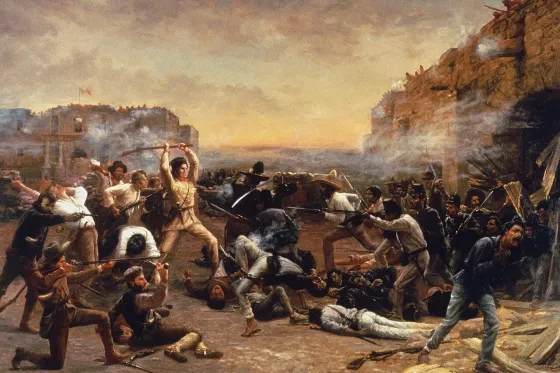
The Fall of the Alamo (Crockett's Last Stand), by Robert Jenkins Onderdonk, c. 1903. The painting depicts Davy Crockett and other Texian defenders making their final stand during the Battle of the Alamo on March 6, 1836.
Public DomainTravis fell early in the assault at the north wall’s battery, while Bowie was killed in his room adjacent to the lunette. The location and manner of Crockett’s death have long been debated, but he may have fallen at the west wall.
Between 400-600 Mexican soldiers were killed or wounded during the battle. Many of them were veteran soldiers.
The 13-day siege and defense allowed time for delegates at a convention on Washington-on-the Brazos to declare independence, galvanizing and uniting the Texians in their fight against Santa Anna. Although Santa Anna ordered the bodies of the Alamo defenders burned as a psychological ploy, it — along with the subsequent execution of a force at Goliad — had the opposite effect on the Texians. On April 21, 1836, Houston’s army, emboldened by the cry “Remember the Alamo” attacked and routed Santa Anna at the Battle of San Jacinto. The Mexican defeat secured independence and gave birth to a republic.
Further Reading:
- Texian Iliad: A Military History of the Texas Revolution by Stephen L. Hardin
- Three Roads to the Alamo: The Lives and Fortunes of David Crockett, James Bowie, and William Barret Travis by William C. Davis
- The Blood of Heroes: The 13-Day Struggle for the Alamo – And the Sacrifice That Forged A Nation by James Donovan
- Blood of Noble Men: The Alamo Siege and Battle, An Illustrated Chronology by Alan C. Huffines
Related Battles
400
189