Republic of Texas

Flag of Texas
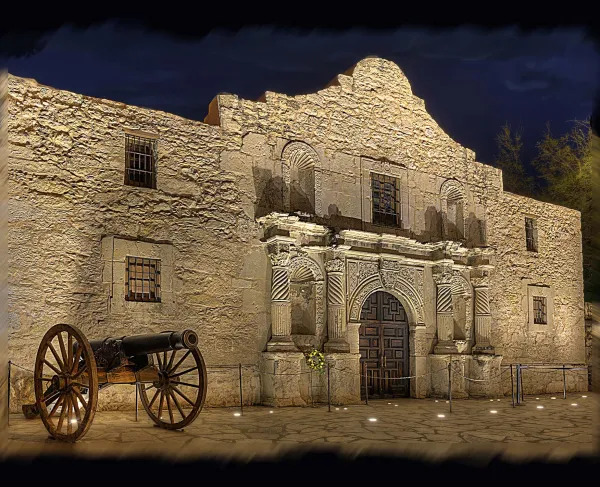
On March 1, 1836, a delegation of Texians convened at Washington-on-the-Brazos in Washington, Texas. With the looming siege at the Alamo a background concern for this delegation, they debated whether they would seek independence from Mexico or not. George C. Childress called for a resolution supporting independence and presented a draft. On March 2, 1836, the 59 delegates present signed the Texas Declaration of Independence, creating the Republic of Texas.
Once independence had been declared, the delegates quickly set out to forge a new government. With the fall of the Alamo on March 6 and the threat of a Mexican attack on the settlements of East Texas, a government was hastily formed. By March 16, a constitution was drafted. Replicating much of the U.S. Constitution, the government of the Republic of Texas would have three branches that included a chief executive (president), a bicameral legislative branch and a judiciary branch. Before this new constitution could be adopted, it needed to be approved by Texas voters once conditions had normalized.
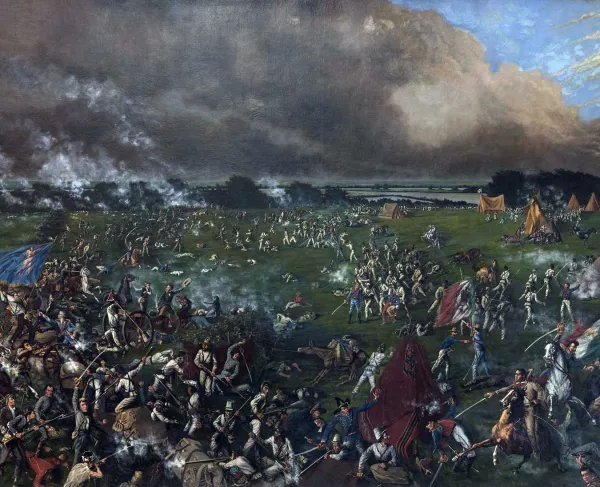
In the meantime, an ad-interim government formed with David G. Burnet serving as the President and Lorenzo de Zavala as the Vice-President of the new nation. This Texas government eventually fled to Galveston Island to evade capture before Santa Anna's army was defeated at the Battle of San Jacinto on April 21, 1836.
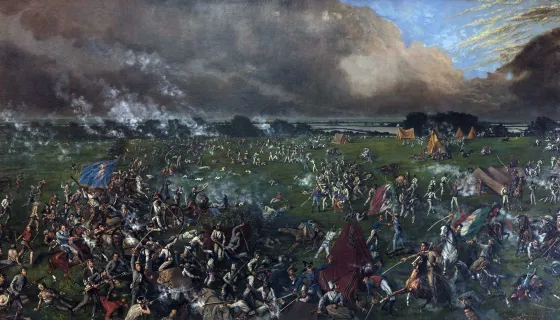
The Battle of San Jacinto, oil on canvas by Henry McArdle, 1895
Texas State Library and Archives CommissionAfter Santa Anna signed the Treaty of Velasco on May 14, 1836, the government under Burnet returned and set the election for the first week of September to formally approve the new constitution. At these elections, voters would also elect new government officials. Debates simmered over whether Texas should seek annexation by the United States and become part of that country. When the votes had been cast, the new constitution was adopted (which also stated the protection of the right of slavery in Texas). Sam Houston – the hero of San Jacinto – became the first President of the Republic, and voters voiced their opinions on ultimately achieving U.S. annexation.
Once the new government began to operate in October 1836, it faced a number of issues. First, the republic was born into debt and witnessed its debt grow to nearly $12 million dollars by the time of its annexation in 1845. Despite Texian desires to be annexed by the United States, the U.S. during Andrew Jackson's presidency hesitated to recognize Texas’ Independence. Jackson delayed until March 3, 1837, just to recognize Texas. By 1838, the people of Texas tabled the annexation issue. Furthermore, Mexico had rejected the Treaty of Velasco and never recognized Texas independence, creating a constant threat of invastion from the south. Due to the chaotic political atmosphere in Mexico, the threat of invasion appeared minor during Houston's first term.
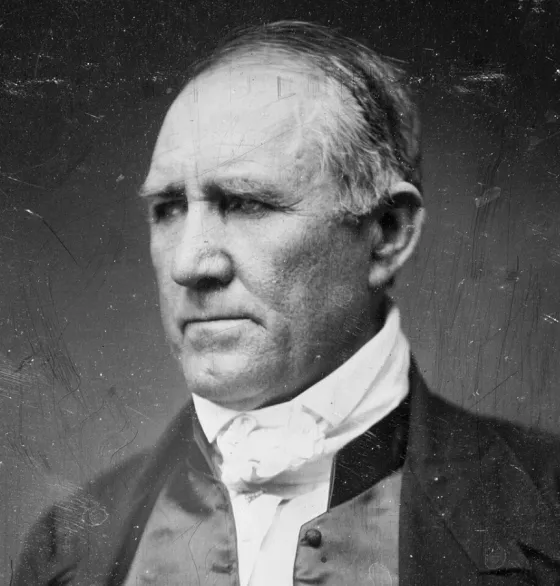
On the frontier, Texans also faced the looming possibility of attacks from the indigenous tribes. For President Houston, “treaties of peace and amity, and the maintenance of good faith with the Indians” was one of his major priorities. Houston actively sought peace treaties with groups like the Cherokee, Comanche, Shawnee and Tonkawa tribes.
As Houston dealt with external threats, there were also internal threats that proved a challenge to the republic’s government. When President Houston sought to replace the commander of the Texian army Felix Huston with Albert Sidney Johnston in February 1837, this led to a duel between the two, and Johnston suffered a serious wound to the ankle. Additionally, by the summer of 1838, a Mexican-Indigenous rebellion near Nacogdoches, Texas, led by Vicente Córdova threatened to overthrow the government and restore Mexican rule. Ultimately, the rebellion was suppressed by Texas militia.
In accordance with the Texas Constitution, Houston had to leave office in December 1838 since he could not run for a consecutive term. Mirabeau B. Lamar won the election and become the second president of the Republic of Texas. Adopting policies and leadership different than Houston's, Lamar soured relations with the natives, did not seek Texas annexation to the United States, sought to establish public schooling in Texas and drastically increased military spending to prosecute war against Mexico until they conceded Texas independence. Even with this show of force towards Mexico—during the growing conflict between France and Mexico—Lamar sent commissioners to broker a peace deal with Mexico that would lead to recognition. However, these negotiations did not produce the hoped-for results.
Under Lamar, the Republic of Texas tried to expand its territorial possessions. In June 1841, with leftover military supplies, an expedition to “convince” New Mexicans to join Texas set out from Austin. By September, the expedition arrived just east of Santa Fe and the roughly 300 so-called “pioneers” were forced to surrender by Mexican authorities. As this episode ended in failure, in December Lamar would be replaced by Houston who had won the recent election.
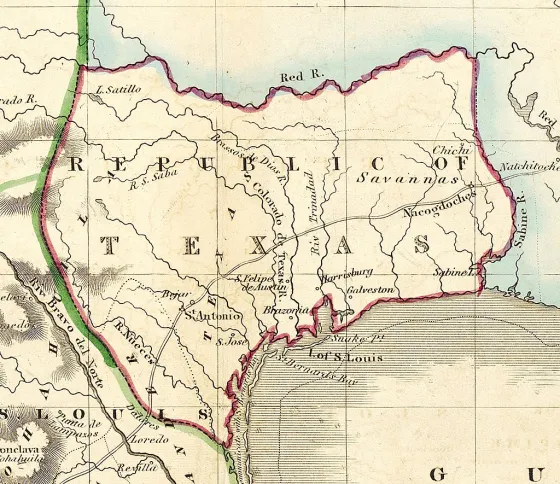
1836 map by William Howe Lizars of the Republic of Texas
Wikimedia CommonsHouston’s second term proved to be just as challenging as his first. The republic received a humiliating blow in March 1842 when roughly 700 hundred Mexican troops under Rafael Vázquez briefly occupied San Antonio. Later, on September 11, a Mexican force commanded by General Adrián Woll occupied the town before being defeated shortly after by Texian forces, just east of the city at Salado Creek. These incidents and the possibility of further Mexican attacks prompted the western counties of Texas to demand action from the Houston administration. Ultimately, Houston sent Brigadier General Alexander Somervall and a contingent of 750 Texian troops to the Rio Grande. While they were able to capture Laredo and enter the town of Guerrero in Northern Mexico, Somervall soon sent his soldiers home. However, over 300 hundred men refused to return home and reentered Mexico. The Mier Expedition, as it became known, ultimately ended with the Texans captured, and on March 25, 1843, the prisoners infamously drew black beans to determine which seventeen men were executed.
As Mexican forces consistently harassed the frontier Texas settlements, Houston attempted to use this opportunity to move the capital from Austin. (The capital had moved to Austin in 1839.) However, when Houstonian supporters attempted to move government documents out of Austin, a fight called the "Archive War" broke out in March 1842 between pro and anti-Houston groups.
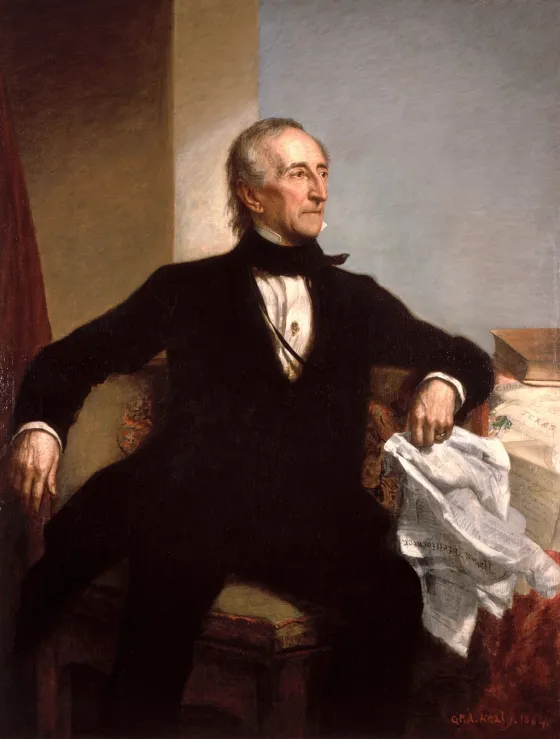
As Houston’s third term entered its third and final year, the issue of annexation gained momentum again. President John Tyler’s administration accelerated negotiations for Texas annexation and on April 12, 1844, an annexation treaty was agreed upon between the U.S. Secretary of State John C. Calhoun and Isaac Van Zandt, Texan chargé d'affaires to the United States. While a treaty had been agreed upon, the U.S. Senate rejected it in June. U.S. President John Tyler and Texas President Anson Jones – elected in 1844 – persisted in their efforts. The U.S. Congress, through a joint-resolution, ultimately approved of Texas annexation in 1845.
When Texas formally entered the union on December 29, 1845, tensions between the United States and Mexico quickly soured, and Mexico cut diplomatic ties. On February 19, 1846, the new state legislature of Texas convened, and Anson Jones watched the republic's flag lowered. Then, the Stars and Stripes were raised, and the Republic of Texas had been formally dissolved. Within three months, due to a dispute over Texas’ southern border, the United States would be at war with Mexico.
Further Reading:
- Sam Houstonby James L. Haley
- Single Star of the West: The Republic of Texas, 1836-1845 edited by Kenneth W. Howell and Charles Swanlund
- Dream of Empire: A Human History of the Republic of Texas, 1836-1845 by John Edward Weems




.jpg)