José Urrea
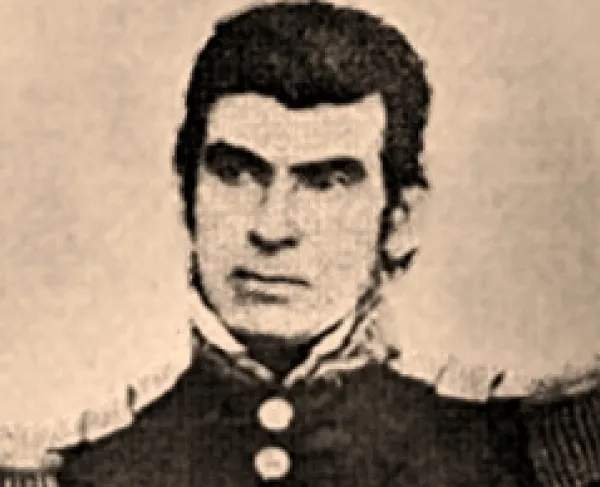
José Urrea was born on March 19, 1797, at the Presidio de San Agustín del Tucsón in modern day Tucson, Arizona. Like American forts along the western frontier, the Spanish, and eventually Mexicans, utilized presidios as tools for governance and security in sparsely populated territories. José Urrea came from a lineage of “presidial officers” within New Spain. José’s father, Mariano, served with distinction in the presidios and because of this the Urrea family had some influence within the Spanish frontier.
José Urrea was immersed in the military lifestyle from a very early age, registering as a Spanish cadet on August 17, 1807, at ten years old. Urrea would earn his first commission, the rank of Lieutenant, in 1816 while Spain was engaged with increasing Mexican revolt. José spent this early portion of his career engaging in operations against the insurgency within Mexico, however by 1820 his loyalty had shifted and he openly aligned with Mexican independence from Spain. Urrea supported the 1821 Plan of Iguala which declared independence from Spain and called for the creation of a constitutional monarchy in its place. In 1823, the Plan of Casa Mata, which Urrea also backed, overthrew the Mexican monarchy under Emperor Agustín de Iturbide and established a constitutional assembly. One of the document’s principal signers, Antonio López de Santa Anna, would soon be closely tied to José Urrea.
Following the War of Mexican Independence, José Urrea ascended to the rank of Captain but began shifting his focus to political aspirations. Despite gaining its independence, Mexico’s infancy was filled with political conspiracy as different factions attempted to gain power. Urrea and his father aligned themselves with the so-called “Scots.” When their political opponents, the Yorkinos, won out, José Urrea was removed from military service while his father was exiled from the country.
While Mexican politicians fought for control, Spain made multiple attempts to reconquer its Mexican territory throughout the 1820s. In 1829 Mexico’s President, Vicente Guerrero pardoned Urrea, allowing him to return to military service against the Spanish. He was recommissioned into the army with the rank of Major, arriving in time for the victory at the Battle of Tampico on September 11, 1829. Throughout this tumultuous period, José Urrea closely aligned himself with Antonio López de Santa Anna, who he considered a trustworthy associate.
By 1835, tensions began to arise within Mexico as Anglo-American settlers, known as Texians, and Tejanos began to openly revolt in the Tejas region. Santa Anna, now president of Mexico, ordered the newly promoted Brigadier General José Urrea to suppress the rebels. Mexico had lost significant battles early in the Texas Revolution, but the arrival of Urrea helped shift the momentum.
In February 1836, Brigadier General Urrea initiated the Goliad Campaign, which sought to reclaim captured cities along the Gulf Coast. Urrea departed the port city of Matamoros on February 18th, accompanied by over 500 soldiers. Upon receiving credible intelligence of a 60-100 strong Texian force occupying San Patricio, he marched his men toward the town.
General Urrea’s unit descended upon the Texians on the early morning of February 27, 1836, capturing 21 while killing 16. The Mexican army continued their push northward, defeating the rebel forces at Agua Dulce Creek on March 2nd and Refugio on March 15th. Urrea would gain his final major victory of the war on March 20, 1836, at the Battle of Coleto Creek.
After capturing Goliad on the 19th, the Mexicans received word of the retreating Texians who were nearby. Deciding to seize the moment, Urrea unloaded his artillery in the town and advanced in pursuit with roughly 400 cavalry and infantry. The Texian unit, under the command of Colonel James Fannin, was outpaced by the Mexican army and became encircled near Coleto Creek. Heavily outnumbered, the rebel defenders capitulated to Urrea and were marched back to Presidio La Bahía in Goliad.
Unbeknownst to the prisoners, General Santa Anna ordered the execution of Fannin and his men under the terms of the Tornel Decree. General Urrea found this decision abhorrent and pleaded with Santa Anna to pardon the roughly 350 Texian prisoners. Despite the petitions to his superior, custody of the prisoners was transferred to Lieutenant Colonel Jose Nicolas de la Portilla, leaving Urrea helpless to the fate of the Texians. Nearly every man captured during the Battle of Coleto would be executed during the Goliad Massacre.
Following the Mexican defeat at San Jacinto, Urrea, frustrated with General Santa Anna’s refusal to continue the fight despite having a larger army, advocated continuing military operations in Texas, but was again dismissed by his commanding officer. As the relationship soured, he became heavily resentful of Santa Anna. When Urrea returned in 1837 he organized an open revolt against President Santa Anna. Despite the relative unpopularity of Santa Anna at the time, the rebellion ended when Urrea was captured in Sinaloa by the Centralist Mexican forces in 1839.
He was subsequently imprisoned at Perote Prison in Veracruz, though he managed to escape confinement on at least one occasion. By 1842, José Urrea had returned to power, becoming governor of Sonora during Mexico’s political infighting. When the United States declared war on Mexico on May 13, 1846, he once again commanded men in the field. Following Mexico’s defeat in the Mexican American War, Urrea returned to Durango where he lived out his final days. General José Urrea died on August 1, 1849, following a bout of cholera.