Herman Ehrenberg's Account of the Goliad Massacre
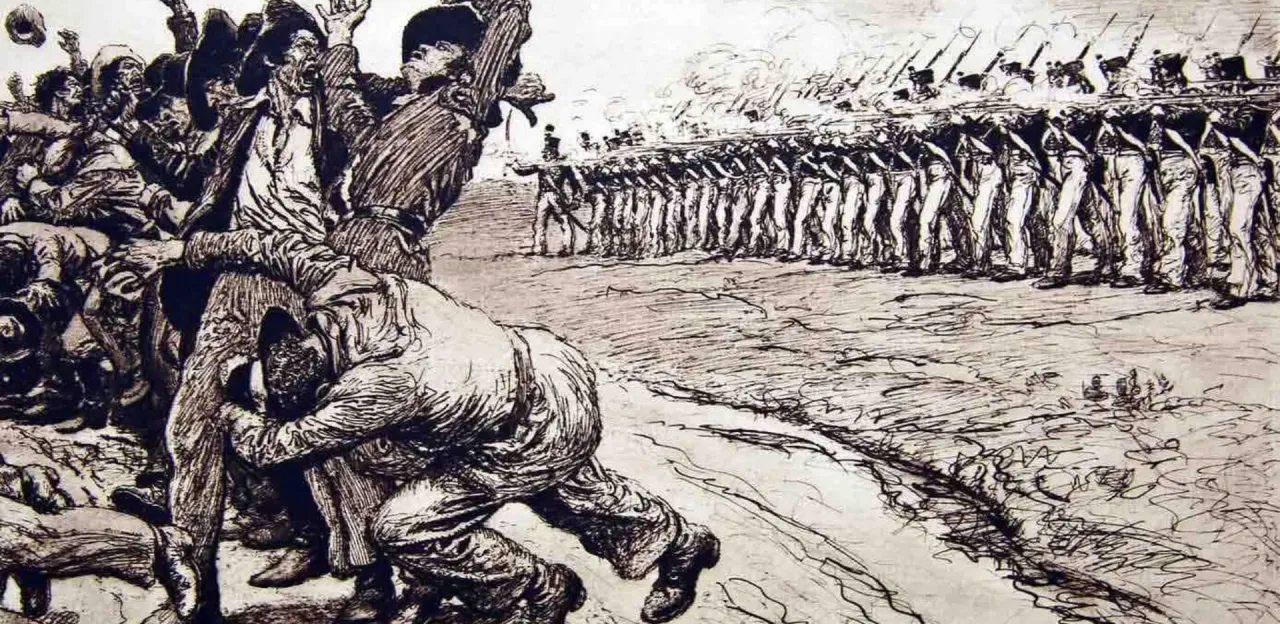
Goliad Executions on March 27, 1836
Texas State Archives and Library CommissionHerman Ehrenberg was a Prussian-born surveyor who joined the Texas Revolution as a volunteer in the New Orleans Greys. He arrived in Texas around the Siege of Béxar and fought until his capture at the Battle of Coleto. Ehrenberg was one of the few Texians survivors of the Goliad Massacre and published his memoir of the war in 1844. The following excerpt is a detailed account of his escape from Goliad, published in the December 31, 1853, edition of Weekly Butte Record.
After the names had been called, the order to march was given, and we filed out through the gates of the fortress, the Greys taking the lead. Outside the gates we were received by two detachments of Mexican infantry, who marched along in either side of us, in the same order with ourselves. We were four hundred, not including cavalry, of which numerous small groups were scattered about the prairie. We marched in silence; not, however in the direction we had anticipated, but along the road to Victoria. This surprised us; but, upon reflection, we concluded that they were conducting us to some eastern port, thence to be shipped to New Orleans, which upon the whole, was perhaps the best and shortest plan. There was something, however, in the profound silence of the Mexican soldiers, who are usually unceasing chatterers, that inspired me with a feeling of uncertainty and uneasiness. Presently I turned my head to see if Miller's people had joined and were marching with us. But, to my astonishment, neither they nor Fanning's [sic] men, nor the battalion, were to be seen.
They had separated from us without our observing it, and the detachment with which I was marching consisted only of Greys and a few Texan colonists. Glancing at the escort, their full dress uniform and absence of all baggage now for the first time struck me. I thought of the bloody scenes of Tampico, San Patricio, and at the Alamo— of the false and cruel character of those in whose power we were, and I was seized with a presentiment of evil. For a moment I was about to communicate my apprehension to my comrades, but hope, which never dies, caused me to take a more cheering view of my situation. Nevertheless, in order to be prepared for the worst, and, in case of need, to be unincumbered in my movements, I watched my opportunity and threw away a bundle among the grass of the prairie, containing the few things which the thievish Mexicans had allowed me to retain.
A quarter of an hour had elapsed since the departure from the fort, when suddenly the command was given in Spanish to wheel to the left, leaving the road; and as we did not understand the officer himself went in front to show the way, and my companions followed, without taking any particular notice of the change in direction. To our left ran a mesquite hedge five or six feet in height, at right angles with the river San Antonio, which flowed at about a thousand paces from us, between banks thirty or forty feet high, and of which banks the one on the nearer side of the river rose nearly perpendicular out of the water. We were marched along the side of the hedge towards the stream, and suddenly the thought flashed across us— Why are they taking us in this direction? The appearance of a number of lancers, cantering about in the fields on our right, also startled us; and just as the foot soldiers, who had marched between us and the hedge, changed their paces, and joined those of their comrades who guarded us on the other hand. Before we could define the reason of this manoeuvre [sic], the word was soon given to halt. It came like a sentence of death; for at the same moment it was uttered, the sound of volleys of musketry echoed across the prairie. We then thought of our comrades, and of our probable fate.
"Kneel down!" now burst in harsh accents from the lips of the Mexican commander.
No one stirred. Few of us understood the order, and those who did would not obey. The Mexican soldiers, who stood about three paces from us, level their muskets at our breasts. Then we could hardly believe that they meant to shoot us; for if we had, we should assuredly have rushed forward in our desperation, and, weaponless though we were, some of our murderers would have met their deaths at our hands. Only one of our number was well acquainted with the Spanish, and even he seemed as if he could not comprehend the order that had been given. He stared at the commanding officer, as if awaiting its repetition, and we stared at him, ready at the first word... the chief of the assassins again ejaculated the command to kneel down.
The sound of a second volley, in a different direction from the first, just then reached our ears, and was followed by a confused cry, as if those at whom it had been aimed had not all been immediately killed. Our comrade, the one who understood Spanish, started from his momentary lethargy, and boldly addressed us:
"Comrades, you hear that report, that cry! There is no hope for us; our last hour is come! Therefore, comrades—"
A terrible explosion interrupted him and then all was still. A thick cloud of smoke was wreathing and curling towards the San Antonio. The blood of our lieutenant was on my clothes and around me lay my friends, convulsed with their last agony. I saw nothing more.
Unhurt myself, I sprang up, and, concealed by the thick smoke, fled along the hedge in the direction of the river, the noise of the water for my guide; suddenly a blow from a heavy sabre fell upon my head, and from out the smoke emerged the form of a little Mexican lieutenant. He aimed a second blow at me, which I parried of with my left arm. I had nothing to risk, but everything to gain. It was life or death! Behind me a thousand bayonets, before me the almost powerless sword of a coward. I rushed upon him, and with true Mexican valor, he fled from an unarmed man.
On I went, the river rolling at my feet, the shouting and yelling behind. "Texas forever!"
And without a moment's hesitation, I plunged into the water. The bullets whistled round me as I swam slowly and wearily to the other side, but none wounded me. Our poor dog, who had been with us through the campaign, and had jumped into the water with me, fell a sacrifice to Mexican cruelty. He had reached the middle of the stream, when a ball struck him and he disappeared.