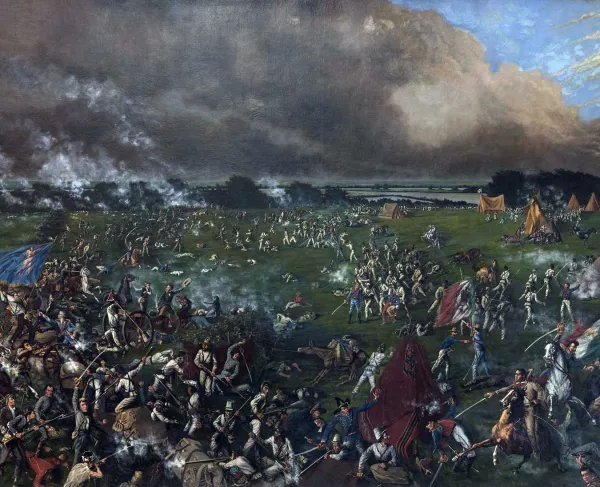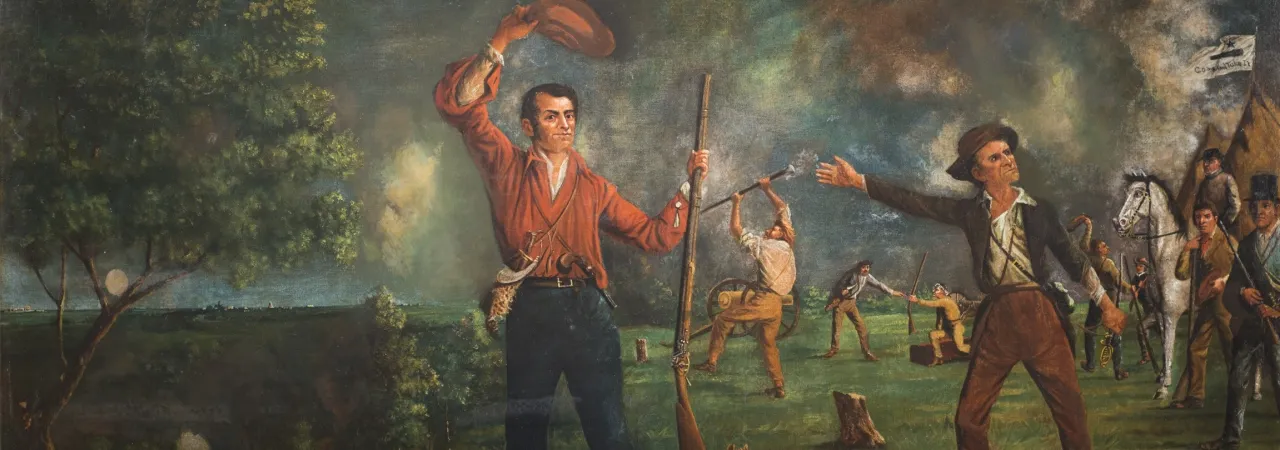
Ben Milam Calling for Volunteers
The early days of the Texas Revolution were marked with relatively small troop movements and engagements between Mexican and Texian forces operating in the region around San Antonio de Béxar. Early defeats by the Mexican military at Gonzales and Goliad sent General Martín Perfecto de Cos into defensive measures to prevent further incursion by a rapidly expanding Texian force. On October 12, 1835, Texian leaders mustered the newly formed “Army of the People” and marched it toward San Antonio de Béxar. Led by the recently elected commander in chief, General Stephen F. Austin, the force numbered roughly 300 men and relied heavily on recruiting volunteers along the march to Béxar.
San Antonio held strategic importance as it was the political center of west Texas and housed the largest command of Mexican forces in the territory. General Cos began fortifying central locations within the town as well as the Alamo. At its peak the Mexican garrison fielded a force of over 700 supported by artillery. The Texian goal was simple, invest Béxar, cut off its lines of communication, and force a surrender of General Cos and his troops. Despite small skirmishes in the preceding days, the siege officially began on October 24th with Stephen Austin predicting a swift victory over Mexican forces within the confines of the town.
“The Army will take up the line of march from this point tomorrow morning and move toward (Béxar) as far as the Salado which is within five miles of the town. There it will take a secure position to await further reinforcements and to effect other important objects of observation on the movements of the enemy and of annoyance to their scouting parties etc. It is now well ascertained that the people of the town are well affected to our cause and will probably be ready, when occasion offers, to render us essential aid. The army is in high spirits and eager to advance but are at the same time not disposed to act precipitately or rashly. It is confidently expected that we shall be able to act conclusively within a very few days.” -General Stephen F. Austin, October 19, 1835.
Despite General Austin’s belief, San Antonio would not fall into Texian hands for another month and half. The first major engagement of the siege would occur just a few short days later at Mission Concepción, a former Spanish mission located roughly 2 miles south of San Antonio. On October 27, Austin ordered 90 men, commanded by Colonel James Bowie and Captain James Fannin, to find defensive ground on the outskirts of the town. Upon learning of this isolated group of Texian troops camped near Mission Concepción General Cos ordered Colonel Domingo Ugartechea and approximately 275 men to intercept Bowie and Fannin’s forces.
Arriving at Mission Concepción around 8:00 AM Mexican cavalry scouts engaged with Texian sentries who quickly fell back to friendly lines. Flanked by the San Antonio River and Mexican cavalry to their west, the Texian forces quickly came under pressure from multiple directions by Mexican infantry and artillery which had been brought across the river. After an extended period of sporadic combat, Mexican forces began to assemble for a linear assault on the Texian positions. Despite being supported by cannon fire, the Mexican advance was largely ineffective as the fire simply passed overhead of the sheltered defenders. Additionally, the Mexican powder was of poor quality putting them at a further disadvantage. The Texians focused most of their fire on the Mexican cannons and were able to render them ineffective throughout the fighting.
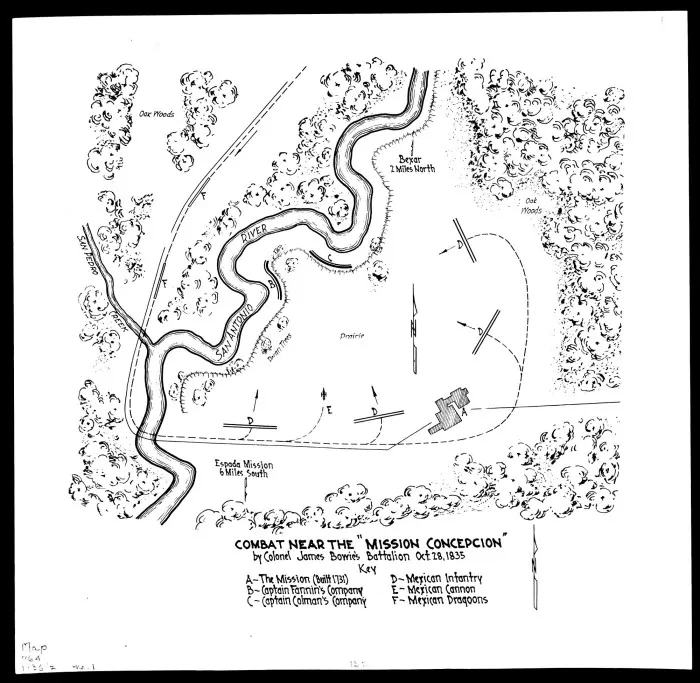
After three attempts to overtake the Texian positions, the Mexicans were repulsed and forced to abandon a 6-pound cannon which was subsequently turned around on the retreating men. The Battle of Mission Concepción proved to be a resounding success for the Texian detachment who suffered only two casualties; one killed and one wounded. Mexican losses range from as low as 14 men killed to upwards of 70 over the three-hour engagement.
In the weeks following the combat at Mission Concepción both sides were reinforced by troops funneling in from both north and south. The Texian forces were heavily aided by innumerable sympathetic men from the United States to enlist in Austin’s army. The most prominent of which were the New Orleans Greys. This unit of roughly 120 men were organized in the New Orleans in October 1835 and set out for Béxar to reinforce the Texian units surrounding the town. Unlike the relatively unorganized and untrained soldiers in camp, the Greys were noticeably more organized and better equipped than their counterparts.
With winter rapidly approaching and no attack in sight, both sides were becoming desperately low on supplies and morale. On November 21st General Austin made one final appeal to his officers for an assault on the fortified city. His subordinates rejected the call. The next day Austin formally announced his resignation from command of the Texian forces citing poor health and a wish to aid the cause in a new role as commissioner to the United States. Colonel Edward Burleson, Austin’s second-in-command, effectively took over military operations around Béxar.
In late November, rumors of a Mexican convoy carrying supplies and gold and silver reached the Texian lines. Colonel Burleson ordered a detachment of scouts west of Béxar to verify these reports. Quickly returning, it was confirmed that around 50 Mexican troops were spotted 5 miles from the town. Burleson then ordered Colonel James Bowie as well as Colonel William H. Jack with 100 infantrymen to intercept the Mexican convoy.
Bowie’s group was the first to encounter Mexican forces crossing a dry ravine nearly a mile from Béxar. Recognizing the threat, General Cos sent an additional 50 men along with a cannon to support his exposed force. In the aftermath of the fight, the Texians were able to capture 40 pack mules. Although expecting to find bundles of gold, the Texians were disappointed to learn that the convoy merely carried feed for animals trapped within the confines of Béxar. For this reason, the skirmish on November 26th would forever become immortalized as the Grass Fight.
December 5th would signal the beginning of the end for the defenders of Béxar. Colonel Benjamin Milam, accompanied by some 300 Texians advanced upon the town and were able to startle Mexican troops and seize two houses located near the town’s plaza. The men fortified these positions until launching another attack on the 7th in which Colonel Milam was mortally wounded. Fierce fighting continued within this urban environment with soldiers using the city’s structures for cover and concealment.
Struggling to repel the onslaught of Texian forces, General Cos withdrew his forces to the Alamo in the early hours of December 9th believing its structure and smaller perimeter would be a more tactically sound position to defend. Despite a reinforcement force led by Colonel Ugartechea and upwards of 600-700 men arriving sometime around the 8th, the situation was dire. Cos intended on a counterattack happening however no such action came to fruition.
“At daylight on the 7th, it was discovered that the enemy had, during the night previous, opened a trench on the Alamo side of the river… The morning of the 8th continued cold and wet… At nine o'clock the same companies who took possession of Don Jose Antonio Navarro's house, aided by a detachment of the Grays, advanced and occupied the Zambrano Row… A heavy fire of artillery and small-arms was opened on this position by the enemy, who disputed every inch of ground, and who, after suffering a severe loss in officers and men, were forced to retire from room to room, until al last they evacuated the whole house… Immediately after we got possession of the priest's house, the enemy opened a furious cannonade from all their batteries, accompanied by incessant volleys of small-arms against every house in our possession, and every part of our lines, which continued unceasingly until half-past six o'clock, a.m., of the 9th, when they sent a flag of truce, with an intimation that they desired to capitulate.” -Colonel Francis W. Johnson, December 11, 1835.
Realizing the effort was futile, Cos sent forward a truce flag indicating his intention to negotiate the terms of surrender to the Texian forces. Under these terms, General Cos and his men were given a period to lay down their arms and return to Mexico, vowing not to reenter to conflict against the Texians. The surrender was formally signed on December 10th, ending all hostilities in San Antonio de Béxar.
Further Reading:
- Battleground Béxar: The 1835 Siege of San Antonio: Richard L. Curilla
- Texans in Revolt: The Battle for San Antonio, 1835: Alwyn Barr
- Stephen F. Austin: Empresario of Texas: Gregg Cantrell
- A Revolution Remembered: The Memoirs and Selected Correspondence of Juan N. Seguín: Juan N. Seguín and Jesús F. de la Teja
- Lone Star Rising: The Revolutionary Birth of the Texas Republic: William C. Davis
- Santa Anna: The Life and Legacy of the Legendary Mexican President and General: Gustavo Vazsquez Lozano and Charles River Editors