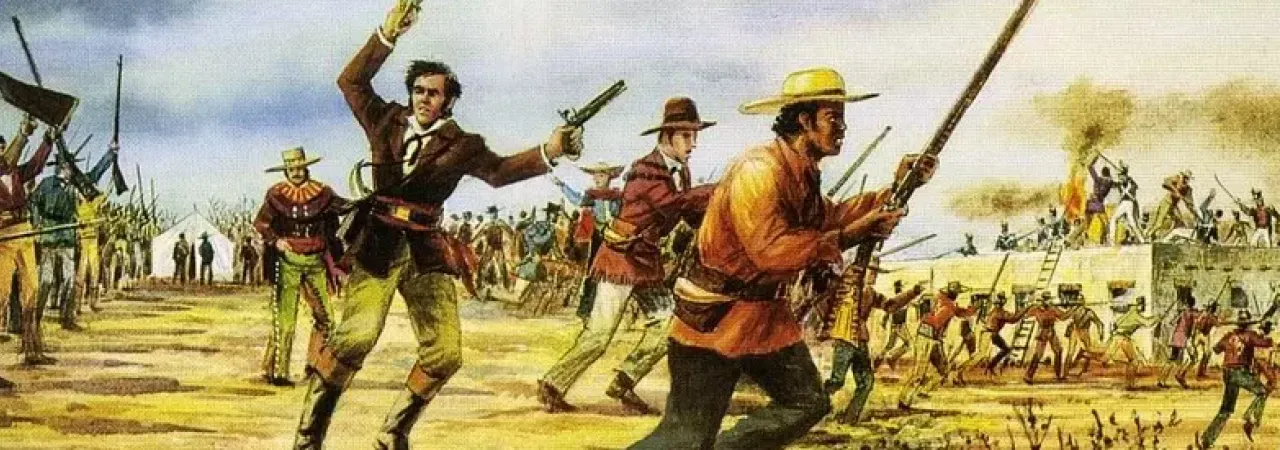
Ben Milam leads the Texian assault on Béxar
Following the outbreak of the Texas Revolution, rebel forces under Stephen F. Austin set their sights on the Mexican stronghold of San Antonio de Béxar. The city served as both a military bastion and a political center. Setting out from Gonzales on October 13, 1835, the Texians expected to quickly invest and route the defenders from Béxar. Instead, the campaign dragged into a two-month siege culminating in an intense battle fought within the concealed urban environment of Béxar.
As the siege carried on from October to November and finally into early December, harsh conditions and stalemate eroded morale on both sides. Making matters worse, General Stephen Austin’s health rapidly deteriorated, contributing to his resignation from the Texian army. Following Austin's exit, Edward Burleson assumed command of the volunteer force surrounding Béxar. As frustrations grew, the Texian chain of command became increasingly turbulent. Despite smaller victories at Mission Concepción and the Grass Fight, the Texians still failed to penetrate Béxar. Although Burleson remained apprehensive, many in the Texian camp grew impatient and wanted to advance on the city.
Fearing the Mexicans had learned his plans, General Burleson revoked an attack order on the city. After some convincing, Burleson remained hesitant but ultimately permitted Milam to organize a volunteer assault. Colonel Milam, who was highly regarded by his men, stepped before the Texian camp and shouted:
"Who will go with old Ben Milam into San Antonio?"
At daylight on the morning of December 5, 1835, 300 volunteer soldiers and two cannons departed the “Old Mill” north of town and marched toward Béxar in two separate columns. Colonel Milam took command of the first column while Colonel Francis “Frank” Johnson guided the second. Colonel James Neill’s battery directed their artillery toward the Alamo, which allowed the Texians to enter via Acequia Street and Soledad Street, catching the Mexican defenders off guard. The rebel forces quickly captured two homes located near the city’s plaza. Fierce fighting continued throughout the day of the 5th, with two attackers killed and a further dozen or so wounded.
Texian forces directed much of their fire toward the San Fernando Church, where General Martín Perfecto de Cos had placed cannons. Artillery from the church, along with support from the Alamo, trapped the attackers in a crossfire and temporarily cut off communications between the Texian columns. That, along with a lack of proper cover, rendered their big guns ineffective. Fighting continued with rebels harassing the Mexican artillery with small arms fire, but the assault ground to a halt as they were unable to dislodge the defenders held up in the surrounding houses. Colonel Milam’s men fortified their defensive positions and hunkered down for the night.
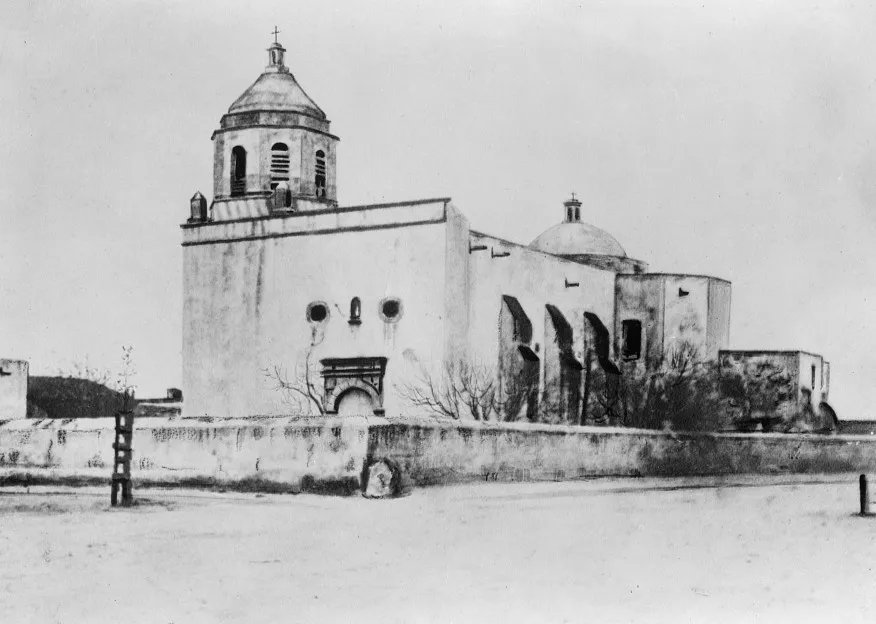
Exterior of San Fernando Church, San Antonio, Texas, photographer unknown, 1865–1868.
UTSA Special CollectionsThough the Texians held a small foothold inside Béxar, they were short on ammunition and water. Their position was still precarious and susceptible to Mexican counterattack. Texian officers immediately sent dispatches to the rear for resupply, though it would take time to arrive. Between Milam and the church stood three strong stone buildings occupied by Mexican troops and surrounded by smaller defensive structures.
On the morning of the 6th, Mexican soldiers positioned atop roofs fired down onto the rebel positions. When the muskets subsided, the defenders opened with steady cannon fire that continued throughout the afternoon. The Texian defenses, which were constructed the night prior, held firm, and the bombardment failed to break them. Johnson and Milam’s units again reestablished communication lines while getting their own cannons online. Later that day, Lieutenant W. McDonald, accompanied by several men, rushed forward to secure another house along the Texian right flank, further extending the Texian lines.
As the sun rose on December 7th, the attackers awoke to see a Mexican trench line, which had been dug the previous night, occupying their left flank across the river. That morning, an exchange of gunfire continued until around 11:00 AM when the Texians gained fire superiority over the Mexican defenders. By noon Henry W. Karnes led a rapid assault into a house positioned ahead of Milam’s column. With crowbar in hand, Karnes, followed by a company of men, forced entry into the building and secured it. As the battle entered into the afternoon, tragedy struck the Texian forces.
Around 3:30 PM, Colonel Ben Milam attempted to cross a yard to rendezvous with Colonel Johnson. Although exposed only briefly, a Mexican sharpshooter located Milam near the Veramendi House and shot the Colonel in the head, killing him instantly. He was one of only three Texian casualties that day, the others being slightly wounded.
Reeling from the loss of Milam, the Texians now fought with even more tenacity under Colonel Frank Johnson. By 10:00 PM, the attackers had gained ground and occupied the strategically important Don Jose Antonio Navarro house, located just north of the San Fernando Church. The weather began to turn cold with frigid rains continuing into the morning of December 8th.
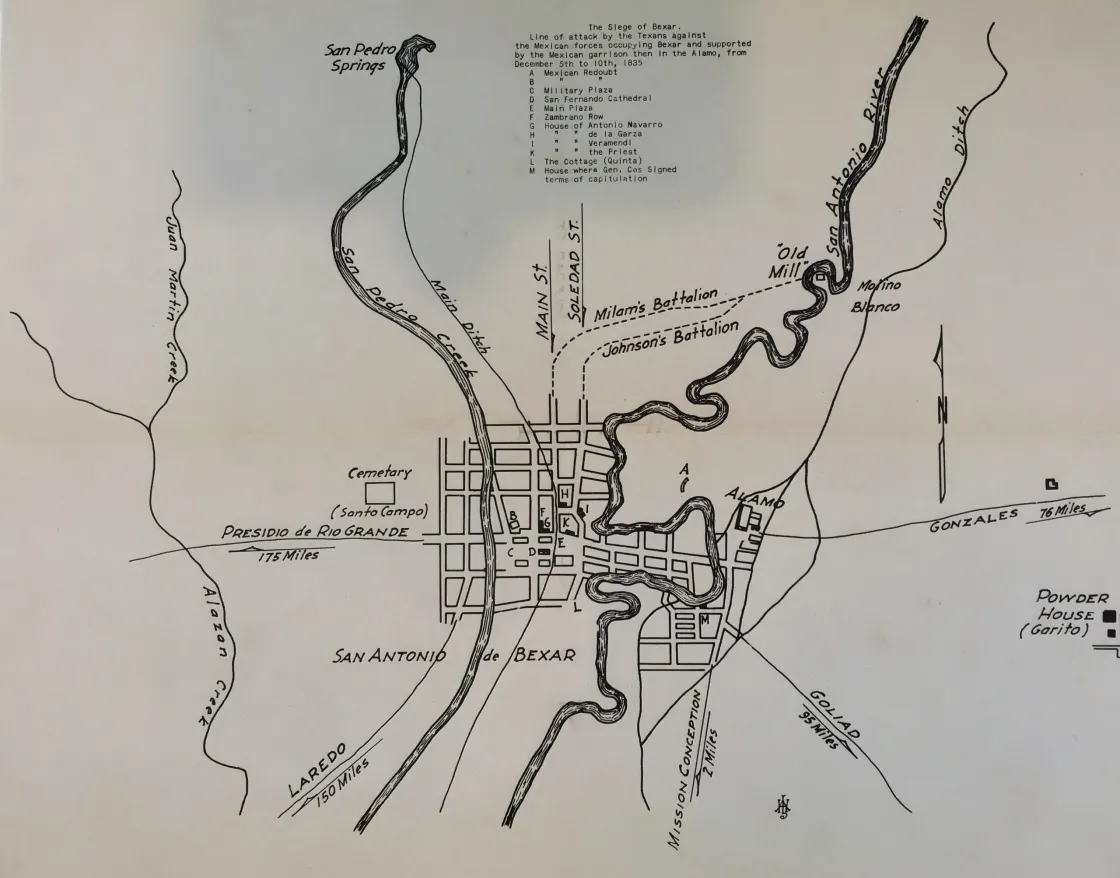
Map Depicting the Assault on San Antonio de Bexar, December 5, 1835, 1938. Map by Andrew Jackson Houston. Originally published in Military Maps of the Texas Revolution (Anson Jones Press).
Public DomainAt 9:00 AM, volunteers, along with an element of the New Orleans Greys, stormed the Zambrano Row, clearing the building room to room. That night, the occupants of Zambrano Row, who were now reinforced, seized the Priests’ House directly across the street. This proved to be the turning point as the Texian volunteers now occupied a continuous sector north of the plaza. Mexican cannon and musket fire continued throughout the darkness; however, the Mexican defenders found their current position futile. Around 1:00 AM on December 9th, General Cos ordered a small detachment to remain in rear guard while the bulk of Mexican forces withdrew across the San Antonio River and into the Alamo.
Despite receiving additional reinforcements the prior day, General Cos was unable to organize a counterattack after his cavalry refused. At this point many soldiers began to abandon their posts, forcing Cos’s hand. At 6:30 AM on the 9th, the Mexicans waved a truce flag and sent Sanchez Navarro forward to Colonel Johnson’s position. In this meeting, the warring parties negotiated the terms of surrender.
By December 10th, both sides agreed to the conditional surrender of the Mexican army located within Béxar. Unable to hold prisoners, General Cos and his men agreed to withdraw south of the Rio Grande and not oppose the Constitution of 1824. This promise would eventually be broken just a few months later when Cos reentered the conflict. The Mexican garrison departed the Alamo within days of surrender, formally signaling Texian victory at San Antonio de Béxar.
Despite the intense urban combat, Texian losses were relatively light, with approximately 2–3 killed and around 20–30 wounded, including several mortally wounded. Historians conclude around 150 Mexican troops were killed, though estimates vary and may include casualties from multiple phases of the fighting. After suffering an embarrassing defeat at Béxar, the Mexican army would return in the spring of 1836, igniting one of the most infamous battles in history.
Further Reading:
- Battleground Béxar: The 1835 Siege of San Antonio: Richard L. Curilla
- Texans in Revolt: The Battle for San Antonio, 1835: Alwyn Barr
- Stephen F. Austin: Empresario of Texas: Gregg Cantrell
- A Revolution Remembered: The Memoirs and Selected Correspondence of Juan N. Seguín: Juan N. Seguín and Jesús F. de la Teja
- Lone Star Rising: The Revolutionary Birth of the Texas Republic: William C. Davis
- Santa Anna: The Life and Legacy of the Legendary Mexican President and General: Gustavo Vazsquez Lozano and Charles River Editors