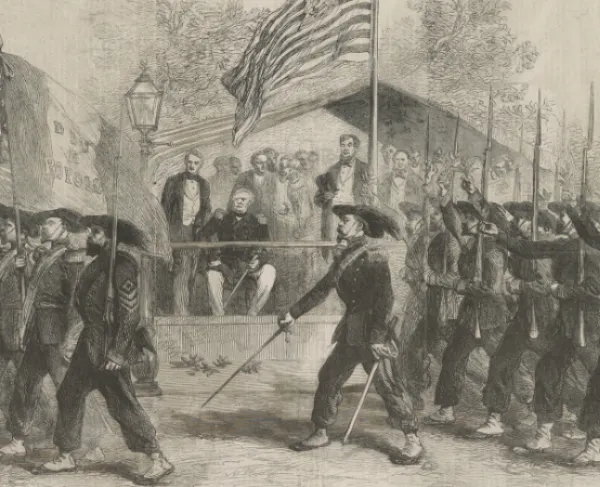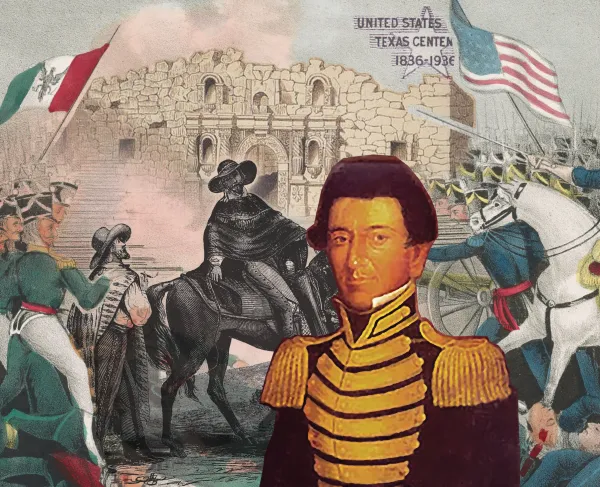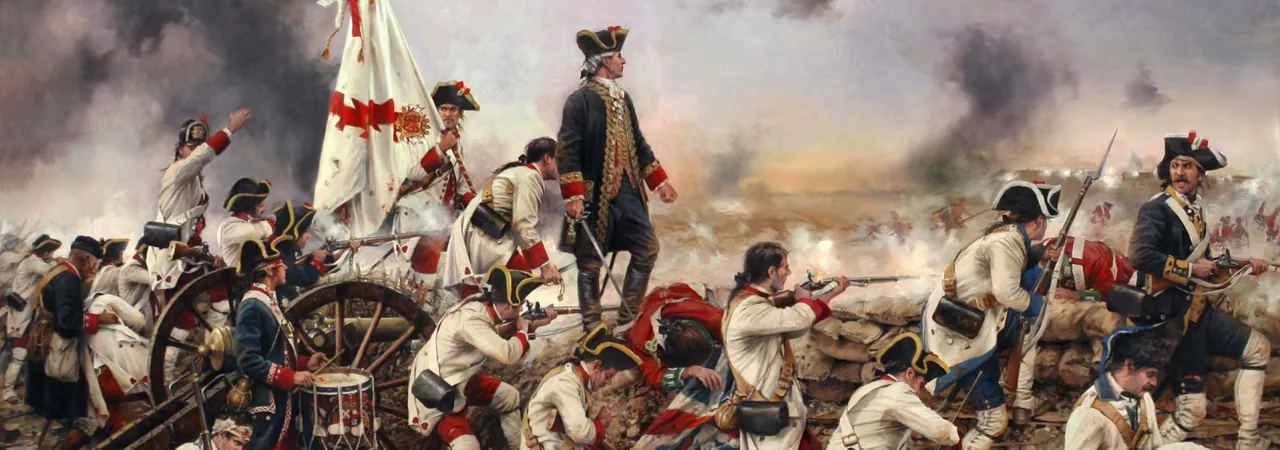
The Spanish forces led by Bernardo de Gálvez at the Siege of Pensacola.
The history of the independence of the United States has traditionally been narrated as an achievement led by the Thirteen Colonies, with decisive support from France. However, this perspective relegates another key player to the background: Spain. Its participation—military, financial, logistical, and human—was crucial to achieving independence, although overlooked for a long time.
Eighteenth-century geopolitical context is key to understanding Spain’s involvement in the American Revolution. Spain intervened in the war for strategic interests, rather than out of ideological affinity with revolutionary ideals. The Bourbon monarchy sought to weaken Great Britain, its principal enemy, and to protect its territories in both the Americas and Europe. This pragmatic approach adds layers to Spain’s contributions. Without the combined support of Spain and France, colonial victory and the establishment of the United States would have been extremely difficult, if not impossible.
From the outset of the conflict, Spain helped discreetly but consistently. Through commercial networks, it facilitated the shipment of arms, gunpowder, uniforms, and financial resources to the patriots, who lacked sufficient means in 1775. Historical figures such as Diego de Gardoqui played a key role in supply efforts, while Juan de Miralles acted as a diplomatic liaison between Spain and the Continental Congress.
A decisive turning point occurred in 1779, when Spain formally declared war on Great Britain and joined France. From that moment, its participation expanded to a global scale. In Europe, Spain carried out significant actions, including attempts to invade southern England, the capture of convoys, the siege of Gibraltar, and the recovery of Menorca. These maneuvers forced Great Britain to divide its forces, thereby reducing pressure on the colonies. All these actions took place between 1779 and 1781, at a critical moment in the Revolutionary War, while Britain pursued a strategy to control the western and southern regions of the colonies.
In the Americas, Spain’s contribution proved even more decisive. Bernardo de Gálvez, governor of Spanish Louisiana, emerged as a central figure. His campaigns succeeded in expelling British forces from the Mississippi Valley and the Gulf of Mexico. Victories at Baton Rouge, Mobile, and especially Pensacola significantly weakened British presence in the South and thwarted their westward expansion.
Spain also organized one of the largest transatlantic military expeditions of the time, sending more than 11,000 soldiers to the Americas. Additionally, it defended key positions such as St. Louis, Missouri, under Captain Fernando de Leyba, and Fort Saint Joseph, halting British advances into territories of the present-day Midwest. These actions not only had direct military impact but also helped maintain the strategic balance necessary for the rebels’ victory.
Spain gave instrumental economic support in the conflict, too. The War of Independence entailed enormous costs, and the Continental Army depended heavily on external assistance. Notably, the victory at Yorktown in 1781 was supported with financial aid delivered by Francisco de Saavedra in Havana, setting the stage for the military triumph. The “Donativo Universal” crucially contributed nearly two million pesos. This collective effort involved diverse social groups: Indigenous peoples, mestizos, creoles, and Europeans all provided financial backing to sustain the war effort.
The diversity of participants was one of the most significant aspects of this history. The Spanish contribution was not exclusively peninsular but profoundly transatlantic. Soldiers, sailors, women, merchants, and civilians of varied origins—including Afro-descendants and Indigenous peoples—actively participated in the conflict from Central America to the Mississippi Valley. This plurality reflects both the complexity of the Spanish Empire and its capacity for mobilization.
Spanish military action also extended to other strategic regions such as the Caribbean and Central America. Campaigns along the Mosquito Coast, the San Juan River in Nicaragua, and San Fernando de Omoa led to the removal of British forces from these areas, securing key trade routes and strengthening the allied position in the Atlantic. Although less well known, these operations significantly contributed to the global weakening of Great Britain.
Despite the magnitude of this participation, Spain’s recognition remained limited for a long time. Recognizing Spain’s role in the independence of the United States does not diminish the contributions of other actors; rather, it enriches the understanding of a complex and global historical process. Independence was not solely the result of colonial efforts, but also of an international network of alliances in which Spain played a crucial role.
Further Reading:
- Every Hazard and Fatigue: The Siege of Pensacola, 1781, Joshua Provan
- An Underappreciated Victory: Bernardo de Galvez's Mississippi River Campaign Against the British, 1779, Stephen L. Kling, Jr. and Kristine L. Sjostrom
For historical data, this article is based on the work of various authors published at https://www.unveilingmemories.com/es/ and their documentary and bibliographic sources. See also:
- Blankets and Pesos for Washington’s Army | Unveiling Memories
- Diego de Gardoqui | Unveiling Memories
- Two Armadas Bring Britain to the Peace Table | Unveiling Memories
- Spain in Missouri: the Defense of St. Louis | Unveiling Memories
- Fernando de Leyba | Unveiling Memories
- The “Donativos”: Finding the Silver that Dropped through the Floor | Unveiling Memories
- Women in Peace and in War | Unveiling Memories