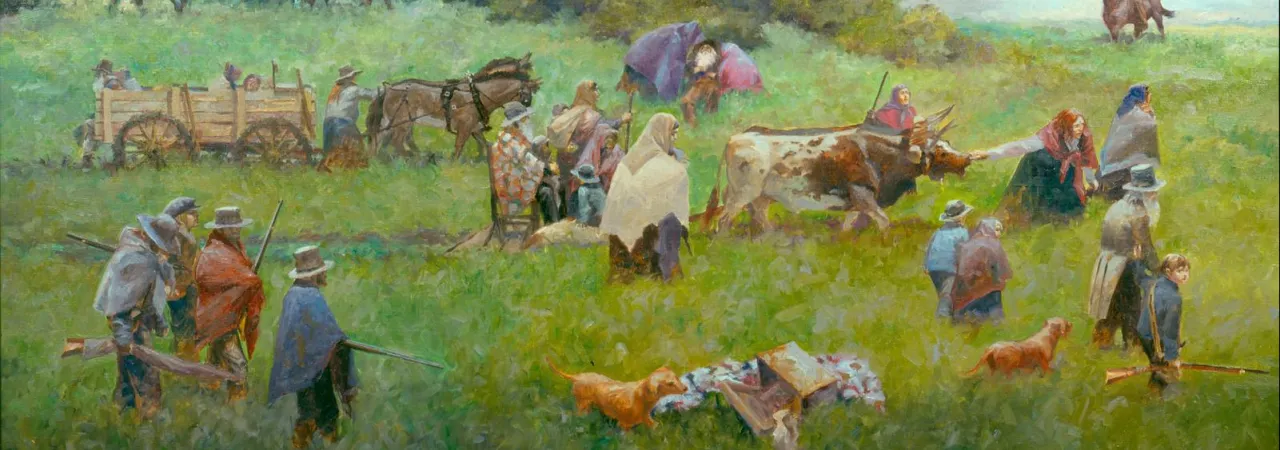
The Runaway Scrape refers not to one singular event, but to the mass exodus of civilians and military eastward across Texas in retreat before the Mexican military in the early months of 1836. Many Texians feared being killed, especially after the Tornel Decree was issued by Mexico on December 30, 1835. This decree deemed foreign fighters ‘pirates’ and therefore subject to execution. Despite the victory of the Texian forces over General Cos at San Antonio de Béxar, retribution from General Santa Anna was imminent.
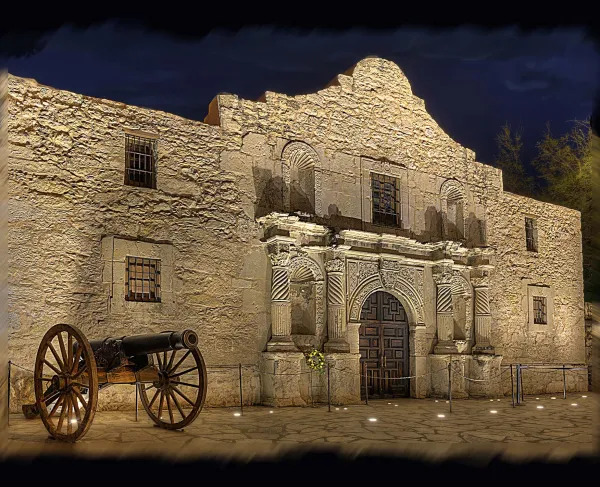
The fall of the Alamo was the catalyst for the Runaway Scrape, although Santa Anna and his men had crossed into Texas as early as January 14, 1836. Command of the forces at the Alamo was initially held by Lt. Colonel James C. Neill. The garrison consisted of 104 soldiers and 21 artillery pieces. However, after Neill departed to tend to his family, command later became divided between Colonels James Bowie and William B. Travis, with Travis assuming sole command after Bowie fell ill.
On February 23rd, the occupants of the Alamo found themselves surrounded as Santa Anna’s troops reached Béxar. Unfortunately for the Texians, Mexican forces made clear that no negotiation would be offered; the only options were surrender or face annihilation. Over the next two weeks, the Texian forces and civilians within the Alamo would suffer an incessant bombardment from Mexican artillery. In the final assault on March 6, all of the defenders perished. Word of the defeat at the Alamo spread panic across the settlements.
“On the 12th of March came the news of the fall of the Alamo. A courier brought a dispatch from General Houston for the people to leave. Colonel Travis and the men under his command had been slaughtered, the Texas army was retreating…. Then began the horrors of the 'Runaway Scrape.' We left home at sunset, hauling clothes, bedding, and provisions on the sleigh with one yoke of oxen. Mother and I were walking, she with an infant in her arms… We camped the first night near Harrisburg, about where the railroad depot now stands. Next day we crossed Vince's Bridge and arrived at the San Jacinto in the night. There were fully five thousand people at the ferry… Our hardships began at the Trinity (River). The river was rising and there was a struggle to see who should cross, first. Measles, sore eyes, whooping cough, and every other disease that man, woman or child is heir to broke out among us.” -Dilue Harris
Family members and slaves of those killed in the fighting were allowed to leave Béxar. The Mexican army also spared enslaved African Americans, which was consistent with Mexico’s anti-slavery laws.
The Runaway Scrape may best be epitomized by Alamo survivor Susanna Dickinson. Susanna, along with husband Almeron, migrated to Texas in 1830 and gave birth to a daughter, Angelina, in 1834. Almeron was present at the outset of the revolution in Gonzales and fought at the Siege of Béxar. After the capture of the town, the family settled in Béxar. Dickinson assisted in the direction of the artillery during the siege of the Alamo. Susanna and Angelina were amongst those spared by General Santa Anna. Now widowed, she and her daughter were left to pick up the pieces. Unfortunately, after the war, Susanna Dickinson would apply for a $500 pension for her loss and be denied by the Republic of Texas.
At the fall of the Alamo Susanna was given a personal message by Santa Anna to deliver to General Sam Houston, commander of Texian forces, then assembling in Gonzales, about 70 miles from the Alamo. This message was intended to spread fear amongst the Texian forces. Houston, upon receiving the news of the Alamo, decided to pull his men out of Gonzales on March 13, 1836, and move east to the Colorado River. According to his estimates, the Texians had 374 men to contend against a significantly larger army under General Santa Anna.
Retreating was the only feasible option and with them came the civilian populace. A detachment of men was left in Gonzales to protect the trailing refugees. They were then ordered to burn the town to the ground leaving nothing for the incoming Mexican forces. Sam Houston now pivoted to a tactic of retreat to stave off a large-scale defeat in the field. The Texians were counting on reinforcements and Houston needed time to drill and instill discipline into his raw army.
Further panic spread amongst the masses in Texas when the Goliad Massacre was carried out on March 27th by the Mexican army against roughly 425-445 Texian prisoners of war. As forces continued to retreat, confusion reigned, leading to the burning of San Felipe de Austin, the center of the first American settlement in Texas, on March 30th. Fleeing settlers began to destroy their property to prevent it from falling into the hands of the Mexican army.
“Many fled from San Augustine. Advancing into the country, we found the roads literally lined with flying families, and, instead of the men turning their faces to the enemy, we met at least 300 men, with arms in their hands, going east. Perhaps they considered the contest hopeless and did not care to throw away their lives. The reports of the enemy's overwhelming numbers and bloody intentions were indeed alarming. We must have met, at least, 1,000 women and children, and everywhere along the road were wagons, furniture, and provisions abandoned. Almost every house was deserted, and its contents left open to depredation.” -John Anthony Quitman
As Santa Anna advanced across Texas, his men enacted a policy of selective destruction tied to logistics and intimidation. Harrisburg was burned in mid-April, followed shortly by the destruction of New Washington, further displacing civilians along the coast. Fate, however, would quickly turn for the Texians.
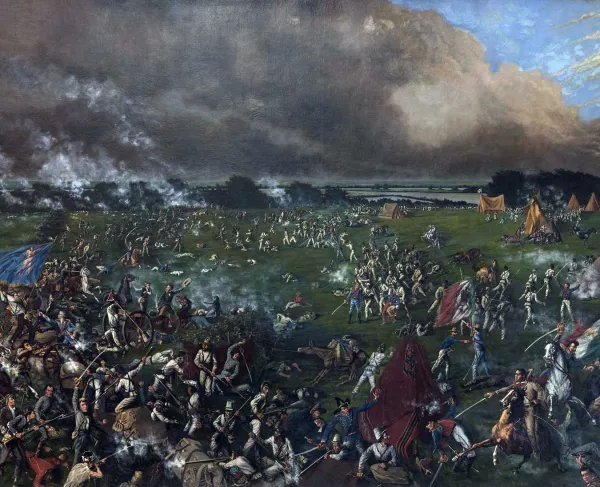
On April 21st, a detached Mexican force under Santa Anna endured one of the most decisive military defeats of the 19th century. Believing the Texian army was still in full retreat, Santa Anna camped his men in an extremely vulnerable position along the San Jacinto River. Houston decided this was the moment to strike. Despite outnumbering the Texian forces roughly 1,300 to 900, the Mexicans suffered around 650 deaths in the span of a few short hours. The Texians sustained only 9 killed in action during that same period. The defeat of Santa Anna at the Battle of San Jacinto signaled the effective end of the Texian Revolution, independence for Texas and the birth of a republic.
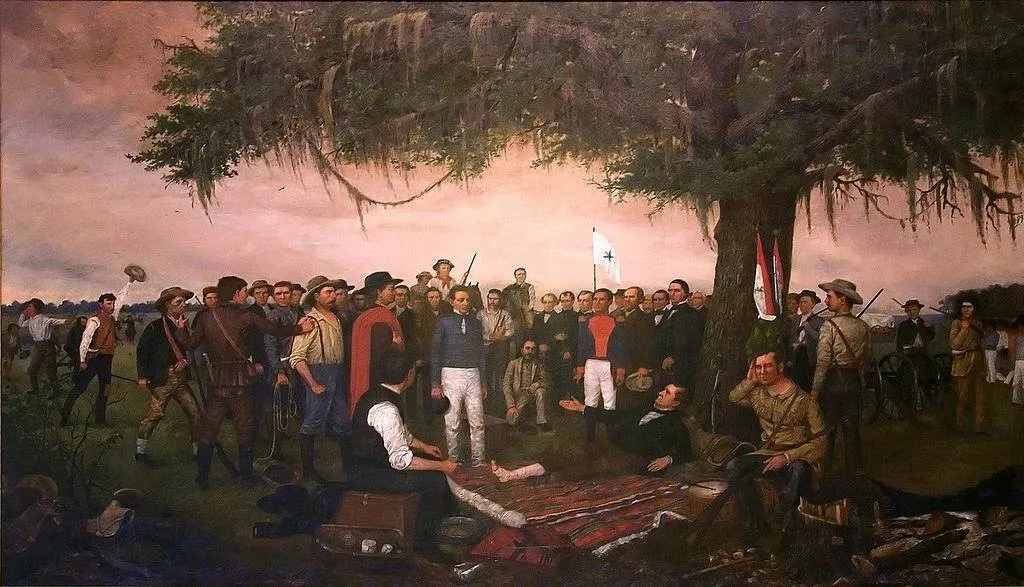
Surrender of Santa Anna, William Henry Huddle’s 1886 depiction of Mexican Gen. Antonio López de Santa Anna surrendering to the wounded Sam Houston following the Battle of San Jacinto in 1836.
Texas State CapitolWith the capture of General Santa Anna, thousands of Texians began to return to their homes and rebuild their lives. The number of Texian and Tejano women, children, and men displaced during the Runaway Scrape may never be accurately counted. The story of the Runaway Scrape represents the cost of war on civilians caught in the middle.
Further Reading:
- Texian Exodus: The Runaway Scrape and Its Enduring Legacy: Stephen L. Hardin
- Texian Iliad: A Military History of the Texas Revolution: Stephen L. Hardin
- The Raven: A Biography of Sam Houston: Marquis James
- Eyewitness to the Alamo: Bill Groneman
- Lone Star Rising: The Revolutionary Birth of the Texas Republic: William C. Davis
- The Reminiscences of Mrs. Dilue Harris: Dilue Harris and Texas State Historical Association
Related Battles
400
189