The Consultation and Convention of 1836
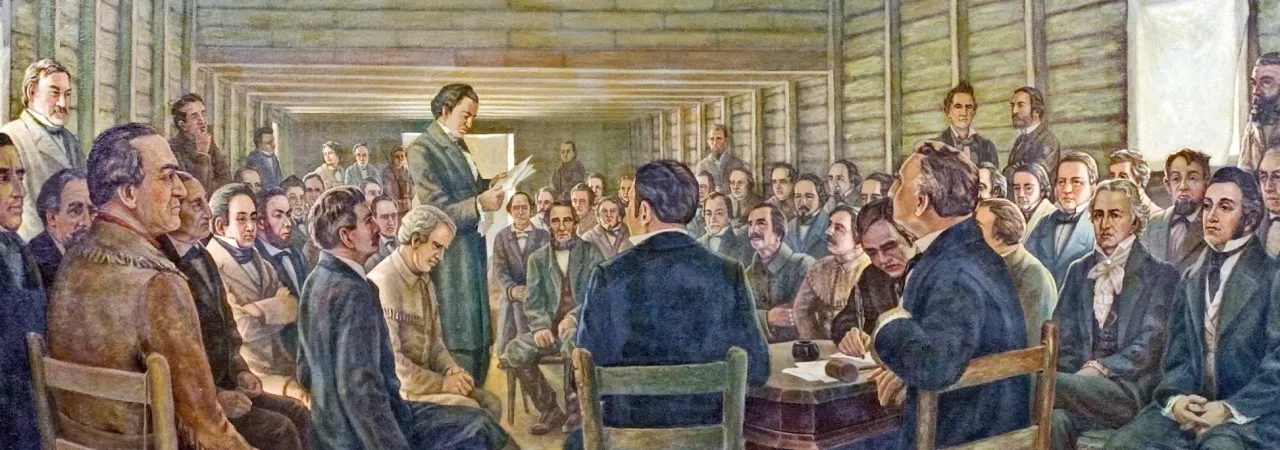
In the summer of 1835 tensions between Mexico and its territory of Tejas reached a boiling point. The Mexican government under President Antonio López de Santa Anna gradually shifted away from federalism to a centralist system. Just a year prior, Santa Anna moved to dismantle the 1824 Mexican Constitution, stripping away certain rights for states like Tejas. The territory, which increasingly consisted of Anglo-American settlers, took issue with what they felt was government overreach. Delegates from across the region agreed to meet to debate the situation on October 15, 1835, however, the onset of war at Gonzales on the 2nd delayed the session.
Finally, by November 3-4, 1835, The Consultation reached quorum and began deliberations. The movement generally splintered between two factions under Stephen F. Austin and John A. Wharton backed by Henry Smith. Austin wished to return to the 1824 Mexican Constitution while Wharton and company sought full independence from Mexico. The major debates revolved around the intended purpose of Texas’s conflict with Mexico and the structure of its provisional government.
58 delegates from around Texas composed The Consultation (Voters elected 98 in total). Mexican occupation restricted participation from Béxar, Goliad, Refugio, Victoria, and San Patricio. For this reason, there was very limited representation on behalf of the Tejano population at the opening meetings. Stephen Austin did not attend the initial hearings as he was leading the Texian volunteer militia near Béxar. On November 7th the delegates announced formal declarations stating:
"the good people of Texas, availing themselves of their natural rights, solemnly declare that they have taken up arms in defense of their rights and liberties which were threatened by the encroachments of military despots and in defense of the Republican principles of the federal constitution of Mexico of 1824." -Declarations of the People of Texas
The Consultation made a deliberate effort to sidestep the issue of independence to garner support from both the United States and sympathetic Mexican regions. They established a new provisional Texian government with Henry Smith as governor, James Robinson as lieutenant governor, and a general council consisting of one man from each municipality. The Consultation completed its purpose and the delegates disbanded on November 15th, leaving the new government to make future decisions.
After Texian forces drove Martín Perfecto de Cos out of Texas, the future of the region remained uncertain. The provisional government steadily faced criticism from citizens and military alike during late 1835 and early 1836. The General Council, low on funds and resources, gave the military permission to seize supplies for the army. These practices alienated a sizeable portion of the civilian population who were already on the fence on the topic of independence. In contrast, many within the Texian military felt the provisional government was not moving swiftly enough toward sovereignty and whispers of a coup quietly spread.
Political infighting was a constant issue in the early days of the Texas Revolution. The General Council, looking to take the fight into Mexican territory began plans for the Matamoros expedition. On January 6, 1836, the council appointed Colonel Frank Johnson to lead the offensive into Mexico, without the approval of Governor Smith. Angered by this decision, both Smith and Texian commander Sam Houston denounced the plan, questioning both its legality and strategic potential. In response, Henry Smith attempted to dissolve the General Council. The council reacted by impeaching Smith and replacing him with James Robinson.
“Necessity has compelled me to adjourn the council. They have joined with the mob to ruin the country. You know they used to threaten to break us up. They now use stronger means; their money. My council became basely corrupt. A veto is useless, and in place of a veto, I sent them the Devil, in the shape of an address… They notified me that I was removed from office and a new Governor was made. I knew however they could not break me to make a new one, and I could adjourn them by force, that is by cutting off all communications with them… I still remain however in good heart and can bear all they can heap upon me. But when my own council turn traitors and attempt to deceive me, it is too bad.” -Henry Smith, January 18, 1836
By the end of January 1836, the Texian government was a shell of itself, and the decision of independence had yet to be resolved. Two months later, on March 1, 1836, a delegation of Texians convened at Washington-on-the-Brazos. By now, the ill-fated Matamoros Expedition hardly materialized, and the Mexican army commanded by General José de Urrea rapidly advanced northward. At this point the war had been raging for nearly five months and the debate over independence was still a concern. This time, however, under a new group of representatives, the case for Texas independence won out.
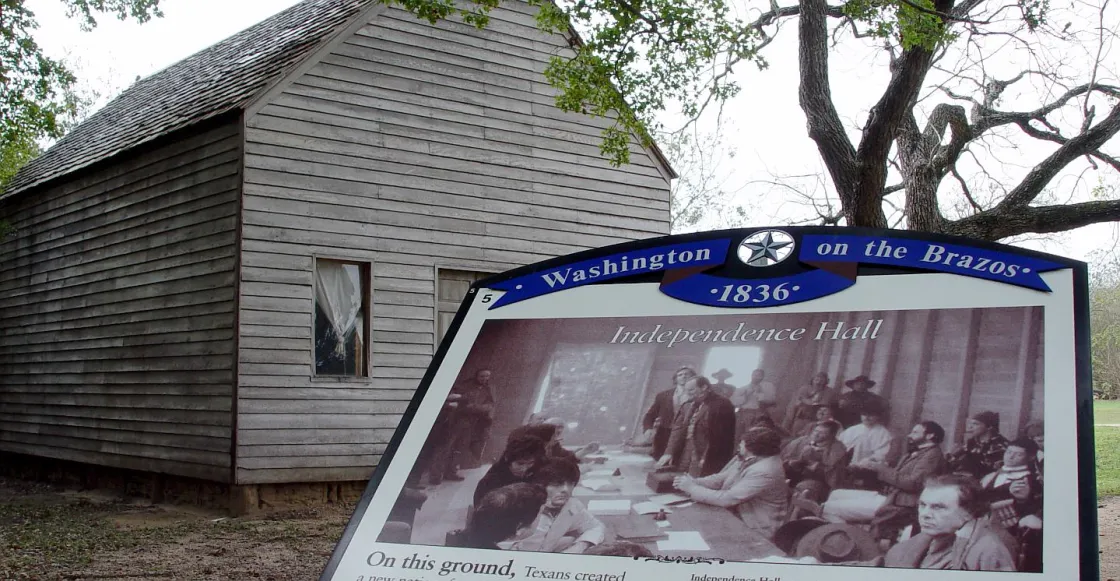
Independence Hall at Washington-on-the-Brazos, Texas
Noconatom (CC BY-SA 4.0)The convention differed from the previous Consultation because it was filled with relatively new migrants to the region. Just ten of the 59 delegates had been in Texas earlier than 1830 and two of them had only arrived that year. Most of the delegation were American nationals who took heavy inspiration from both the United States’ Declaration of Independence and Constitution when drafting their own. Just as the American Founding Fathers had, the representatives elected George C. Childress to lead a committee of five men to draft Texas’s Declaration of Independence.
On March 2, 1836, they adopted the Texas Declaration of Independence, giving birth to the Republic of Texas. Once the delegates had declared independence, they promptly set out to forge a new government. They knew they had to act rapidly as The Alamo fell on March 6th, further accelerating the Runaway Scrape across Eastern Texas.
By March 17th, the committee presented a draft of the Texas Constitution, modeled after the Constitution of the United States. The Republic of Texas would have three branches consisting of a chief executive or president, a bicameral legislative branch and a judiciary branch. The representatives subsequently elected David G. Burnet as President and Lorenzo de Zavala as the Vice-President of Texas that morning.
After the delegates approved the new measures, they hurriedly left Washington-on-the-Brazos with the Mexican army on its heels. The Texas government fled to Galveston Island to evade capture and continue forging new legislation. While in exile, the fortune of the young Republic shifted drastically. The Texian military, which had been in full retreat, capitalized on the hubris of General Santa Anna and ambushed his army near the San Jacinto River. Sam Houston’s army defeated Santa Anna’s forces at the Battle of San Jacinto on April 21, 1836, solidifying Texian victory over Mexico.
Further Reading:
- The Republic of Texas: A Brief History of Texas From the First American Colonies in 1821 to Annexation in 1846: Clarence R. Wharton
- Life and Times of Henry Smith: John Henry Brown, Henry Smith
- The Mexican Side of the Texan Revolution: Translated by Carlos E. Castañeda
- Big Wonderful Thing: A History of Texas: Stephen Harrigan
- Lone Star Nation: The Epic Story of the Battle for Texas Independence: H.W. Brands
- The Raven: A Biography of Sam Houston: Marquis James