Zachary Taylor Northern Mexico Campaign
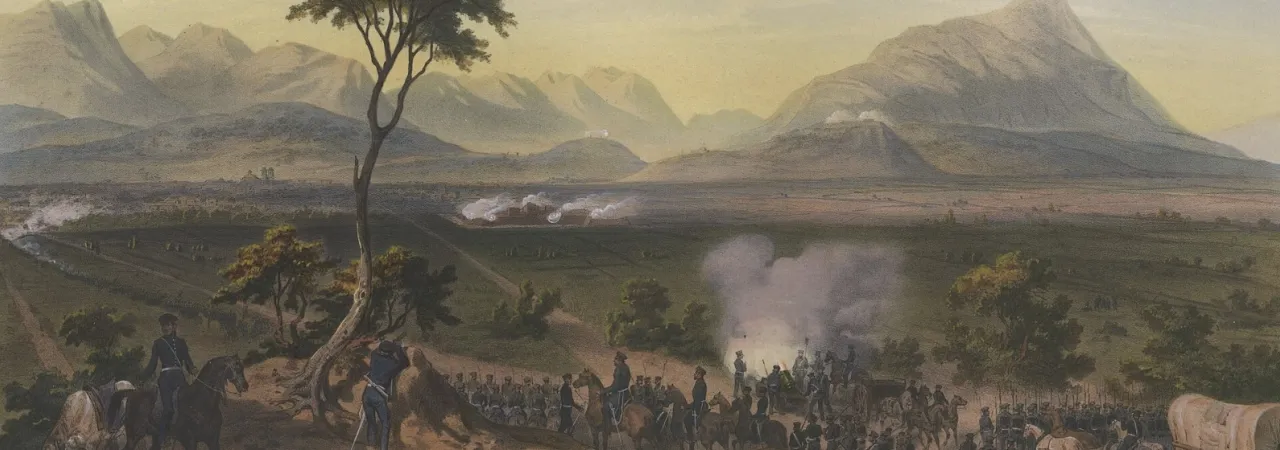
Capture of Monterey, 1851. Carl Nebel; lithographed by Adolphe Jean-Baptiste Bayot. From The War Between the United States and Mexico Illustrated by George Wilkins Kendall and Carl Nebel.
During the Mexican-American War, Major General Zachary Taylor led the Army of Occupation to victory in the Texas and Northern Mexican Campaigns. While Taylor did not spark the war itself, his success secured American control of northeast Mexico, a crucial bargaining chip for peace. Famous for these campaigns, Taylor would go on to become the 12th president in 1848.
The Texas Campaign
President James K. Polk created the Army of Occupation on April 23, 1845, to protect the Louisiana-Texas border from potential Mexican attacks while Texas annexation talks were ongoing. Brigadier General Zachary Taylor was appointed as its first commander. Within the week, Taylor and his 2,400 men crossed into Texas, setting up base on the Nueces River in Corpus Christi. When negotiations with Mexico over the new border in early 1846, Taylor was ordered to move South to the Rio Grande, in the process establishing Fort Texas (today known as Fort Brown in Brownsville, TX). Hearing that Mexican forces under General Anastasio Torrejon crossed the Rio Grande on April 24, 1846, Taylor sent Captain Seth B. Thornton with 80 men to investigate. The next day, Torrejon’s 1,600 men ambushed Thornton, killing fourteen and capturing 59. News of the Thornton Affair reached Washington two weeks later, prompting the US to officially declare war on Mexico on May 13, 1846.
In the meantime, General Mariano Arista, commander of the Army of the North, joined General Torrejon across the Rio Grande. On May 1, Taylor moved the bulk of his army to Point Isabel, a supply depot, leaving a small detachment under Maj. Jacob Brown to defend Fort Texas. Sensing an opportunity, General Arista began a siege of the fort two days later, on May 3. Leaving General Pedro de Ampudia to direct the siege, Arista moved 3400 men north to Palo Alto to cut off Taylor. Determined to relieve his men, Taylor and his 2400 men confronted Arrista at Palo Alto on May 8, delivering a crushing defeat to the Mexican force. US flying artillery decimated Mexican forces, forcing them to retreat overnight to more defensible ground at Resaca de la Palma. However, the messy retreat proved fatal when American forces reengaged the next morning. Taylor overwhelmed Arrista, forcing the Mexicans to abandon their siege and retreat across the Rio Grande. Victories at the Battles of Palo Alto and Resaca de la Palma secured full American control of Texas. For his success, Taylor was promoted to major general on June 29.
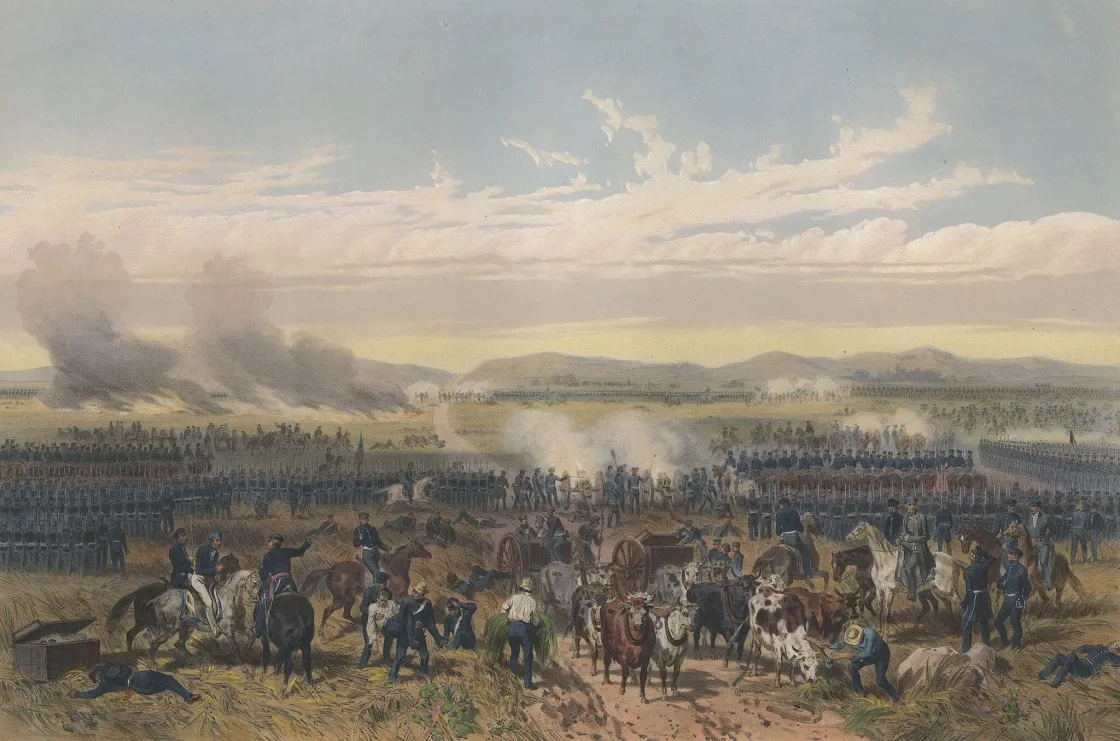
Battle of Palo Alto (May 8, 1846), 1851. Hand-colored lithograph by Adolphe Jean-Baptiste Bayot after a drawing by Carl Nebel. Originally published in The War Between the United States and Mexico Illustrated.
Public Domain
The Northern Mexico Campaign
Crossing the Rio Grande, the Army of Occupation captured Matamoros on May 18 and Camargo on July 14, making the latter their headquarters. To secure control of northern Mexico, Taylor knew he needed to capture the major city of Monterrey. Therefore, on September 21, Taylor, with over 6,000 men (three units of the Army of Occupation joined by the Texas Rangers), began their attack on the city. Monterrey was the first truly urban battle for the U.S. Army. Attempting to use traditional tactics against General Ampudia’s entrenched army, the Americans sustained heavy casualties. Major General James Pinckney Henderson and his Texas Rangers, familiar with Mexican urban warfare from their own war of independence, taught Taylor’s men more effective tactics. On September 24, after heavy fighting, Taylor trapped Ampudia’s 7300 men in the city plaza. Signing an armistice, Taylor allowed Ampudia to retreat in exchange for control of the city. Taylor would break the armistice on November 16 to occupy Saltillo. In the end, the Americans lost 531 casualties compared to the Mexicans’ 367.
Despite the victory, President Polk was enraged when he heard of the armistice and high casualties. He moved many men from the Army of Occupation to Major General Winfield Scott’s Veracruz invasion force, leaving Taylor in a weak position. In early 1847, finding out about this weakness, General Antonio Lopez de Santa Anna, commander of the Mexican Army, moved his 20,000 troops north. His plan was to destroy Taylor before Scott could land. The long and arduous march north left only 15,000 exhausted men in Santa Anna’s army. On February 22, Taylor rejected a surrender demand, and Santa Anna began a massive attack. Taylor’s 4600 men were entrenched in the La Angostura mountain pass and were able to inflict great casualties on the Mexicans. While nearly pushed from their positions, US forces maintained the pass with the help of the Mississippi Rifles volunteers, led by Colonel Jefferson Davis and an artillery battery under Captain Braxton Bragg. Despite assessments that the Mexicans could break the American position, Santa Anna decided to retreat the next morning. Overall, 591 Mexicans and 267 Americans (including Lt. Col. Henry Clay Jr., son of the famed politician) were killed during the Battle of Buena Vista. In the United States, the battle inspired a wave of patriotism as an army of mostly volunteers defeated a Mexican force three times their number, making Taylor a national hero. While both sides claimed victory, the United States retained control of northern Mexico in the battle’s aftermath.
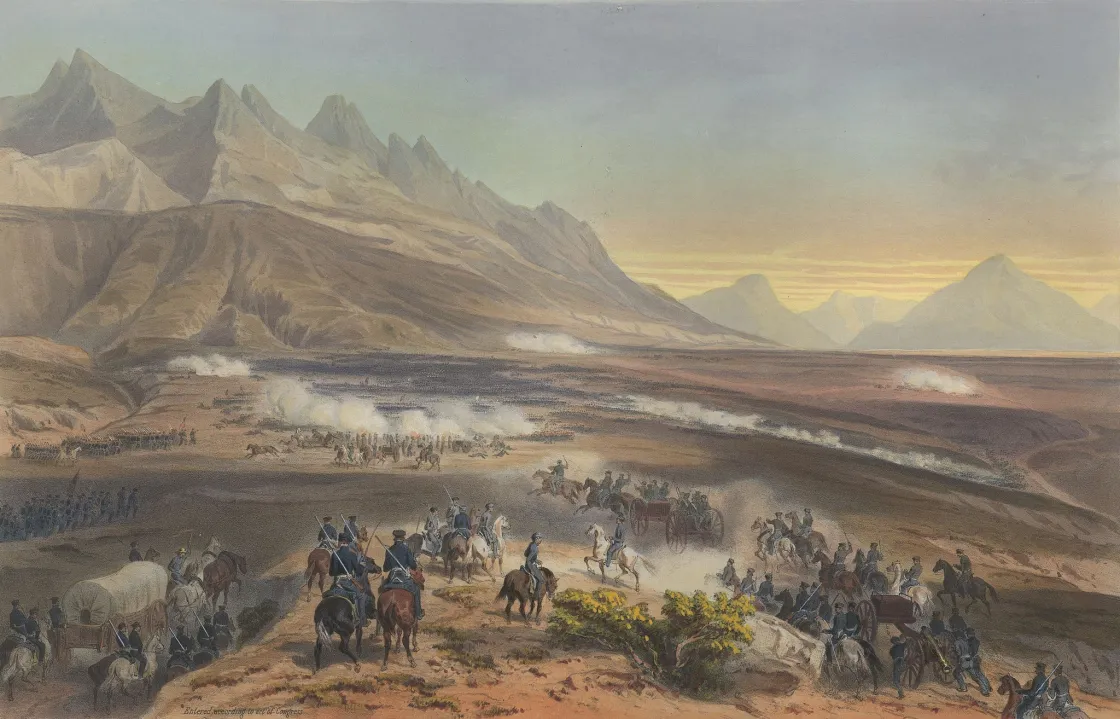
Battle of Buena Vista (February 23, 1847), 1851. Hand-colored lithograph by Adolphe Jean-Baptiste Bayot after a drawing by Carl Nebel. Originally published in The War Between the United States and Mexico Illustrated.
Public Domain
The Mexican-American War would formally end with the signing of the Treaty of Guadalupe Hidalgo on February 2, 1848, and Mexico gave up claims to all land above the Rio Grande. Taylor commanded the Army of Occupation until November 1847. Upon his return to the United States, Taylor became the Whig presidential nominee and won the 1848 election. He only held office for two years, however, dying in 1850 of gastroenteritis.
Related Battles
10
4
51
100
122
515


.jpg)
.jpg)
.jpg)