The Fighting MacArthurs
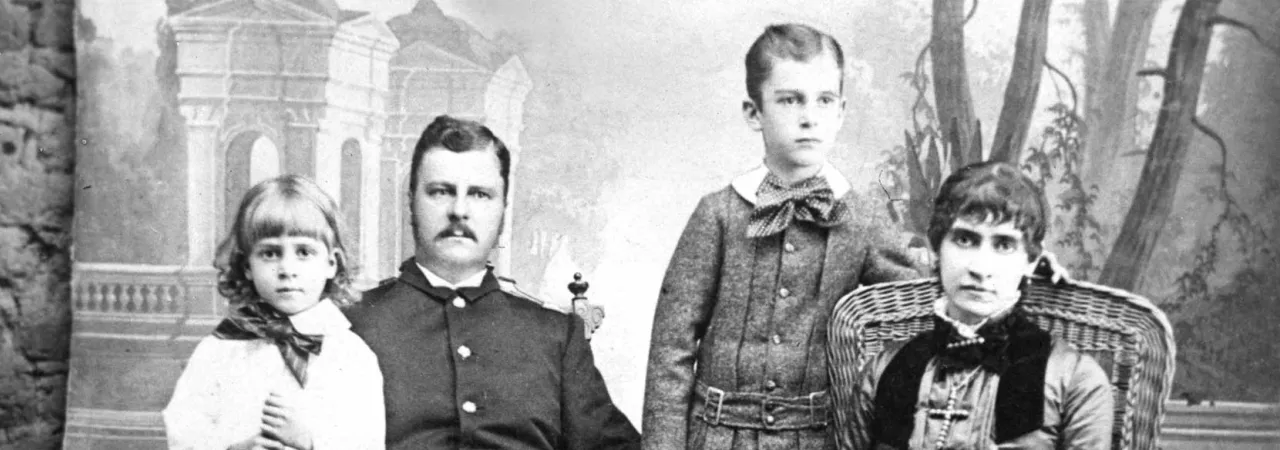
From left to right: Douglas, Arthur Jr., Arthur III., and Mary MacArthur
Ancestry and Fold3 have been helping people understand their ancestors and why they fought for causes large and small for decades. Now, Ancestry and Fold3 have joined forces with the American Battlefield Trust, so that you can find the veterans in your family's past and understand their stories and the impact on the generations that followed. You can learn more at https: www.fold3.com/projectregiment. (opens in a new window)
In addition to this recurring Hallowed Ground column, this partnership has resulted in an exclusive discount for Trust members to subscribe to Ancestry and Fold3! Check your email for this exclusive offer.
There have only been two pairings of father and son to receive the Medal of Honor since the award’s inception, but it’s clear that for these two duos, valor runs in the family. Theodore Roosevelt and Theodore Roosevelt, Jr., share a surname and the title of Medal of Honor recipient, but they were only cemented in the history books as related recipients in 2001 when the elder Roosevelt was awarded his Medal posthumously. The first pair to hold the honor was Arthur MacArthur, Jr., in the Civil War and Douglas MacArthur in World War II — with MacArthur, Jr., one of many recipients of the Medal of Honor for actions at Chattanooga.
Born in Massachusetts in 1845, Arthur MacArthur, Jr., soon moved with his family to Milwaukee, Wisconsin, for his father’s political career in local and state government. His exposure to the Civil War came quickly — at the outbreak of the war in 1861, his father attempted to enroll him at West Point to serve but was unable to. In the summer of 1862, though, the senior MacArthur secured the 17-year-old junior a commission as a first lieutenant of the 24th Wisconsin Volunteer Infantry Regiment.
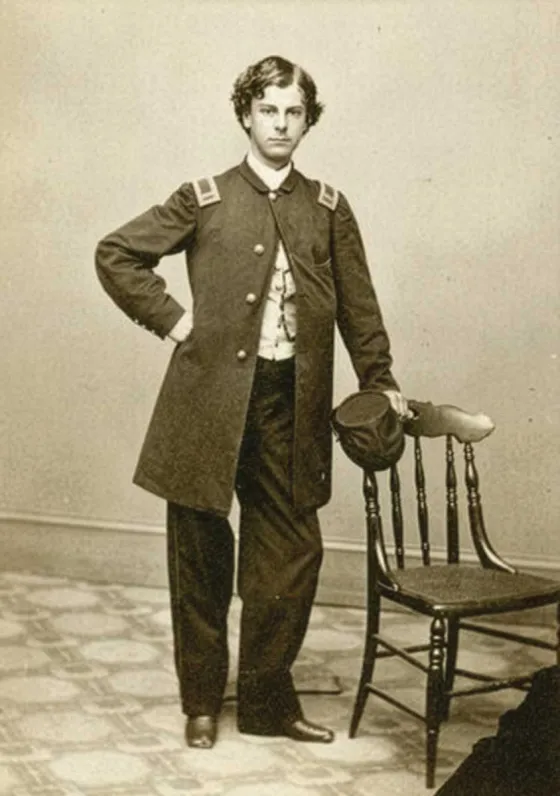
Arthur MacArthur, Jr.
Wisconsin Historical SocietyOn November 25, 1863 — about one year into his service — Arthur MacArthur, Jr., was part of the charge on Missionary Ridge. The conflict had started two days prior on November 23, after Confederate troops put the Union army under siege in Chattanooga by holding positions on Missionary Ridge and Lookout Mountain. By afternoon on November 25, however, the Union was looking to take the final line: Missionary Ridge.
Maj. Gen. George Thomas ordered 24,000 Union troops to attack rifle pits at the base of the Missionary Ridge to distract from fighting on its southern point. The soldiers successfully overran the 9,000 defenders and continued the charge, despite orders to the contrary. This largely uncoordinated and spontaneous attack continued up the hilltop, with MacArthur in its midst.
The Union troops fought up the hill, with regimental color bearers at the front of the charge. When one fell, MacArthur seized the flag and planted the regimental colors on the crest of Missionary Ridge. Shouting “On, Wisconsin!” he encouraged his fellow soldiers at a critical moment on the captured works. MacArthur received the Medal of Honor for this courage in action following the major victory at Chattanooga.
Arthur MacArthur, Jr., would continue his rise through the ranks, becoming a brevetted colonel the following year at age 19. Becoming known as “The Boy Colonel,” he mustered out as a lieutenant colonel in 1865. He ultimately saw action at Chickamauga, Stones River, Chattanooga, the Atlanta Campaign and Franklin through his four years of service in the Civil War.
MacArthur resumed his career with the Army in 1866. He served in the Indian Wars, Spanish-American War and Philippine-American War, moving between military bases for decades. In 1875, he married Mary Pinkney “Pinkey” Hardy, and the couple had three children. Douglas MacArthur, his son with whom he shares the Medal of Honor, was born in 1880 at the Arsenal Barracks in Little Rock, Arkansas. With the elder MacArthur’s position, Douglas grew up in a succession of posts in the West, learning to shoot and ride as soon as he could walk.
Douglas followed in his father’s footsteps quickly, attending West Texas Military Academy for high school and entering West Point at age 19. A great baseball player and an even better student, MacArthur was commissioned as a second lieutenant in the Army Corps of Engineers after graduating. He spent the next chapter of his life traveling Asia as his father’s aide-de-camp, examining military bases in Japan, India and China.
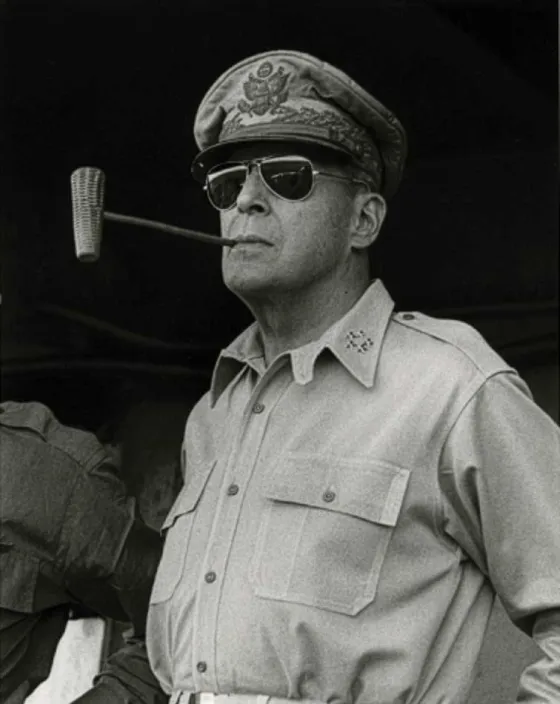
Gen. Douglas MacArthur smoking a corn cob pipe, 1945.
Smithsonian Museum of American HistoryDouglas MacArthur worked his way up to colonel as World War I began, leading his troops through multiple raids in Europe to great success. He was nominated for the Medal of Honor in 1918 for his role in a reconnaissance patrol in France during which he was wounded and the sole survivor, but he did not receive it. Following the war, he became the superintendent of West Point before assuming command of a brigade of the Philippine Division of the Army in 1923. On January 17, 1925, he became the Army’s youngest major general at age 44.
As the United States entered World War II in 1941, MacArthur was named commander of the U.S. Army Forces in the Far East and resumed his leadership in the Philippines. It was for this role that he received the Medal of Honor, the citation noting his conspicuous leadership, gallantry and intrepidity above the call of duty against invading Japanese forces, as well as his calmness in crisis. He was the oldest living active-duty recipient at age 62 and the highest-ranking military servicemember to receive it.
If valor did run in the family, it may have started in the Revolution. Douglas MacArthur was a member of the Sons of the American Revolution (SAR). His patriot ancestor, John Barney, was a private in the Massachusetts Militia. MacArthur himself is depicted on SAR’s Patriot Medal, which is awarded for service to the organization. He approved the design shortly before his death in 1964 and was the first recipient of the medal, presented posthumously at his tomb, where it is now on permanent display. Thanks to his father, MacArthur was also a member of the Sons of Union Veterans of the Civil War.
The MacArthurs individually committed acts of incredible valor time and time again throughout their years of service. Their courage and leadership were instrumental in major American events, spanning from the Civil War to World War II.