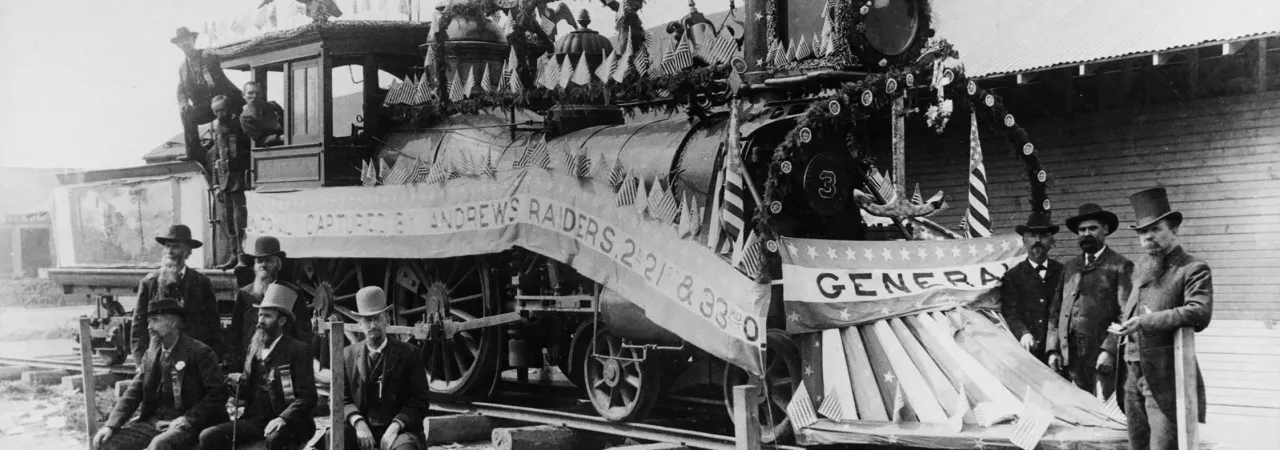
Ten of the 11 surviving Andrews’ Raiders posing by the General along with Capt. William A. Fuller at the Grand Army of the Republic Encampment in Columbus, Ohio, August 1888. On the train, left to right: John A. Wilson, Wilson W. Brown, William J. Knight. Standing below: Elihu H. Mason, William H. Reddick. Seated: John Wollam, Daniel A. Dorsey, William Pittenger. Right side, in front of locomotive: WIlliam Bensinger, Jacob Parrott, Texas captain William A. Fuller.
In April 1862, a daring band of Union soldiers and civilian operatives led by James J. Andrews slipped deep behind Confederate lines to steal the locomotive General, disrupt rail communications and strike a blow against Southern morale. What followed was one of the Civil War’s most dramatic pursuits — a desperate race through North Georgia that ended with executions, daring escapes and some of the earliest Medals of Honor ever awarded.
These are Andrews' Raiders.
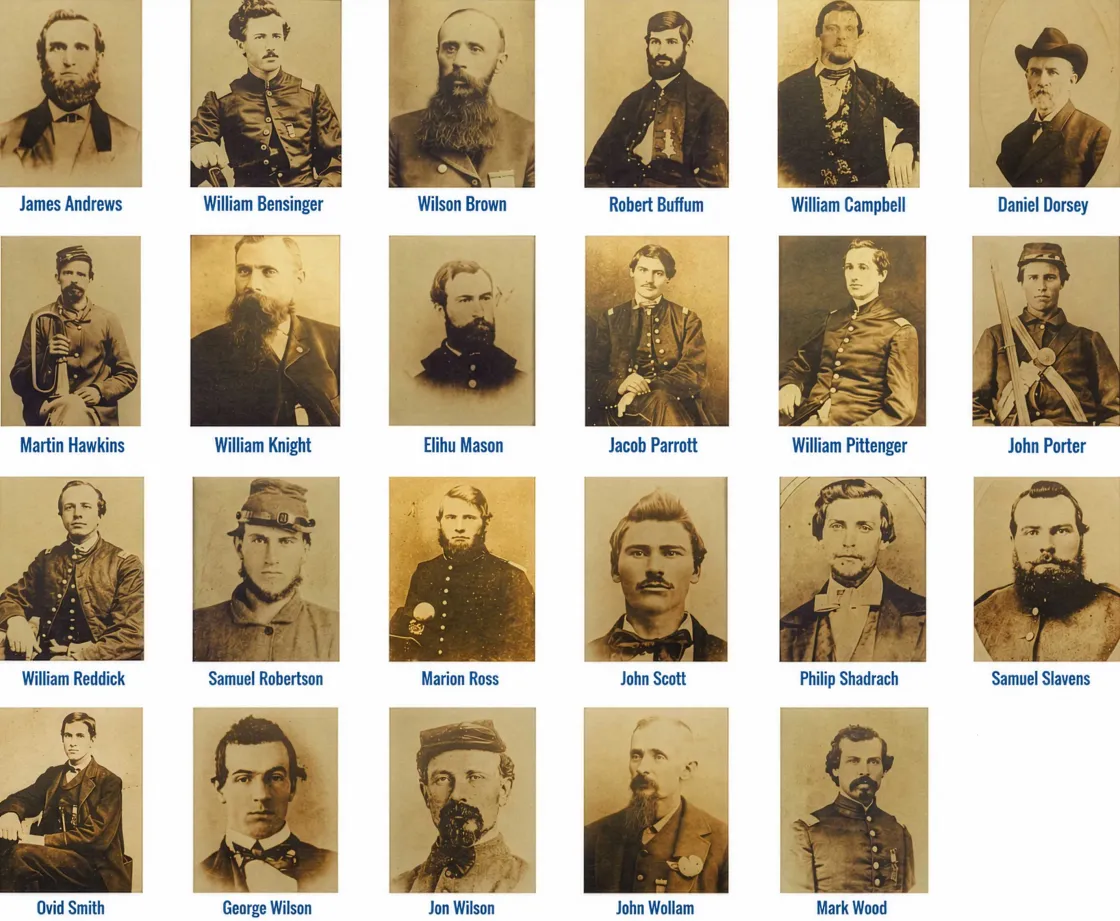
A civilian scout who conceived the April 12, 1862, seizure of the locomotive General, Andrews led the daring raid to sever Confederate rail communications. Captured after the pursuit, he was hanged as a spy on June 7, 1862. As a civilian, he was never eligible for the Medal of Honor.
William Bensinger
Private, Company G, 33rd Ohio Infantry. Bensinger helped disrupt rail traffic and communications during the northward dash toward Chattanooga. Captured and imprisoned, he was later exchanged. He received the Medal of Honor in 1863, among the first soldiers formally recognized for the raid.
Wilson W. Brown
Private, Company F, 21st Ohio Infantry. Brown worked to damage track during the race northward and was captured after the chase ended. Sentenced as a spy but spared execution, he was eventually exchanged. He received his Medal in September 1863.
Robert Buffum
Private, Company H, 21st Ohio Infantry. Buffum took part in severing telegraph lines and dismantling track before being captured. He later escaped from prison and rejoined Union lines. For his actions in the raid, he received the Medal of Honor in March 1863.
William Hunter Campbell
Another civilian, Campbell was ineligible for the Medal of Honor. Among those captured and convicted of spying, his first trip to the scaffold was unsuccessful as his large frame and heavy build snapped the rope. A second attempt to hang Campbell and Samuel Slavens was successful.
Daniel A. Dorsey
Private, Company H, 33rd Ohio Infantry. Dorsey tore up rails and obstructed pursuit along the Western & Atlantic Railroad. Captured after the locomotive was abandoned, he survived imprisonment and was exchanged. He received the Medal of Honor in September 1863.
Martin J. Hawkins
Private, Company A, 33rd Ohio Infantry. Hawkins participated in sabotaging rail lines and was captured and condemned as a spy, though the sentence was not carried out. Exchanged later in the war, he received the Medal of Honor in September 1863.
William James Knight
Sergeant, Company E, 21st Ohio Infantry. Knight led the detail responsible for prying up rails and twisting iron to hinder pursuit. Captured and imprisoned, he was later exchanged. He received the Medal of Honor in March 1863.
Elihu H. Mason
Sergeant, 21st Ohio Infantry. Mason was among the raiders who mounted an escape from the Confederate prison in Atlanta on October 16, 1862. When illness prevented him from keeping pace with the group, he urged them to continue without him, at which point Mason was recaptured. He was part of a prisoner exchange on March 18, 1863, and was one of the first Medal recipients.
Jacob Parrott
Private, Company K, 33rd Ohio Infantry. Among the first aboard the General, Parrott helped cut telegraph lines. After capture, he was severely beaten but refused to betray the mission. He became the first recipient of the Medal of Honor on March 25, 1863.
William Pittinger
Private, Company G, 2nd Ohio Infantry. Pittinger assisted in severing communications and uncoupling railcars before capture. Exchanged later in 1862, he received the Medal of Honor in March 1863. After the war, he became a minister and published an influential account of the raid.
John Reed Porter
Private, 21st Ohio. Despite oversleeping and not actually participating in the operation, Porter was captured along with the rest of the raiders within two weeks. He was one of only six who escaped from prison and managed to reach Union lines, receiving the Medal in March 1863. He died in 1923, the last of the raiders.
William H. H. Reddick
Private, Company B, 33rd Ohio Infantry. Reddick helped damage track and telegraph lines during the raid and was captured after the locomotive stalled. He endured imprisonment before exchange and received the Medal of Honor in March 1863 for his role.
Samuel Robertson
Private, Company G, 33rd Ohio Infantry. Robertson worked to tear up rails and sever communications before capture. Tried as a spy, he was hanged in Atlanta on June 18, 1862. He was posthumously awarded the Medal of Honor in September 1863.
Marion A. Ross
Private, Company A, 2nd Ohio Infantry. Ross participated in cutting telegraph wires and sabotaging rail lines before capture. He was one of eight raiders hanged in June 1862 and received the Medal posthumously in September 1863.
John Morehead Scott
Sergeant, Company K, 21st Ohio Infantry. Scott assisted in removing rails to impede Confederate pursuit. He was one of the eight raiders executed on June 18, 1862, and his Medal of Honor was awarded posthumously in August 1866.
Philip G. Shadrach
Private, Company K, 2nd Ohio Infantry. Shadrach assisted in cutting telegraph wires during the early stages of the raid. Captured soon after, he was tried and hanged in Atlanta in June 1862, but unlike his comrades did not receive the Medal posthumously the following year. President George W. Bush authorized his award in 2008, but it was not presented until 2024.
Samuel Slavens
Private, Company G, 33rd Ohio Infantry. Slavens helped dismantle track during the northward dash and was captured after the locomotive was abandoned. He was one of the eight raiders hanged in June 1862, although the rope broke on the first attempt. He received his Medal of Honor posthumously in 1883.
Ovid Wellford Smith
Private, 2nd Ohio. Smith became ill during preliminary phases of the operation and did not participate in the raid. He was detained behind enemy lines near Huntsville, Alabama, but escaped and managed to rejoin his unit. He received the Medal of Honor in July 1864.
George D. Wilson
Corporal, Company H, 2nd Ohio Infantry. Wilson helped destroy railroad infrastructure before being captured. Treated as a spy, he was hanged in Atlanta on June 18, 1862. He was posthumously awarded the Medal of Honor in 1863.
John Alfred Wilson
Private, 2nd Ohio. Wilson, part of the October 1862 escape group from the Confederate prison in Atlanta, was the second raider who, by virtue of accidental omission, did not receive the Medal of Honor fairly swiftly. President George W. Bush authorized the Medal in 2008, but it was not awarded until 2024.
John Wollam
Private, Company G, 33rd Ohio Infantry. Wollam had a dramatic path throughout the war. After the raid, he escaped from Confederate prison in June 1862 but was recaptured later that same month — only to escape again in October. He rejoined his unit but was captured again during the Battle of Chickamauga the following year, then received his Medal of Honor in 1864 after being exchanged.
Mark Wood
Private, Company C, 21st Ohio Infantry. Wood was part of the contingent that escaped the Confederate prison in Atlanta in October 1862, evading capture by sailing down the Chattahoochee River. He rejoined his unit but was captured again at the Battle of Chickamauga. He received his Medal of Honor in January 1864.