Perhaps no other story better conjures the notion of daring and adventure during the Civil War than the Great Locomotive Chase of April 12, 1862. The episode contains all the elements of a fantastic novel: a spectacular plan, infiltration behind enemy lines and high-stakes exploits between daring raiders and determined pursuers. Further cementing this event in the imagination is its conclusion, with the presentation of the first Medals of Honor to Union soldiers. It is little wonder that Hollywood discovered the story and memorialized it on film in 1926 and 1956. Because of all this, it can be easy to forget that the event was real and that actual lives were tragically lost.
Despite all the attention — then and ever since — the Great Locomotive Chase didn’t do much to affect the course of the war. The raiders failed in their mission, and Union efforts to take Chattanooga didn’t materialize. In some ways, it made both sides more aware of and vigilant in protection of supply lines and infrastructure within their own territories. Mostly, it served as a source of pride for the courage displayed by individual participants on both sides. And as the impetus for the first Medal of Honor ceremonies.
So exactly what was the Great Locomotive Chase, and why is it still so remembered?
The episode occurred relatively early in the Civil War, when many on both sides still believed that a decisive event or two might win the war for their side. Railroads were still in their infancy, just coming onto the American scene in the 1830s, but already playing a meaningful role in the conflict, including transporting reinforcements at First Manassas in July 1861. Perhaps even more important, railroads were proving instrumental in moving supplies for the war effort. For the South, Chattanooga, Tennessee, served as a rail hub connecting points as disparate as Richmond, Memphis and Atlanta. Losing Chattanooga would be disastrous to the Confederacy.
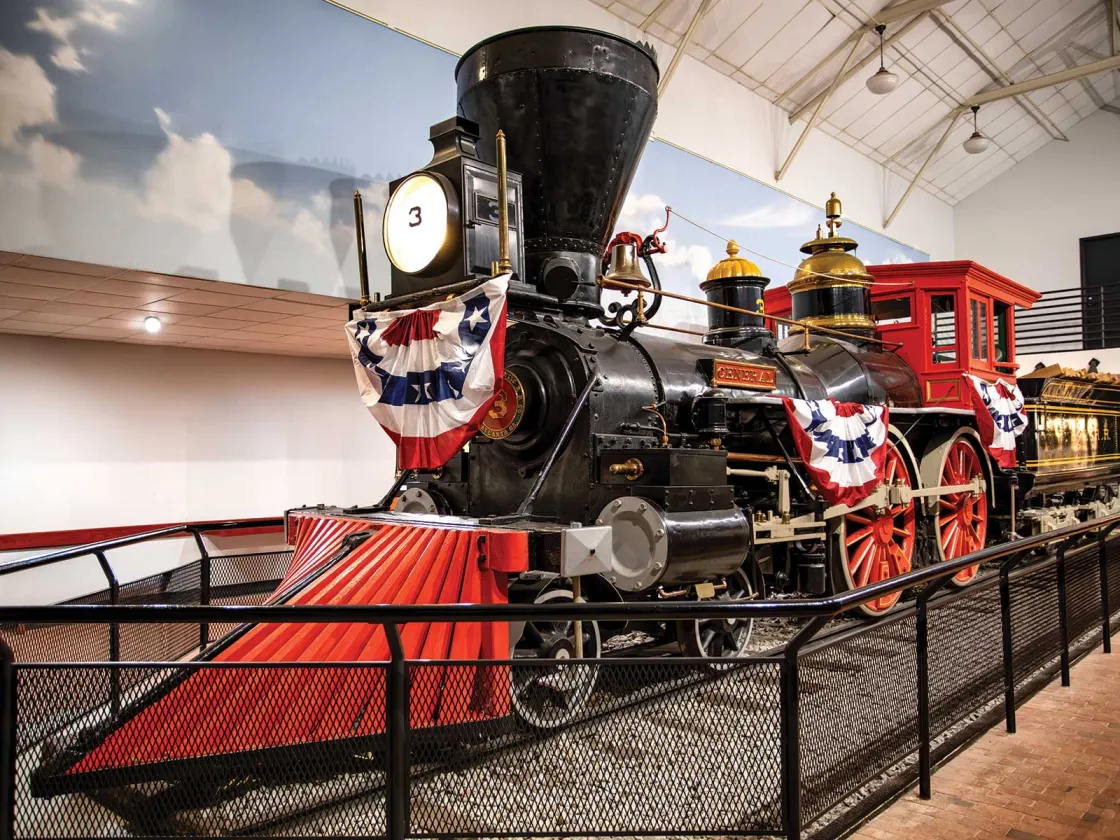
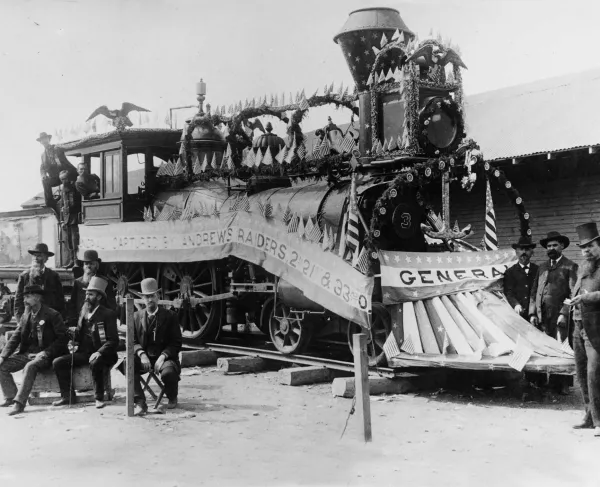
The General at The Southern Museum in Kennesaw, Ga.
Buddy SecorJames Andrews recognized the importance of railroads to the outcome of the war. He was also familiar with Union Maj. Gen. Don Carlos Buell, having worked as a civilian spy during the 1862 campaign against Fort Donaldson, Tennessee. With Buell’s approval, Andrews made his first, unsuccessful attempt to go behind enemy lines to damage a Southern railroad in March 1862. The attempt failed. He then worked under Union Brig. Gen. Ormsby Mitchel, who commanded the Third Division of Buell’s Army of the Ohio. Andrews and Mitchel believed a similar operation could work if the railroad raid was coordinated with a larger simultaneous military move.
Andrews recruited men from Mitchel’s regiments, seeking out individuals with railroading and track skills who could be daring yet calm, able to follow his direct orders. In total, 24 men joined the raiders. Five were from the Second Ohio, nine from the 21st Ohio and eight from the 33rd Ohio, plus Andrews and another civilian, William Campbell. The plan called for them to infiltrate enemy lines in small groups dressed as civilians for the purpose of capturing a Confederate locomotive on the Western and Atlantic Railroad in Georgia. They would then engineer this locomotive north toward Chattanooga, damaging bridges and severing communications along the way. Simultaneously, Mitchel’s division would move south from Nashville to capture Huntsville, Alabama. This, they hoped, would open the door to an attack by Mitchel on Chattanooga.
The raiders divided into small groups for their travel behind enemy lines to Chattanooga. If questioned, the men were to claim to be from Kentucky and looking for a similar Confederate regiment in which to enlist. While traveling, two of the men, Samuel Llewellyn and Ovid Smith, were questioned and forced to enlist in Jasper, Tennessee. Once the rest of the group made it to Chattanooga, they were to board southbound trains toward Marietta, Georgia, where they would congregate on April 10 at the Fletcher (later renamed Kennesaw) House.
This carefully sequenced timing was crucial to the plan, but the weather had other ideas.
It began raining and conditions deteriorated, making the men’s passage through the Cumberland Mountains toward Chattanooga difficult. Because of this, Andrews passed word to his party postponing the raid by one day. He incorrectly assumed that Mitchel was experiencing the same difficulties and would also be delayed. It was a fatal mistake; Mitchel proceeded on schedule.
On the morning of Saturday, April 12, at 5:15 a.m., James Andrews and his raiders, with tickets to various locations up the line, boarded a northbound train and sat together. Two members of the intended group, John Porter and Martin Hawkins, had overslept and missed the train. The plan limited most raiders’ interaction with outsiders. Andrews would do any necessary talking, representing himself as a government railway man on official Confederate business.
The train the raiders boarded was pulled by a locomotive named General that had left Atlanta at 4:00 a.m., for its run north and consisted of boxcars followed by passenger cars. Capt. William Fuller served as conductor. (Most railroad conductors were bestowed with the title of “Captain” during this time.) The train made its way north to Big Shanty (now Kennesaw) and at 6:00 a.m. stopped for 20 minutes to allow passengers and crew to depart for breakfast at the local eating house commonly referred to as the Lacy Hotel. While the others dined, Andrews and his men disengaged the passenger cars and began moving the General north.
When Andrews selected Big Shanty, he was focused on the breakfast stop and the lack of a telegraph station. He had not considered the nearby Confederate training facility at Camp McDonald, the presence of which later caused Captain Fuller and others to assume that the train had been stolen by Confederate deserters.
Wishing to avoid attracting attention, the raiders followed standard railroad rules and adhered to the regular timetable as they headed north. Besides, deviation risked coming face to face with an approaching southbound train, and such an encounter on the single track mainline could end the mission.
Although the idea was to sabotage along the way, the raiders had not brought tools with them so as not to attract suspicion. All they had were tools obtained from a naïve pole car crew they overtook at Moon’s Station, the next stop north of Big Shanty. It is believed that the pry bar the raiders came across was an all-purpose pry bar and not a track pry bar, meaning it didn’t have the v-notched end needed for lifting spikes out of ties. Instead, they may have had to try to disassemble track by prying the rail upward, which can be very difficult and slow. The wet weather also hampered any attempts to burn trestles or bridges. They did have a saw and used it to cut the telegraph lines in several locations.
Unknown to Andrews, he was being pursued.
Captain Fuller, along with his engineer Jefferson Cain and Anthony Murphy, a foreman with the Western & Atlantic Railroad, took off on foot to retrieve the train, which they expected would be abandoned by Southern deserters a few miles up the line. After coming across the pole car crew who had handed over their tools, Fuller, Cain and Murphy discovered the first missing rail. Suddenly it was clear they were not trailing deserters. Continuing north with new purpose, Fuller’s company arrived at Etowah, where the Cooper Iron Works spur connected with the Western & Atlantic mainline, and commandeered the Cooper Iron Works locomotive Yonah, speeding their progress.
Andrews hit trouble when he began running into unscheduled trains heading south. This was ironic because they bore Confederate supplies being shifted south from Chattanooga to Atlanta for safekeeping — a move spurred after Mitchel, still operating on the original timeline, captured Huntsville the previous day. For almost an hour, Andrews was held up at Kingston as three southbound trains passed before losing his patience and forcing his way out.
Only four minutes later, Fuller and the Yonah arrived at Kingston, but found the way further north blocked by the chaos caused by the General’s disorganized departure. Fortunately for Fuller, he found the William R. Smith, a standard-size locomotive from the Rome Railroad, sitting under full steam just north of Kingston and renewed his pursuit. But a rail dislodged by the raiders forced them to abandon the William R. Smith. Cain dropped out of the pursuit and stayed with the engine, but Fuller and Murphy resumed chasing the General on foot.
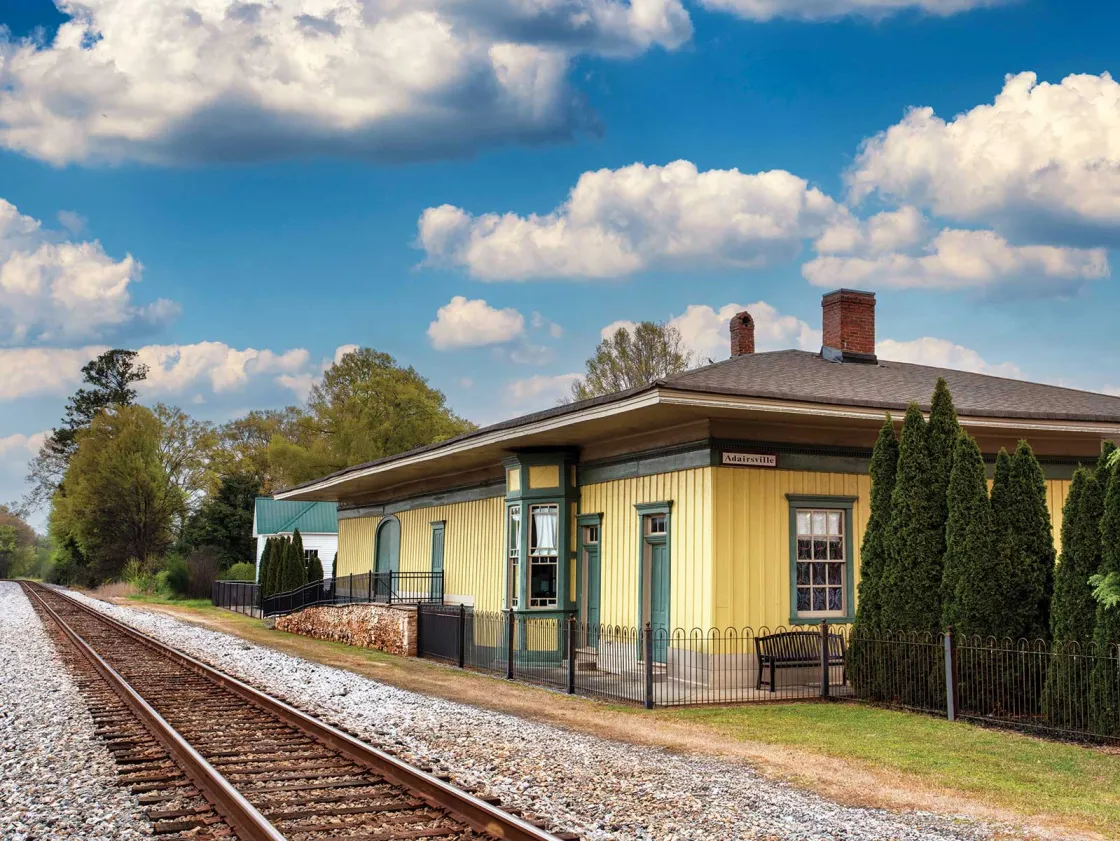
The train station in Adairsville, Ga. Adairsville is one of several towns that commemorates the chase every spring.
Buddy SecorIn Adairsville, Andrews learned of Mitchel’s attack on Huntsville. He also came to the realization that he was being pursued.
Once again frustrated by unscheduled southbound freight trains, and facing questions as to his identity and purpose, Andrews forced his way north out of Adairsville. Unfortunately for him, one of the southbound trains was pulled by the Texas, whose engineer, Pete Bracken, recognized Fuller and listened to his urgent tale. Bracken took Fuller and Murphy back to Adairsville, where they dropped the engine’s freight cars and took up pursuit of the General with the Texas in reverse. The Great Locomotive Chase was in full swing!
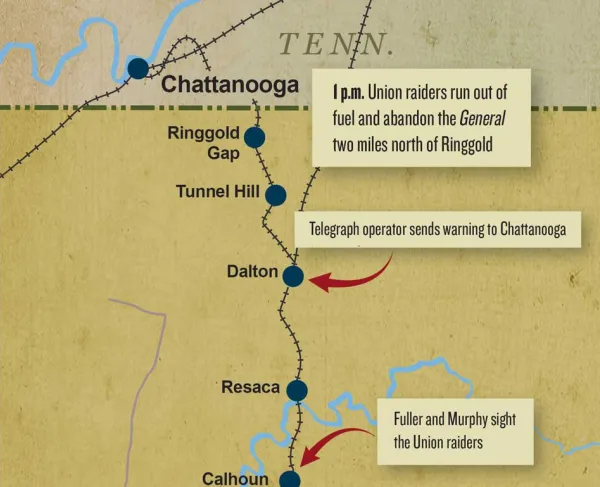
Up to this point, the chase itself was hardly high speed. Typical locomotives of the day proceeded between 10 and 20 miles per hour along the main lines of America, making numerous scheduled stops along a designated route. They were not equipped with brakes, instead rolling into stations or slamming into reverse for an emergency stop. Speed was further restricted by track conditions, turns and grades. There is no consensus on an actual top speed for the time, but it’s plausible that during this stage locomotives reached top speeds between 40 and 60 miles per hour. Meanwhile, the raiders became desperate to stop the Texas. They tried sending a boxcar backward into the other engine, a tactic that would have been more successful if they hadn’t chosen a level grade on which to do so. They also tried heaving ties and wood onto the track, while they continued cutting telegraph wires. Andrews even attempted to burn the Oostanaula Bridge south of Resaca by setting a boxcar on fire and leaving it on the span. But heavy rains had left things waterlogged, and the resulting smoldering boxcar was pushed from the bridge by the Texas. Nothing worked to stop Fuller! Surprisingly, Andrews made no attempt to disrupt the pursuit while traveling through the 1,477-foot-long Chetoogeta Mountain Tunnel. Of further detriment to Andrews, Fuller had enlisted telegraph operator Ed Henderson at the Dalton station to get a message through to Confederate Gen. Danville Leadbetter at Chattanooga: The General had been stolen by Union spies!
With Fuller and the Texas in hot pursuit, Andrews could not afford any more stops. Ultimately, the General ran out of wood and lost steam just two miles north of Ringgold at 1:30 p.m. The raiders had made it 89 miles when Andrews gave his final order: “Jump off and scatter! Every man for himself!”
With seemingly all of north Georgia aware of the operation, they didn’t get far. All the raiders were rounded up within 12 days. Andrews was tried and sentenced to death. Despite a brief escape and recapture, he was transported aboard a train pulled by the General to Atlanta, where he was hanged on June 7, 1862. In total, eight raiders were executed.
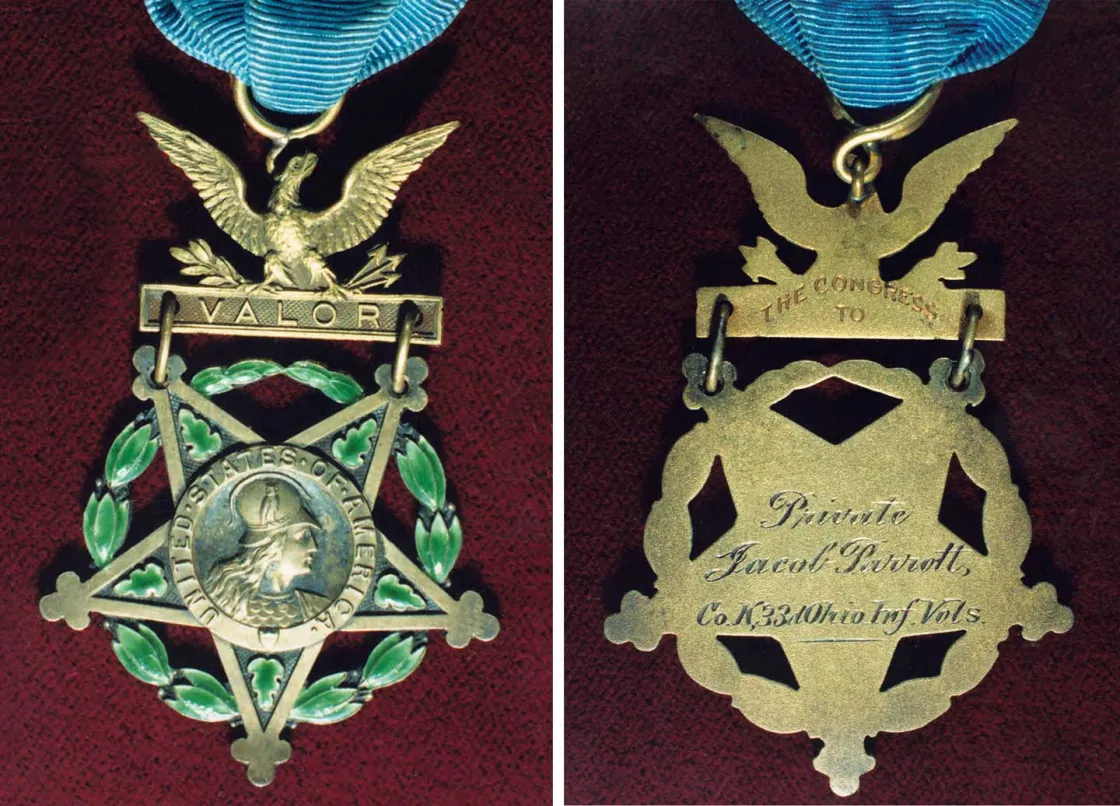
Jacob Parrott’s Medal of Honor was the very first ever awarded in 1863. After the medal was redesigned in 1904, all Recipients received this new Gillespie design, usually in the mail.
McComb Public LibraryThe United States Army awarded the first six Medals of Honor to select raiders on March 25, 1863, with Jacob Parrott being the initial recipient. In all, 21 of the 24 raiders have received the Medal of Honor. As civilians, Andrews and Campbell were ineligible, and Samuel Llewellyn had enlisted in Jasper and missed the chase. Although most of the Medals were presented during the war, two were recently awarded posthumously in 2024. Medals belonging to Wilson W. Brown and John Scott are among the raid-related items on display at the Southern Museum of Civil War and Locomotive History, along with the General locomotive itself.
Fuller was revered for his role in stopping the raid and was viewed as a Confederate hero, although according to some, he became quite possessive of how the Great Locomotive Chase story was told. Fuller continued working for various railroad lines after the war and was recognized posthumously in 1950 when the Georgia State Legislature presented a special gold medal to his son William Alford Fuller.
The Great Locomotive Chase remains just as compelling and intriguing a story today as it was more than 160 years ago. Museums and attractions from Atlanta to Chattanooga proudly retell the story and their community’s special place in it. An annual three-day festival commemorates the chase every spring. The story behind April 12, 1862, has persisted and passed into legend. In this way at least, James Andrews made a permanent mark on the history of the Civil War.