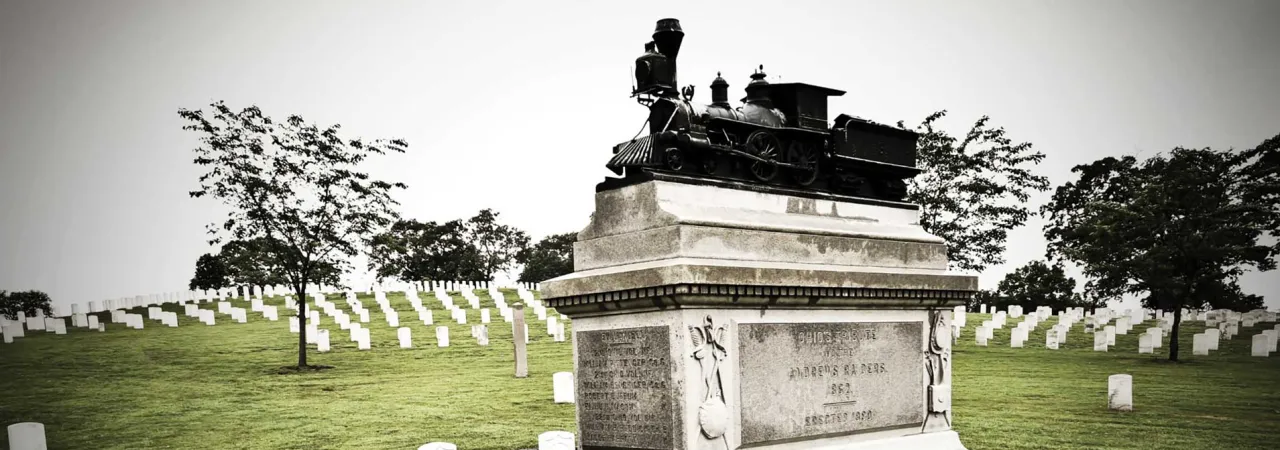
Monument to Andrews’ Raiders, Chattanooga National Cemetery, Tenn.
Covering some 120 acres and home to more than 50,000 burials, Chattanooga National Cemetery is one of the oldest and most interesting units in a now-vast network that includes 173 military cemeteries across the United States and its territories, as well as 26 permanent military cemeteries and 31 federal memorials in 17 countries beyond its borders.
On Christmas Day, 1863, Union Maj. Gen. George Thomas ordered his Army of the Cumberland to transform this formerly contested ground in view of Missionary Ridge and Lookout Mountain into a military cemetery. It took shape under the direction of Army Chaplain Thomas B. Van Horne. Much of the labor was performed by Black soldiers — including men of the 42nd and 44th United States Colored Troops (USCT) regiments, originally raised in Chattanooga — who cleared, graded and laid the stone walls establishing the grounds.
During the war and its immediate aftermath, Union burials associated with battlefields and hospital sites across southeast Tennessee and northern Alabama and Georgia were relocated to Chattanooga. By 1870, some 12,000 interments had been made, many of them unknown individuals. Unlike most other Civil War–era national cemeteries, burials have continued ever since, and, thanks to a recent expansion, will likely extend through 2045.
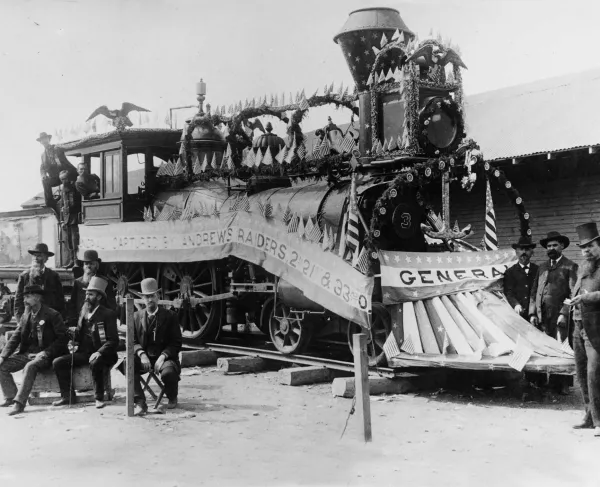
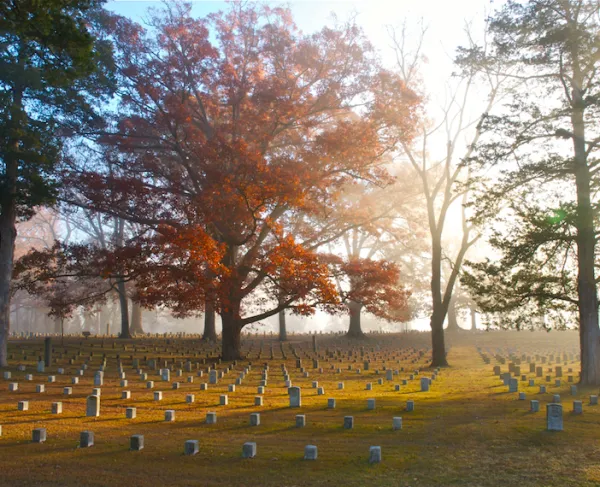
Among those buried in Section H of the cemetery are the eight Andrews’ Raiders executed as spies in June 1862: Pvt. Samuel Robertson, Sgt. Maj. Marion Ross, Sgt. John Scott, Pvt. Samuel Slavens, Pvt. Philip Shadrack and Pvt. George Wilson, and civilians James Andrews and William Campbell.
In 1890, the State of Ohio — the state from which all the soldiers involved in the raid hailed — placed a unique memorial at the center of the section, near their graves: a tiered marble base is topped with a bronze replica of the General, the locomotive they commandeered for their 200-mile exploit behind enemy lines. Sculpted by R.D. Barr and cast at the Bureau Brothers Foundry — both entities with a prolific track record of producing monuments of the era — it lists the names of those who participated in the raid by regiment, and their fate.
Chattanooga National Cemetery has a number of interesting burials besides the Raiders, such as long-lived Revolutionary War veteran S. Miller (Section B, Site 830) and German POWs from both world wars. In addition to the Raiders, there are five Medal of Honor recipients from other conflicts, including Pvt. William F. Zion, who received the Medal for action during the Boxer Rebellion in China. He was later promoted to lieutenant and placed in charge of a German POW barracks at Fort Oglethorpe, Georgia, in July 1917 during World War I, but died at the age of 46 of an accidental gunshot wound while cleaning his weapon in March 1919.
Hometown hero Charles Coolidge was the final Medal recipient during World War II. Born on Signal Mountain, he returned to Chattanooga after the war and eventually took over the family business, which celebrated its 100th anniversary in 2010. His son, Charles H. Coolidge, Jr., is a retired lieutenant general in the U.S. Air Force.
Nor is The Great Locomotive Chase the only Hollywood film whose inspiration is found in the cemetery. Cpl. Desmond Doss, a World War II combat medic, is one of only three conscientious objectors to have received the Medal of Honor. His dramatic story gained renown through the Oscar-winning 2016 film Hacksaw Ridge.