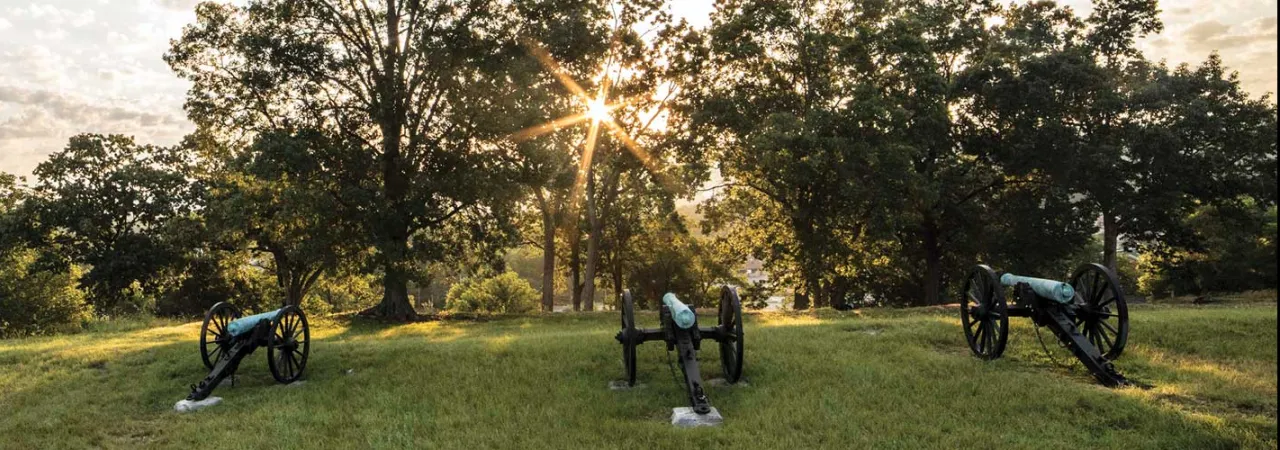
Missionary Ridge, Chickamauga and Chattanooga National Military Park, Chattanooga, Tenn.
The Battle of Chickamauga had proven disastrous for the Union army under Maj. Gen. William Rosecrans, which had pulled back to Chattanooga, Tenn, and was soon encircled by Confederate forces on the dramatic ridgelines surrounding the city that cut off its supply lines.
When word reached Union Maj. Gen. Ulysses Grant in mid-November that Rosecrans was planning to evacuate Chattanooga, surrendering the important rail hub to Bragg, Grant instead placed the “Rock of Chickamauga,” Maj. Gen. George Thomas, in command and ordered him to hold Chattanooga at all costs.
Thomas vowed to hold the town until his troops starved, a real possibility in the besieged city. In response, Grant set out to secure what has become known as the Cracker Line, a supply line that extended over wagon roads from the Union supply depot in Bridgeport, Ala. A key moment came at Brown’s Ferry on October 27, when a small Union force floated down the Tennessee River in the pre-dawn light to establish a bridgehead where a pontoon crossing could be established. The link was tenuous at first, but the sharper fight at Wauhatchie the next night solidified it; the Cracker Line could hold and feed the city. But the issue was far from resolved.

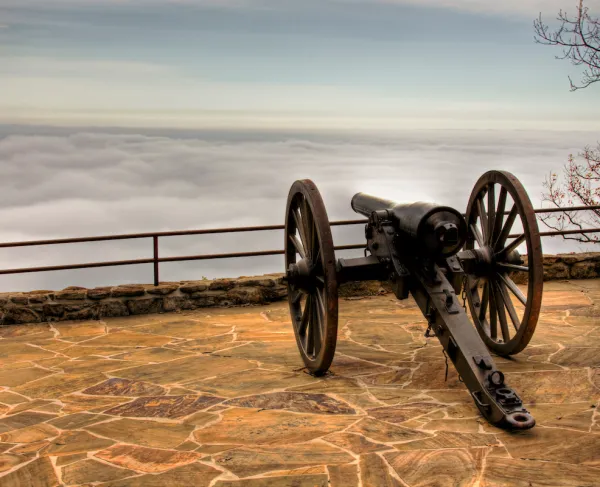
Beginning on November 23 and continuing until November 25, the two armies fought fiercely over control of the rail hub - nearly 14,000 casualties in just two days. Ultimately, Bragg’s outnumbered Southerners were forced to withdraw, first from Lookout Mountain, then from Missionary Ridge and finally from Chattanooga itself, fighting for time to shift his supplies into the safety of north Georgia at Ringgold Gap.
In total, 38 men received the Medal of Honor for actions associated with the Chattanooga Campaign – two at Wauhatchie on October 28, two at Orchard Knob on November 23, eight at Lookout Mountain on the 24th, 25 at missionary Ridge on the 25th and one at Ringgold Gap on the 27th. These are a few of their stories.
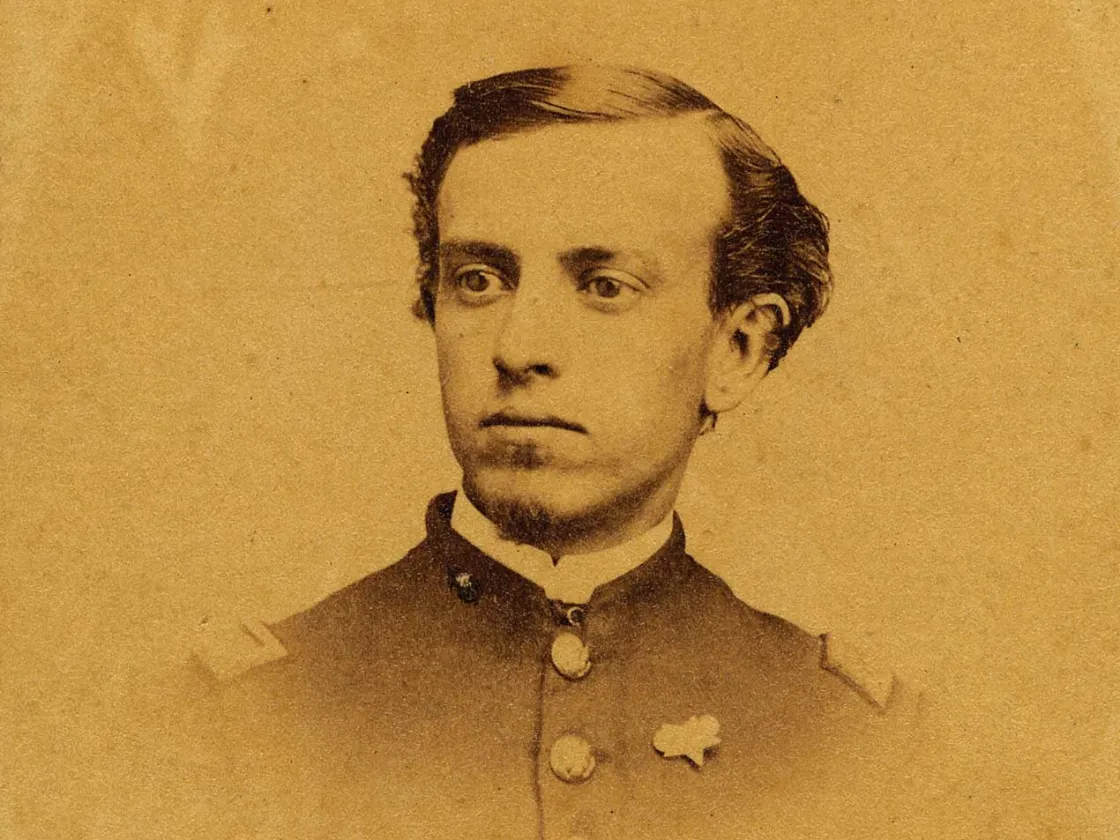
Lt. John James Toffey, 33rd New York
New Jersey State ArchivesLt. John James Toffey
33rd New York ★ From Sickbed to Hero
John James Toffey was born June 1, 1844, in Quaker Hill, Dutchess County, New York. Although he remained an Empire State resident, he crossed the Hudson River in August 1862 when he heard a regiment was being formed to enlist as a private in Company C of the 21st New Jersey Volunteer Infantry.
On June 19, 1863, he received a commission to the rank of 1st Lieutenant in Company F of the 33rd New Jersey Volunteer Infantry. In late November he was so ill that the regimental surgeons ordered him into a hospital. But sensing a major battle on the horizon, Toffey protested - going so far as to tear up the orders and rejoin the regiment.
On November 23, 1863, the anticipated fight came, and Toffey’s regiment was part of the assault against the extreme right of the Confederate line. The Southerners were well protected in a dense woodlot that could only be reached across an open field.
Companies A and I, leading the charge, immediately came under heavy fire that mortally wounded their captains, sending the disoriented units into a chaotic retreat. Col. George W. Mindil, seeing his two lead companies in such disarray, ordered Toffey to take command.
Toffey ran through the open field and, somehow, reached the advanced line, now milling about and taking cover where they could find it. Toffey reformed the line and led a charge into the woods. Pressing onward, into the teeth of live fire, they took the position, but Toffey received a serious wound that saw him discharged to the Veteran Reserve Corps in June.
While still recuperating from his wound, Toffey was at Ford’s Theater the night of April 14, 1865, where he witnessed the assassination of President Abraham Lincoln. With others from the Veteran Reserve Corps, he participated in the search for John Wilkes Booth and the rest of the conspirators, then testified at their trials. He finished the assassination saga by witnessing the executions of the guilty parties.
Following his discharge from service, he moved to his adopted state of New Jersey and raised a family, including his youngest son, who joined the Army and rose to the rank of colonel. First a sheriff in civilian life, Toffey later served as state treasurer of New Jersey, a Jersey City alderman and a member of the New Jersey state legislature. On September 10, 1897, he was awarded the Medal of Honor for actions on Missionary Ridge. Although he died on March 13, 1911, it took 93 years for this distinguished man’s headstone to finally reflect his Medal of Honor.
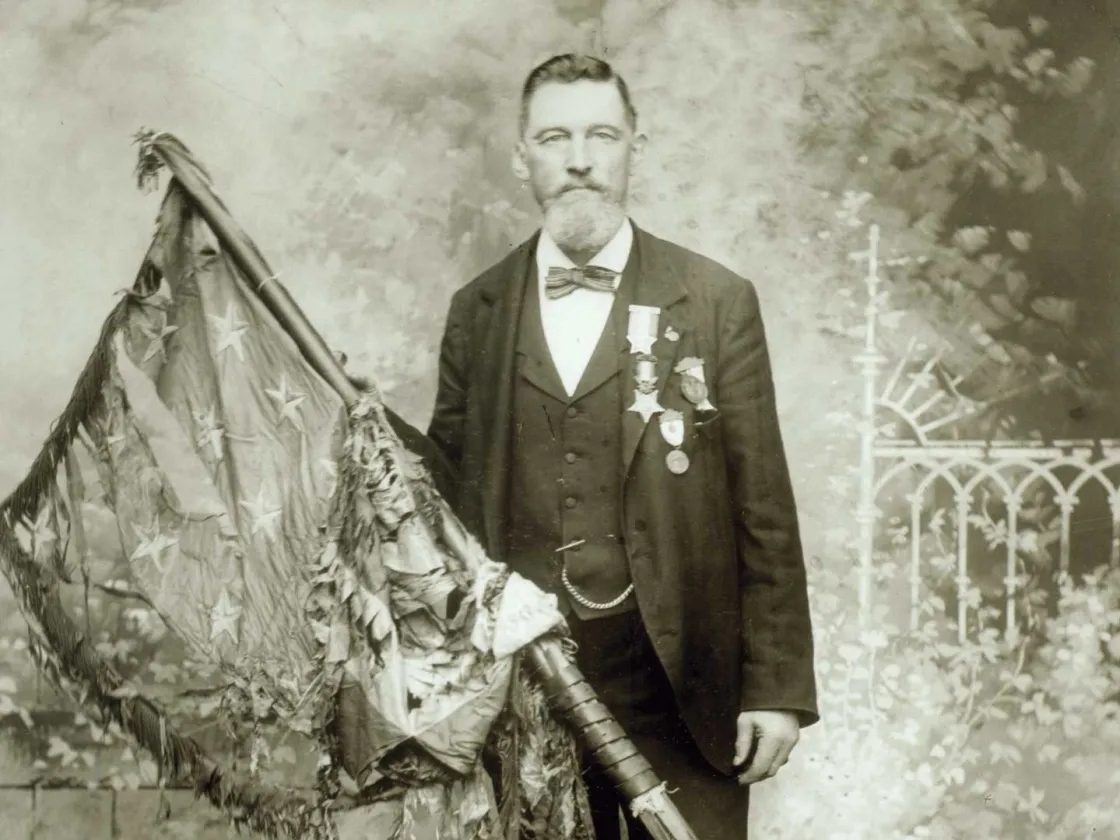
Sgt. John Kiggins, 149th New York
Onondaga Historical AssociationSgt. John Kiggins
49th New York ★ Friendly Fire Savior
John Arthur Kiggins was born in Syracuse, New York, on February 2, 1837. On September 2, 1862, he enlisted as a private into the 149th New York Infantry and assigned to Company D. He was promoted to corporal on May 10, 1863, and again to sergeant on November 1, 1863.
The regiment saw little action over the first several months of its existence, serving in expeditionary capacities before entering winter camp at Falmouth, Va. They participated in the infamous Mud March of January 1863 before finally seeing intense battle action at Chancellorsville and Gettysburg. In September, the entire XII Corps was transferred from the Army of the Potomac westward to join the Army of the Cumberland, beleaguered at Chattanooga. Arriving in Tennessee, and as part of efforts to open the city’s supply line, the regiment helped repulse the Confederate midnight attack at Wauhatchie on October 27, with Kiggins serving as flag bearer throughout that entire time.
On November 24, 1863, Kiggins and his regiment moved on the entrenched Confederate position on Lookout Mountain, charging through a thickening fog above the Craven House. The owner, a wealthy iron master and slave owner, had fled to Georgia with his family during the siege, making the unoccupied house a favorite target of the Union artillery.
With visibility impaired by both the fog and the smoke of battle, a Union battery inadvertently opened fire on the New Yorkers. As his comrades fell all around him, Kiggins rushed out between the two lines, stood on a stump, and began waving his flag frantically, hoping to gain the attention of the gunners and stop the friendly fire. But his actions also drew Confederate fire - one Rebel ball struck him in the thigh and another grazed his head before he was able to reach the safety of the Union line. Once there, he found nine bullet holes in his clothing.
Kiggins survived the Battle of Lookout Mountain, albeit with nine holes in his clothing, and went on to fight through the Atlanta Campaign, the March to the Sea and onward to Bentonville, before mustering out on June 12, 1865, near Bladensburg, Maryland.
Kiggins returned to the Syracuse area, married and raised four children. He was presented with the Medal of Honor on January 12, 1892, and proudly wore it until his death in 1914 at age 77. Two of his Medals - one original 1863 design and a 1904 Gillespie design replacement - are housed at the Onondaga Historical Association in Syracuse.
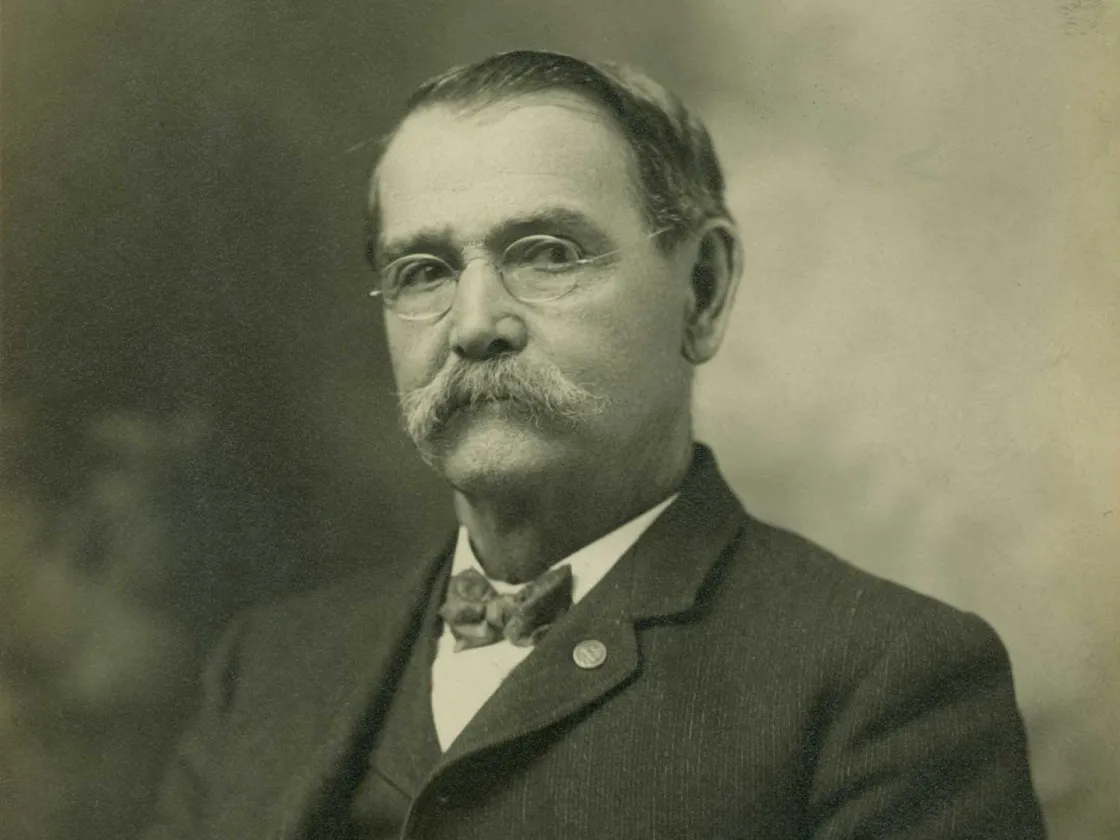
Sgt. George Lovell Banks, 15th Indiana
Kansas Historical SocietySgt. George Lovell Banks
15th Indiana ★ First Flag on the Parapet
Following the defeat of the Confederate army at Lookout Mountain on November 24, 1863, Confederate Gen. Braxton Bragg reassembled his troops on nearby Missionary Ridge. An extremely steep 330-foot rise above the city of Chattanooga, it presented a nearly impregnable position.
Predictably with such steep terrain and well-entrenched Confederate defenders, the next day’s uphill attack did not begin well for the Union army. Both its right and left flanks stymied, taking heavy losses. A frustrated Major General Ulysses S. Grant ordered Major General George H. Thomas’s Army of the Cumberland to attack the center of the Confederate line.
Sixty regiments, including the 15th Indiana advanced under heavy artillery fire from the top of the ridge. Their basic goal -- capture the rebel rifle pits at the base of the ridge – was clear, but the particulars were lost in conflicting orders. Should they hold that position? Or continue forward and advance as far as they could?
Under the cover of choking gunsmoke, the 15th Indiana was among those that advanced, unauthorized and unexpected, as it would turn out. They soon encountered heavy fire that caused the men to drop face down to the ground, made muddy by heavy rains the day before. But when Major Frank White screamed above the din, “Men, for God’s sake, forward!”, color-Sergeant George L. Banks leaped to his feet without hesitation, exhorting the men to follow him.
Banks had already suffered a relatively minor but painful wound to his left hand, and was soon struck again by in the chest by a minie ball. Stunned, fell to the ground, his already tenuous grip on the flag relaxing. Banks could not discern who picked up the flag, but saw him fall almost immediately. As Banks struggled to fully regain his senses, a total of four other men briefly carried the colors; two were killed outright, the other two wounded badly.
But Banks’s second wound was comparatively fortuitous -- bloody and painful, but not fatal, thanks to a novel and packet of letters in his coat pocket. He was winded and shaken by the impact, but he got to his feet and made his way forward, catching up with the colors just as the fourth unfortunate man fell. Banks grasped the staff before it reached the ground for the fifth time in the charge.
Approaching the ridge, the 15th Indiana dropped to the ground so that the waiting rebel guns fired a volley over their heads. Before the Confederates could reload, the Federals rose and charged the summit, with Banks leading the way. As he planted the first colors on the parapet, Banks received a third wound, this one to the head.
Banks recovered from his wounds and moved west, spending time in Michigan and Indiana before settling permanently in Kansas. He was presented with his Medal of Honor on September 28, 1897, and wore it proudly until his death in 1924.
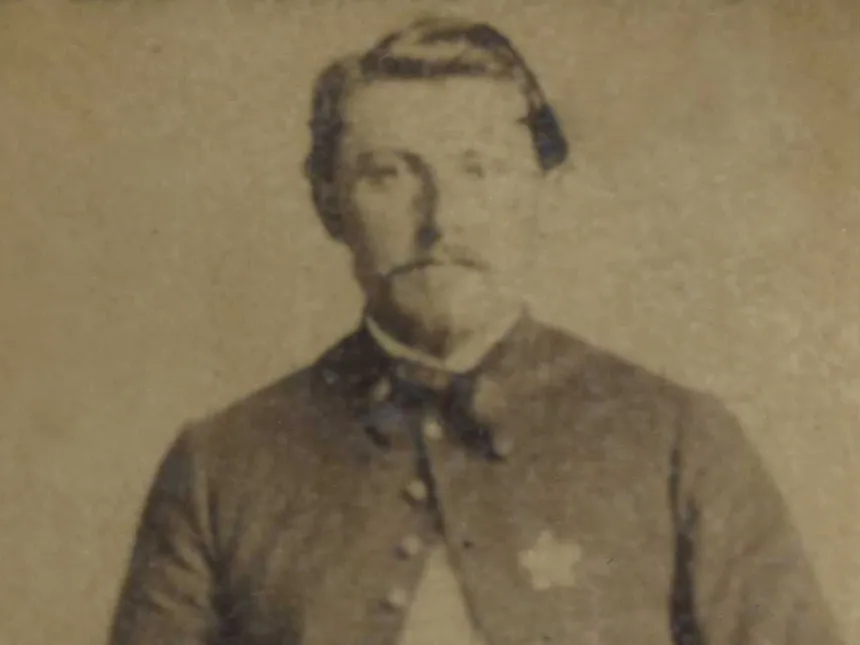
Pvt. Philip Goettel, 149th New York
Special Collections and College Archives, Gettysburg CollegePvt. Philip Goettel
149th New York ★ Capture the Flags
LITTLE IS KNOWN about the early years of Philip Goettel - the second in a family of what became 11 children - between his birth on September 2, 1840, and his enlistment in the 149th New York Infantry on September 18, 1862. He departed Syracuse for Washington, D.C., just five days later.
Like his comrade in the 149th and fellow recipient John Kiggins, Goettel participated in the Mud March and fighting at Chancellorsville, where he was wounded on May 3, 1863, causing him to miss their action at Gettysburg. But he had recuperated and rejoined his regiment in Tennessee before the fighting at Chattanooga. On November 24, he participated in the charge for which Kiggins was recognized, and moved with his unit as it redeployed following the Union Capture of Missionary Ridge the next day.
On November 27, the 149th New York met the Confederates again at Ringgold Gap, Ga., where the Western & Atlantic Railroad passed through Taylor’s Ridge. Earlier Union arrivals to the Gap were already giving way to the Confederate army when the newly arrived division was ordered to hold the line until artillery could take up position. As its brigade advanced, the 149th New York was at the fore, moving deliberately and putting a Rebel cannon out of service.
They held position until the Union artillery arrived and opened fire into the Southerners. The added firepower sent the Confederates into a fighting retreat, with the New Yorkers in pursuit. Racing toward a Confederate flag bearer, Goettel tore the flag from the startled man’s grasp before the Rebel realized he was there; he also captured a second flag and an artillery battery’s guidon.
Compared to many Civil War compatriots, Goettel received his Medal of Honor quickly, on June 28, 1865. Following the war, he returned to New York, settling in Syracuse and having three children with his wife Henrietta, before her untimely death at just 29. A second marriage produced another child, but Goettel ultimately spent 18 years a widower before being buried beside both women in Woodlawn Cemetery in 1920.
Seventy-three years later, Henry Crumb, one of Goettel’s great-grandsons, donated two versions of his medal to the Civil War Institute at Gettysburg College, of which he had been a longtime member, and ardent admirer of its mission.


Related Battles
5,824
8,000