Chancellorsville
Spotsylvania County, VA | Apr 30 - May 6, 1863
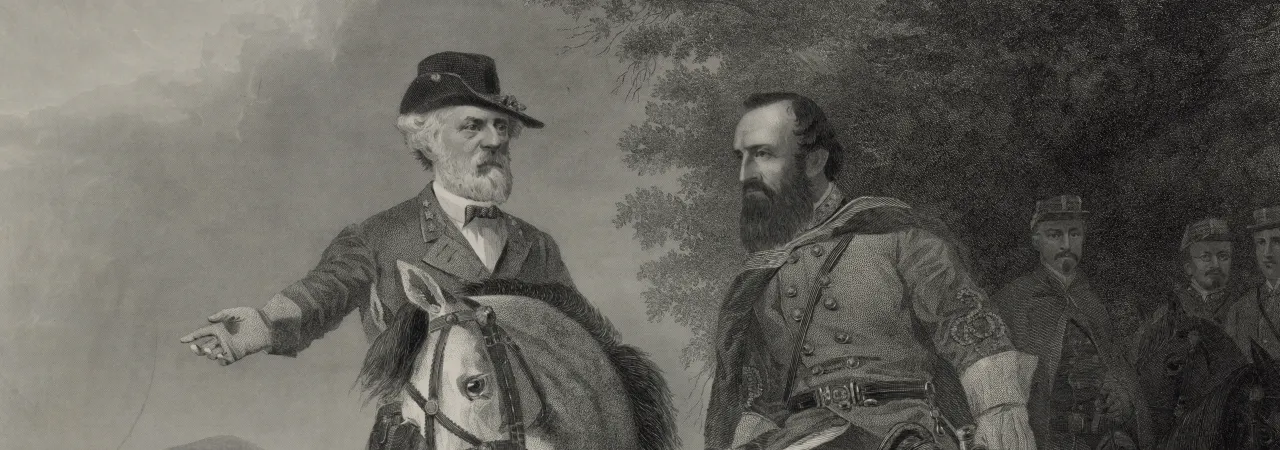
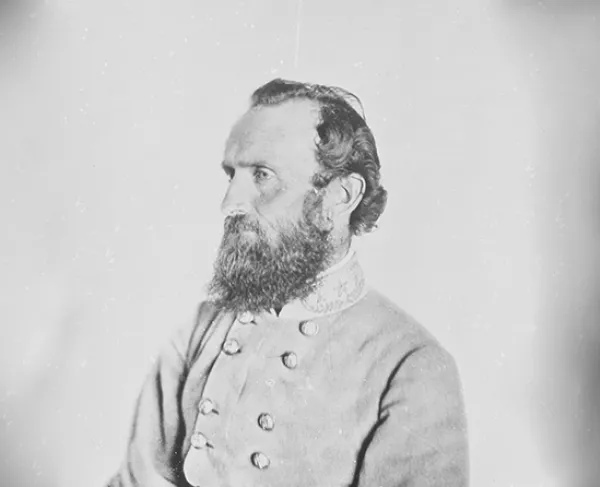
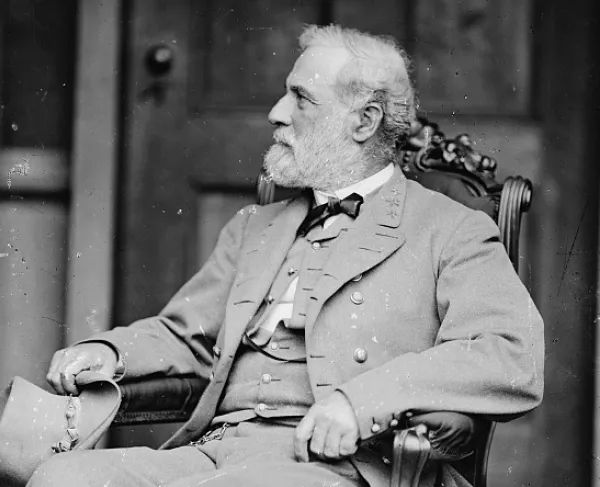
Despite the heavy casualties sustained there, the Battle of Chancellorsville is considered Gen. Robert E. Lee’s greatest military victory. It was the last battle for Confederate Lt. Gen. Thomas J. “Stonewall” Jackson, who was mortally wounded by friendly fire.
How it ended
Confederate victory. General Robert E. Lee’s audacious decision to take on Maj. Gen. Joseph Hooker’s Army of the Potomac, though he had less than half the number of men, resulted in an improbable win for the South. Hooker’s timidity in battle led to poor choices and a huge disappointment for the North.
In context
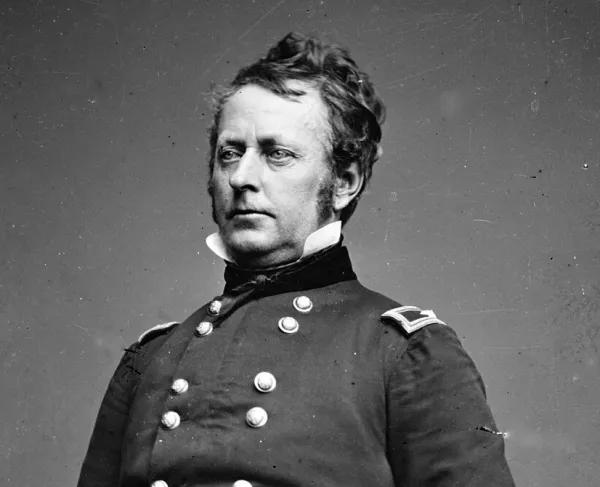
Major General Ambrose E. Burnside lasted only a single campaign as the head of the Army of the Potomac. His abject failure at Fredericksburg in December 1862, followed by further fumbling on January's "Mud March," convinced President Abraham Lincoln to make another change in army commanders. He appointed 48-year-old Massachusetts native Joseph Hooker to take charge.
Hooker's energetic make-over polished the Union army into tip-top condition, and he declared them “the finest army on the planet.” With complete confidence, Hooker orchestrated a “perfect” plan to confront Lee and drive him from his camp at Fredericksburg. Though outmanned, Lee did not retreat. He met Hooker’s challenge head on, engaging him in one of the bloodiest battles of the Civil War. Brilliant tactics by Lee and “Stonewall” Jackson thwarted Hooker’s ambitions and resulted in a victory for the South. Buoyed by the outcome, Lee later launched an offensive into Pennsylvania, where the opposing armies met on the battlefield in Gettysburg in July 1863.
Seizing the initiative, Hooker develops a plan to trap Lee’s army around Fredericksburg between two pincers of his force. The calvary will ride toward Richmond and sever Lee’s communication with the Confederate capital. The infantry will cross the Rappahannock River, get behind the Confederate defenses, and sweep east against Lee’s left flank. “My plans are perfect,” Hooker boasts, “and when I start to carry them out, may God have mercy on General Lee, for I will have none.” Part of Hooker’s confidence may be due to the fact that Lee’s valuable officer, Lt. Gen. James Longstreet, is away on a resupply mission, leaving Lee with only 60,000 troops to confront Hooker’s 130,000 men.
Hooker starts his campaign on April 27 and marches his men toward the Rappahannock. Maj. Gen. John Sedgwick’s Sixth Corp erects pontoon bridges below Fredericksburg. By April 29, the Federals are on Lee’s side of the river.
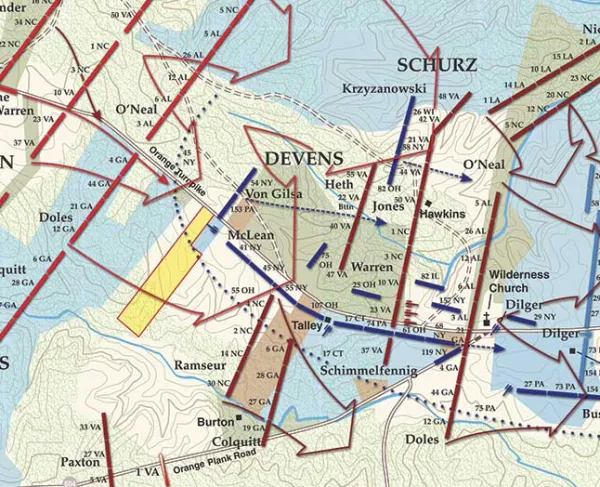
April 30. With his Fifth, Ninth and Twelfth Corps. Hooker approaches the intersection of Orange Turnpike and the Orange Plank Road, which is dominated by the Chancellorsville tavern and is located in the Wilderness — a tangled, brush-choked thicket that covers the area.
May 1. Lee hurriedly gathers his army. The general hopes to stall Hooker in the Wilderness, where the Union advantage in manpower will be negated. Lee divides his smaller army and pushes his main body west along the Orange Turnpike and the Orange Plank Road toward Hooker, leaving Maj. Gen. Jubal Early’s division to watch Sedgwick at Fredericksburg.
The two forces meet near the Zoan Church, three miles east of Chancellorsville, late that morning. On the turnpike, the Union Fifth Corps encounters Confederate Maj. Gen. Lafayette McLaws’s division and is pushed back after three hours of fighting. Elements of the Twelfth Corps are likewise stopped by Lt. Gen. Richard Anderson’s division on the Plank Road to the south. Then, inexplicably, Hooker orders his corps commanders to fall back to Chancellorsville, believing it better to have Lee to attack him there. Lee will oblige him. That evening, Lee and Jackson conceive a battle plan for the next day.
May 2. Jackson takes nearly 30,000 men off on a march that clandestinely crosses the front of the enemy army and swings around behind it. Jackson’s objective is the right flank of the Union line that rests “in the air” along the Orange Turnpike near Wilderness Tavern. That leaves Lee with only about 15,000 men to hold off Hooker's army around the Chancellorsville crossroads. He skillfully manages the formidable task by feigning attacks with a thin line of skirmishers.
At about 5:00 p.m. Jackson, having completed his circuit around the enemy, unleashes his men in a violent attack on Hooker's right and rear. His men burst out of the thickets screaming the “Rebel Yell.” They shatter the Federal Eleventh Corps and push the Northern army back more than two miles. Yet three hours later, the army suffers a nadir as low as the afternoon's zenith, when Jackson falls, mortally wounded by the fire of his own men. Maj. Gen. J.E.B. Stuart is now in temporary command. Both sides settle in for an anxious night, with pickets occasionally exchanging musket fire in the dark.
May 3. The long marches and daring tactics of the last two days give way to a slugging match in the impenetrable woods on three sides of Chancellorsville intersection. The fighting is intense and the casualties mount on both sides. Hooker abandons key ground in a further display of timidity. Confederate artillery roars from Hazel Grove, and Southern infantry doggedly pushes ahead. When a Confederate artillery round smashes into a pillar against which Hooker leans, the Federal leader is knocked unconscious for a half hour. His return to semi-sentience disappoints the veteran corps commanders who had hoped that without him they would be free to employ their army's considerable untapped might.
By mid-morning, Southern infantry smashes through the final resistance and unites in the Chancellorsville clearing. Their boisterous, well-earned, celebration does not last long. Word comes from the direction of Fredericksburg that the Northern rearguard threatens the army’s rear.
Sedgwick has crossed the Rappahannock and broken through Early’s battle line on Marye’s Heights. Pressing west to join Hooker, he meets resistance by more Confederates from McLaws’s division at Salem Church on the Plank Road, sent there by Lee who has divided his army a third time.
May 4. McLaws and Early counterattack Sedgwick and push him back across the river, halting the Union threat from the east.
May 5. Hooker holds a council of war with his corps commanders, who want to continue the fight. But the general has had enough and initiates the army’s retreat.
May 6. Hooker’s army re-crosses the Rappahannock to its north bank.
17,304
13,460
Many of Hooker’s men grow despondent after their commander’s decision to stop the fight on May 5. One soldier of the 141st Pennsylvania wonders, “…must we lose this battle? Have these brave comrades who have fought so bravely and died at their post died in vain?” Southerners, too, are baffled. Confederate cartographer Jedediah Hochkiss, who was taking measurements in the area for a map of the campaign, records in his journal on May 12, 1863, that he "had no idea the enemy were so well fortified and wonder they left their works so soon."
The Army of the Potomac trudges back across their pontoons on May 5 and by May 6 at 9:00 a.m., the last Federals reach the left bank of the Rappahannock. Union engineers pull the pontoon bridges from the river, ending the North’s campaign against Lee and the Army of Northern Virginia.
When Abraham Lincoln learned of Hooker’s retreat, he cried, "My God! My God! What will the country say? What will the country say?" Editor Horace Greeley of the New York Tribune echoed the president’s anguish: "My God!" he said, when word of the battle arrived, "it is horrible—horrible; and to think of it, 130,000 magnificent soldiers so cut to pieces by less than 60,000 half-starved ragamuffins!" On the home front, the finger-pointing began. Everyone was eager to affix blame for the debacle, but ultimately it was Joseph Hooker, all swagger and little substance, who was accountable. Although his confidence in his commander was shaken by the outcome of Chancellorsville, Lincoln kept him on. When Lee moved north into Pennsylvania in the summer of 1863, Hooker’s mission was to prevent him from reaching Washington, D.C. However, administrative disputes led him to resign just days before Gettysburg, and Maj. Gen. George Meade took over the post Hooker had held for only five months.
South of the Mason-Dixon Line spirits were high after the battle. On May 10, 1863, Catherine Ann Devereux Edmondston, a North Carolina woman, wrote in her diary: "[our relatives are] full of our Victory, which all admit to be a glorious one, throwing that of Fredericksburg in the shade." She added, "Hooker is terribly beaten & that too by a force one half his own. Off with his head & let him too take a house in N Y & join the clique of beaten Generals—'Beaten Row' or 'Vanquished Square' or 'Conquered Place' and call it as their taste may be." Confederate president Jefferson Davis thanked Lee and his army "in the name of the people . . . for this addition to the unprecedented series of great victories which your army has achieved," Lee's amazing triumph, without Longstreet’s troops and against a general who declared his troops to be the finest, reinforced the South’s faith in his command and made Southern independence seem like an attainable goal.
On the night of May 2, 1863, after his celebrated flank assault, Jackson and members of his staff rode in front of their lines to reconnoiter for a night attack without informing the troops in the area. As they travelled the Mountain Road, they were mistaken for Union cavalrymen and fired on by their own troops. The party scattered as several men were killed or wounded, including Jackson. “Cease firing!” You are firing into your own men” yelled Lt. Joseph G. Morrison, Jackson’s aide, who was also his brother-in-law. The Confederate troops, having been tricked by Federals in the past, did not believe him. “It’s a lie,” they responded, and they kept firing.
Morrison and several others tended to Jackson and helped get him to an ambulance that carried him to a field hospital. Jackson's left arm was amputated. On hearing the sad news, Lee remarked prophetically, “He has lost his left arm, but I have lost my right.” Jackson was taken to a safe place south of Fredericksburg to recover. But a week later, on May 10, Jackson died from pneumonia.
Despite their uplifting victory at Chancellorsville, Jackson’s death damaged the Confederate Army’s morale. Some historians wonder if the South might have triumphed in the Civil War had he not been killed. Though he an enemy to the North, The New York Times, couldn’t help but acknowledge his greatness as an officer, “His death is a tremendous and irreparable loss to the secession cause, as no other rebel of like character has been developed during the war. He will figure in history as one of the ablest of modern military leaders; and it will only be the brand of traitor on his brow that will consign him to infamy.”
Chancellorsville: Featured Resources



All battles of the Chancellorsville Campaign
Related Battles
97,382
57,352
17,304
13,460