Jim Bowie
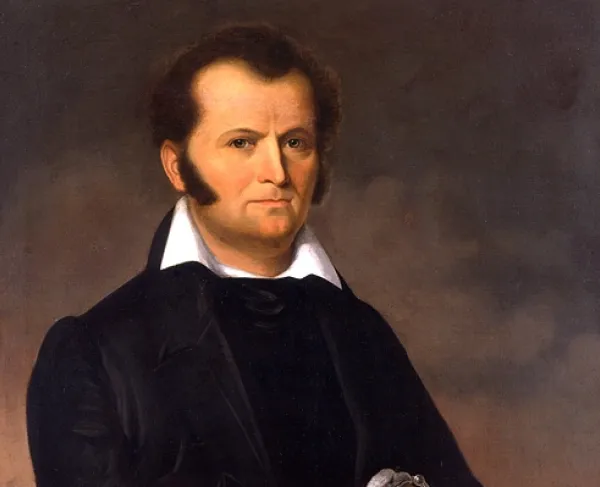
James “Jim” Bowie was a frontiersman and hero of the Alamo. While already famous during his lifetime, he became even more so as the Alamo became a rallying cry and part of American folklore.
Jim Bowie was born as the ninth of ten children on April 10, 1796, in Logan County, Kentucky. When he was just four, Bowie’s family moved across the Mississippi into Spanish Louisiana, first to modern-day Missouri before settling in Lower Louisiana. They continued moving around the Louisiana territory after its purchase by the United States, before finally settling in Opelousas in 1812. Growing up on the frontier, Bowie and his siblings learned important survival skills such as fishing, hunting, farming, and gun and knife usage. Jim and his brother Rezin also became fluent in Spanish and French.
Answering General Andrew Jackson’s call for volunteers, Jim and Rezin enlisted in the Louisiana militia in late 1814. However, they reached New Orleans too late, just missing the momentous battle, and were forced to go back home. Five years later, Jim Bowie participated in the Long Expedition, an attempt by James Long to create an independent Texan Republic. While the expedition ultimately failed, its goal would stay in Bowie’s thoughts.
With the help of his brother Rezin, James returned to Louisiana, establishing large estates in the Opelousas and Lafourche areas. The two began speculating land and smuggling enslaved Africans (despite the American ban on the slave trade since 1808) to make a profit. In 1825, the pair joined their brother Stephen in buying Acadia Plantation, establishing the first steam-powered sugar cane griding mill in Louisiana.
Bowie first rose to national prominence after the Sandbar Fight on September 19, 1827, when a simple duel turned into a full-blown brawl. Despite being shot in the hip and stabbed with a cane, Bowie managed to kill his rival, Sherriff Norris Wright, with a knife. His unlikely victory earned him a reputation as a fighter, and his unique knife became incredibly popular, seeing mass production and becoming known as the Bowie knife. After recovering from his wounds, Bowie decided to move to Texas, at the time a Mexican province. He settled in San Antonio de Bexar in 1830. Over the next few years, he became a Mexican citizen, married Maria Ursula de Veramendi, daughter of the vice governor of Coahuila y Texas province. Tragically, Ursula died of cholera in September 1833.
On August 2, 1832, Bowie joined an Anglo-Texians protest outside Nacogdoches against Mexican General Jose de las Piedras, who was demanding that all citizens disarm. The Texians fired back when Mexican troops attempted to ambush them. Piedras was forced to evacuate the city in the ensuing Battle of Nacogdoches. For his role, Bowie was appointed to be a delegate to the Convention of 1833, which requested statehood for Texas within the Mexican federation.
On October 22, 1835, two weeks after the eruption of the Texas Revolution, Austin sent out Colonel Jim Bowie to scout the area around San Antonio de Bexar for defensible positions and supplies. Finding Mission Concepcion, Bowie positioned his men and waited for the Mexicans. On the morning of October 28, Colonel Domingo Ugartechea led 300 Mexican troops into the area. Ugartechea attack while Bowie remained near the mission, and when the Mexicans stopped to reload their weapons, the Texians charged. Ugartechea withdrew, allowing Austin to lay siege to San Antonio.
Hearing of General Antonio Lopez de Santa Anna’s plan to lead a force to recapture San Antonio de Bexar, Bowie arrived at the Alamo on January 19, 1836. Major General Sam Houston gave Bowie and commander James C. Neill the option to destroy the fort, but the two refused, instead favoring holding it. On February 8, Davy Crockett arrived with more volunteers. When Neill went on furlough the following week, Bowie and William B. Travis agreed to split command between them; Bowie would direct the volunteers and Travis the regulars.
On February 23, 1836 the Mexican army arrived in San Antonio. Bowie quickly gathered his troops and supplies from around town into the Alamo and prepared for a siege. The next day, however, Bowie, overcome by illness had to relinquish his command to Travis. He was housed in the Low Barrack at the main gate and was often brought out on his cot to inspire the men.
The siege of the Alamo ended on March 6, when Mexican troops stormed the fort. Bowie perished along with the other defenders. His death at the Alamo further solidified his legacy in the early annals of the American Southwest.
Related Battles
400
189