Hubbardton | Jul 7, 1777
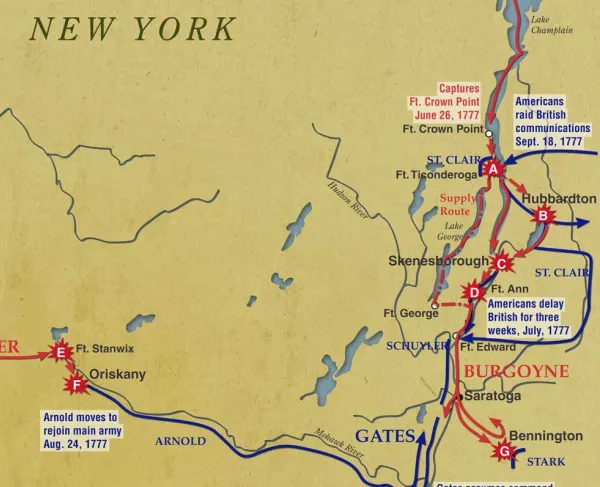
As General Sir William Howe's force geared up for its strike against the rebel capital at Philadelphia, the wheels were in motion for the second part of the Crown’s 1777 campaign. General John Burgoyne envisioned a three-pronged strike to divide New England from the rest of the rebellious American colonies. One force would move down the St. Lawrence River onto Lake Ontario and proceed down the Mohawk River Valley to draw American forces in that direction while also rallying Native American allies. Another force would move up the Hudson River from New York and threaten the American rear, while Burgoyne’s main army moved south from Canada via the Richelieu River and Lake Champlain. Coordinating three forces so widely dispersed in the 18th century was an impossible task, and the two other British forces were eventually thwarted by the rebels. Burgoyne did find initial success at Fort Ticonderoga, though, and the “Gibraltar of North America” fell into British hands with relative ease (July 2-6, 1777).
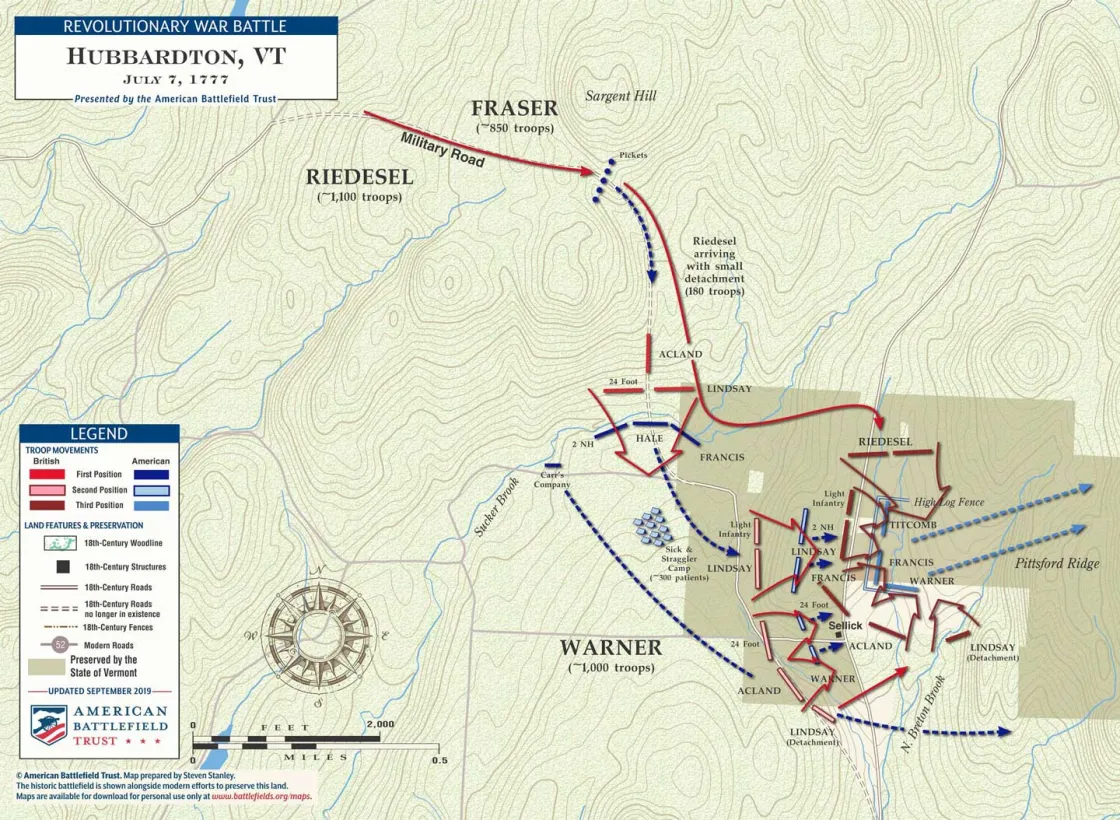
As the American forces retreated from Fort Ticonderoga toward Fort Edward, Burgoyne’s army gave chase. General Simon Fraser marched early on the morning of July 6, 1777, with a force of some 850 men. Burgoyne later dispatched a contingent of Hessians commanded by Gen. Friedrich Adolf Riedesel to follow and support Fraser. The next day, Fraser’s command made contact with the American rearguard near Hubbardton (in present-day Vermont), where cantankerous American Col. Seth Warner had assumed command. Warner, who was experienced in rearguard tactics, was a good candidate for the job, though he balked at taking orders from Continental officers, which came to haunt him and his men. Warner’s force was exhausted from the evacuation and forced march from Fort Ticonderoga. In a council of war, Warner decided to allow his men to rest, a decision counter to the orders received from Gen. Arthur St. Clair.
Fraser’s men were in hot pursuit of the rebels, and they made contact with the enemy on the morning of July 7 just as the patriots were preparing to continue their march. Initial confusion on the American side gave way to a more determined stand. Colonel Ebenezer Francis and his 11th Massachusetts shook out into a battle line, and the men of Col. Nathan Hale’s regiment supported the Bay State men as best as they could following the initial shock of battle.
Each side tried to find a weakness in their opponent’s lines. While the Americans manned strong positions behind stone walls bolstered by felled trees, the superior training of the British got the best of them. Taking a risk, Fraser dispatched a contingent of men in an assault on the American right flank. The Scotsman gambled that his slow-to-arrive Hessian support would even the odds when they did finally arrive on the field. Soon, and the combined Crown forces worked their way around the Rebel flanks. Although St. Clair tried to reinforce Warner’s force at Hubbardton, there was little he could do. The Americans broke for the rear and, amid the retreat, Francis fell dead and Nathan Hale was captured by the British.
Fraser wanted to pursue his prey, but Riedesel was not up for the challenge and fell back to Burgoyne’s main army. A few days later, Fraser did the same. Some of the rebels scattered to the wind while others rejoined St. Clair’s force at Fort Edward.
Related Battles
367
190