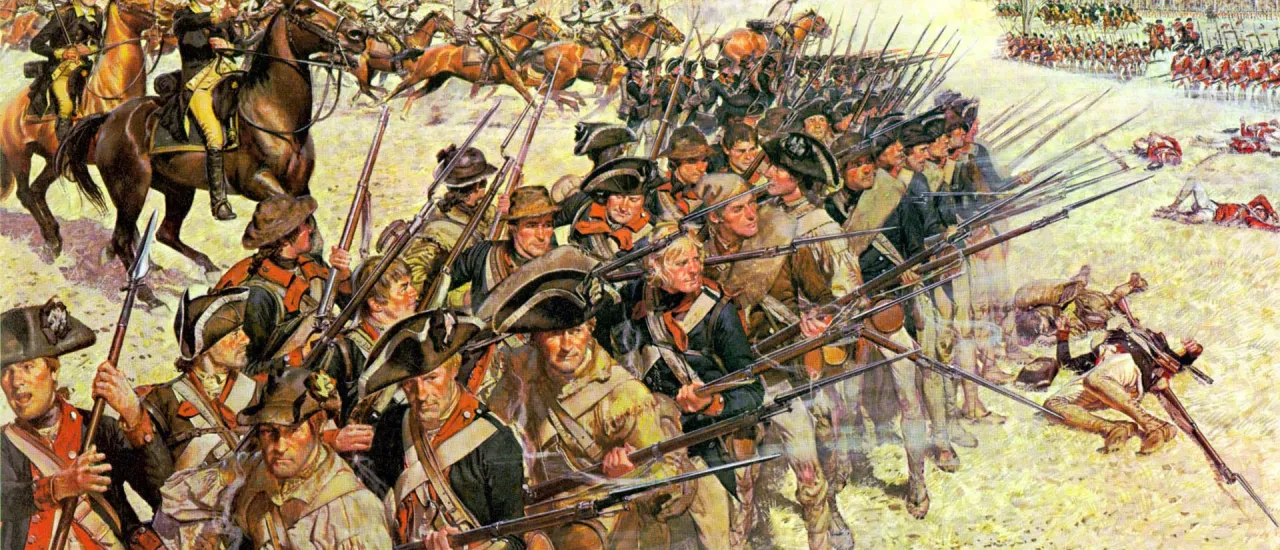
The 1st Maryland Line stands their ground at the Battle of Guilford Courthouse
Guilford Courthouse: 1781 Perspectives Lesson Plan
A lesson plan for use in middle and high school classrooms.
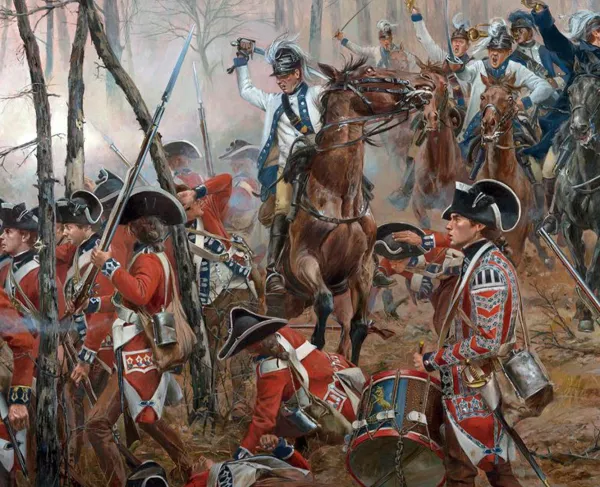
On March 15, 1781, British General Charles Lord Cornwallis’s army of 2,100 men engaged a Continental army under Major General Nathanael Greene at Guilford Court House, near present-day Greensboro, North Carolina. The resulting battle was a British victory, but they lost 25% of his men and could not pursue the Americans. A few weeks later, the Cornwallis shifted his campaign to Virginia, a decision that would contribute to the end of the war and the independence of the United States.
This Lesson Plan can be used as a prepared resource by following this curriculum plan which aligns to NCSS and Common Core Standards.
This Lesson Plan's assets can also be used on their own as supplemental resources. The display format is prepared for easy access, exploring, and learning.
North Carolina & The American Revolution Lesson Plans
Upon completion of this lesson, the students will be able to:
1. Knowledge
- Briefly explain the outcome of the Battle of Guilford Courthouse and describe what some eyewitnesses or participants experienced.
2. Comprehension/Application/Analysis
- Examine multiple primary sources to gain perspectives on the battle and its outcomes.
3. Evaluation
- Discuss findings from primary sources and how the Battle of Guilford Courthouse brought the Revolution War closer to its end and American independence.
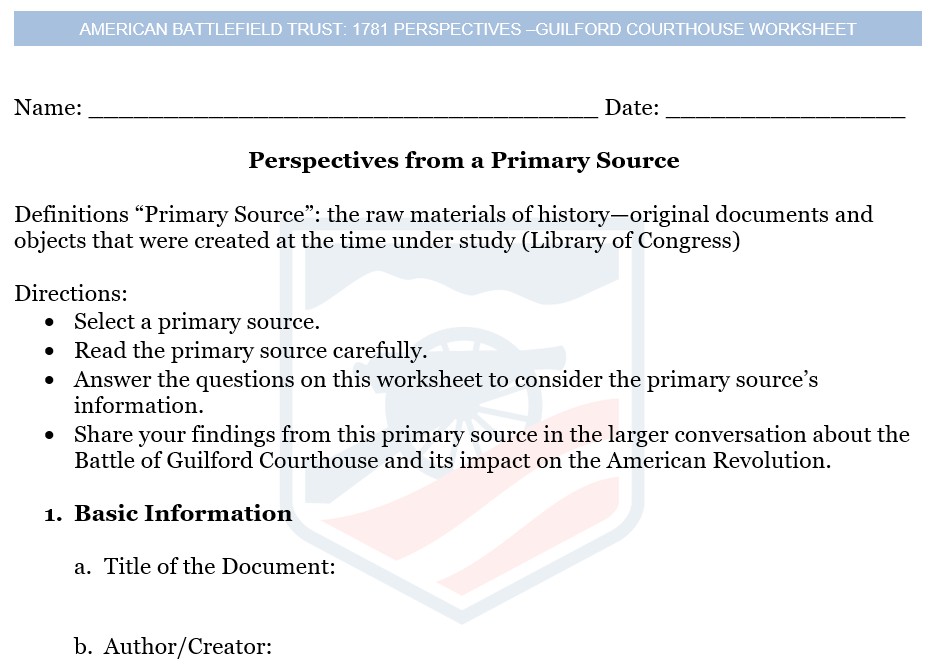

Check out the Lesson Plan Teaching Guide for more instructions on using the prepared Lesson Plan.
Lesson Plan Primary Source Activity:
- Use the Lesson’s PowerPoint to explore the context and history; the PowerPoint introduces context and foundational knowledge of the Battle of Guilford Courthouse.
- The primary sources for this perspectives lesson plan offer multiple perspectives from different people who fought or observed the battle; students can be divided into groups to read and fill out the worksheet.
| American | Guilford Courthouse: "We have blundered through” |
| American | 1781: "Marched to Guilford Court House“ |
| American | Robert Kirkwood: "With a Determination of Fighting the British Army" |
| American | Thomas Carney: "Bore His Share of Privation and Suffering" |
| British | 1781: "Cleared ground about Guilford Court-house" |
| British | 1781: "Victory Most Honorable...Of No Real Advantage to the Cause" |
- Distribute the lesson’s worksheet.
- Students will read a primary source and fill out the worksheet which will guide them through exploring the document.
- Encourage a class discussion from the worksheet, draw group conclusions, answering the questions:
- Who won the Battle of Guilford Courthouse? Depending on who wrote a particular document, what reasons were given for the outcome of the battle?
- What were some reactions to the Battle of Guilford Courthouse in these primary sources?
- What did people think would happen next after the Battle of Guilford Courthouse?
- What have you heard about the Battle of Guilford Courthouse? Do you think it should be a better-known event from the American Revolution? Why or why not?
- General Greene and the American army were defeated at Guilford Courthouse. Are there lessons we can draw from this defeat when looking at the larger historical context of the Revolutionary War?
OPTIONAL HOMEWORK/ASSESSMENT/ADDITIONAL ACTIVITIES:
Option 1: Nathanael Greene
Though he lost the Battle of Guilford Courthouse, General Nathanael Greene had the resolve to fight again, a contrast to his predecessor (General Horatio Gates) in the Southern Department. Learn more about Greene, his character and his roles in the Continental Army during the American Revolution.
- Nathanael Greene (4-minute video)
- Nathanael Greene: The Savior of the South (3-minute video)
- Nathanael Greene (biography article)
- Nathanael Greene as Quartermaster General (article)
- Human Heroes: Henry Knox and Nathanael Greene (article)
- “We fight, get beat and fight again” (primary source, May 1781)
Have students share or write a short essay about Nathanael Greene. What’s one fact from his life that is interesting? What do they like? What do they dislike? If time travel was possible, would they want to meet Greene – why or why not?
Option 2: Lesser-Known Soldiers
Explore the lives and stories of some lesser-known American soldiers present at the Battle of Guilford Courthouse.
- Peter Francisco: A Virginia Giant (video)
- Peter Francisco: The Incredible Hulk of the American Revolution (article)
- Thomas Carney (biography)
- Thomas Carney: “Bore his share of privation and suffering” (primary source)
- Robert Kirkwood (biography)
- Robert Kirkwood: “With the determination of fighting the British Army” (primary source)
Have students note these soldiers’ regiments – can they find them on the battle map? What did these soldiers specifically do during the Battle of Guilford Courthouse? What experiences were similar among the three men? What was different?
Common Core State Standards- ELA & History/Social Studies
Grades 6-8
- Key Ideas and Details:
- CCSS.ELA-LITERACY.RH.6-8.1
- Cite specific textual evidence to support analysis of primary and secondary sources.
- CCSS.ELA-LITERACY.RH.6-8.2
- Determine the central ideas or information of a primary or secondary source; provide an accurate summary of the source distinct from prior knowledge or opinions.
- CCSS.ELA-LITERACY.RH.6-8.1
- Craft and Structure:
- CCSS.ELA-LITERACY.RH.6-8.6
- Identify aspects of a text that reveal an author's point of view or purpose (e.g., loaded language, inclusion or avoidance of particular facts).
- CCSS.ELA-LITERACY.RH.6-8.6
- Integration of Knowledge and Ideas:
- CCSS.ELA-LITERACY.RH.6-8.8
- Distinguish among fact, opinion, and reasoned judgment in a text.
- CCSS.ELA-LITERACY.RH.6-8.8
Grades 9-10
- Key Ideas and Details:
- CCSS.ELA-LITERACY.RH.9-10.1
- Cite specific textual evidence to support analysis of primary and secondary sources, attending to such features as the date and origin of the information.
- CCSS.ELA-LITERACY.RH.9-10.2
- Determine the central ideas or information of a primary or secondary source; provide an accurate summary of how key events or ideas develop over the course of the text.
- CCSS.ELA-LITERACY.RH.9-10.3
- Analyze in detail a series of events described in a text; determine whether earlier events caused later ones or simply preceded them.
- CCSS.ELA-LITERACY.RH.9-10.1
- Craft and Structure:
- CCSS.ELA-LITERACY.RH.9-10.5
- Analyze how a text uses structure to emphasize key points or advance an explanation or analysis.
- CCSS.ELA-LITERACY.RH.9-10.6
- Compare the point of view of two or more authors for how they treat the same or similar topics, including which details they include and emphasize in their respective accounts.
- CCSS.ELA-LITERACY.RH.9-10.5
- Integration of Knowledge and Ideas:
- CCSS.ELA-LITERACY.RH.9-10.8
- Assess the extent to which the reasoning and evidence in a text support the author's claims.
- CCSS.ELA-LITERACY.RH.9-10.9
- Compare and contrast treatments of the same topic in several primary and secondary sources.
- CCSS.ELA-LITERACY.RH.9-10.8
Grades 11-12
- Key Ideas and Details:
- CCSS.ELA-LITERACY.RH.11-12.1
- Cite specific textual evidence to support analysis of primary and secondary sources, connecting insights gained from specific details to an understanding of the text as a whole.
- CCSS.ELA-LITERACY.RH.11-12.2
- Determine the central ideas or information of a primary or secondary source; provide an accurate summary that makes clear the relationships among the key details and ideas.
- CCSS.ELA-LITERACY.RH.11-12.3
- Evaluate various explanations for actions or events and determine which explanation best accords with textual evidence, acknowledging where the text leaves matters uncertain.
Craft and Structure:
- Evaluate various explanations for actions or events and determine which explanation best accords with textual evidence, acknowledging where the text leaves matters uncertain.
- CCSS.ELA-LITERACY.RH.11-12.6
- Evaluate authors' differing points of view on the same historical event or issue by assessing the authors' claims, reasoning, and evidence.
- CCSS.ELA-LITERACY.RH.11-12.1
- Integration of Knowledge and Ideas:
- CCSS.ELA-LITERACY.RH.11-12.8
- Evaluate an author's premises, claims, and evidence by corroborating or challenging them with other information.
- CCSS.ELA-LITERACY.RH.11-12.9
- Integrate information from diverse sources, both primary and secondary, into a coherent understanding of an idea or event, noting discrepancies among sources.
- CCSS.ELA-LITERACY.RH.11-12.8
Social Studies - National Council for the Social Studies
- Theme 2: Time, Continuity, and Change
- Theme 3: People, Places, and Environments
- Theme 5: Individuals, Groups, and Institutions
- Theme 6: Power, Authority, and Governance
This Lesson plan
contains the following:
3 Activities | 27 Resources
Audience: Middle school | High school