Valley Forge | Dec 19, 1777 - June 19, 1778
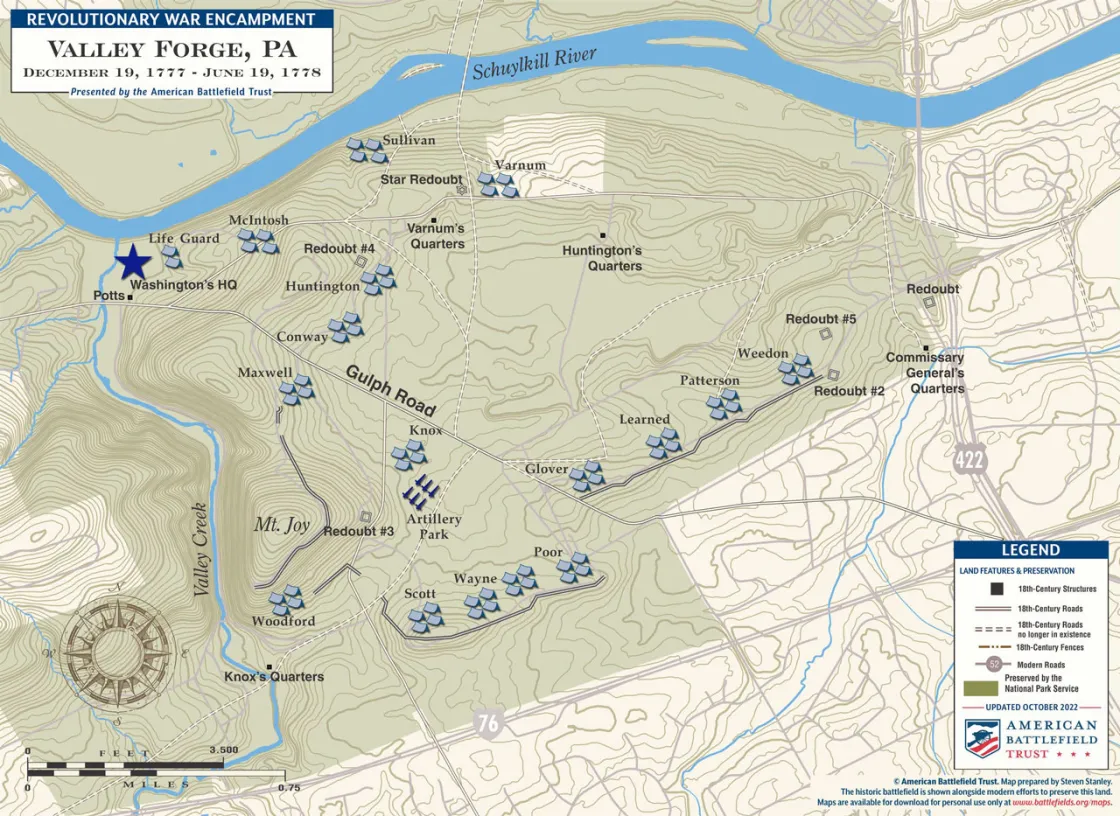
On December 19, 1777, Gen. George Washington's beleaguered army trudges along Gulph Road and entered its winter encampment. The rolling hills and fields tucked between Valley Creek and the Schuylkill River played host to perhaps the most iconic event of the Revolutionary War – the encampment at Valley Forge.
Although short, Washington’s campaigning season in 1777 was an utter disaster. Defeat at Brandywine. A massacre at Paoli. The loss of Philadelphia. Opportunity squandered at Germantown. The cause of liberty stood on a knife’s edge in the winter of 1777-1778. If not for Horatio Gates’ victory at Saratoga and the tepid pursuit by Howe’s forces after the fall of Philadelphia, the rebellion would have been all but snuffed out.
Washington looked to regroup, refit, and resupply his army. To do so, while keeping a watchful eye on the British occupying force in and around Philadelphia, the army established its winter encampment some twenty miles west of Philadelphia.
The soldiers immediately set to work on huts for living quarters, fortifications, and other infrastructure. The encampment grew to number more than 2,000 structures and nearly 13,000 people and could be considered the fourth-largest “city” in the colonies.
A myth has grown around the “harsh” winter of 1777-1778. Images of the snow-covered fields and huts buried in snow are far from reality. While snow fell on the encampment, they received less than 10 days of appreciable snowfall during the “Valley Forge Winter.” Mud and cold temperatures were far more prevalent than the imagined constant blizzard conditions.
Conditions were harsh on the soldiers. Many lacked proper clothing and food. Washington appointed his trusted subordinate, Nathaniel Greene, to head the Quartermaster Department. Greene chaffed at the thankless job but performed miracles in securing supplies.
On February 23, 1778, a flamboyant former Prussian officer arrived in camp, Baron Friedrich von Steuben. Washington tasked the Baron with training the American soldiers in the European way of war. Steuben drilled the men and instilled a new discipline and will within the Continental Army.
Meantime, Washington battled with Congress, other generals, and the Conway Cabal, as he did all he could to keep the army together, while retaining his command.
On June 19, 1778, the Continental Army marched out of Valley Forge. It was now a well organized and more professional army. Valley Forge marked a turning point—proof that the American cause could survive extreme adversity and emerge stronger. The winter there became a powerful reminder that independence would require sacrifice, endurance, and unity.