Rhode Island | Aug 29, 1778
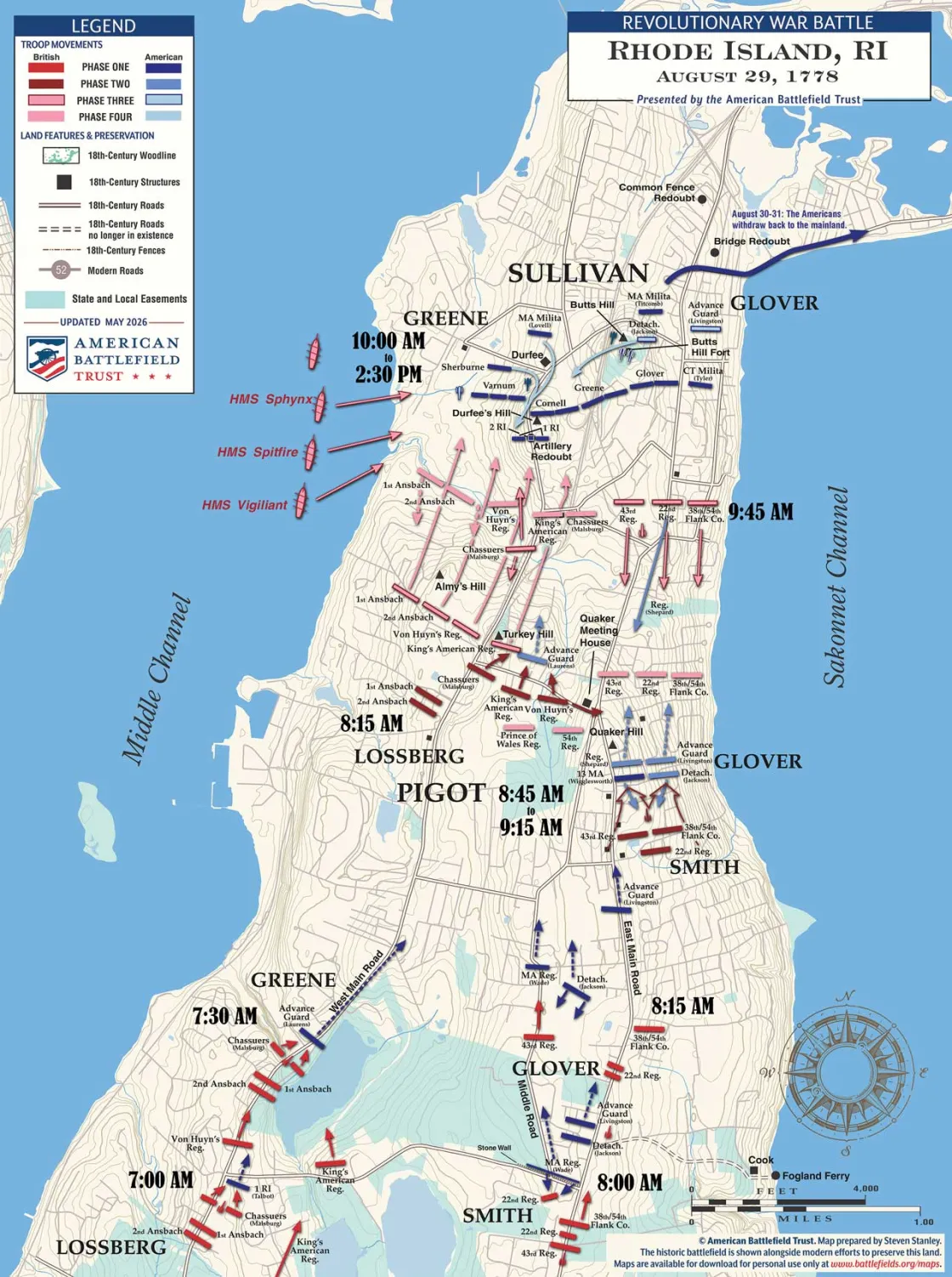
In the late summer of 1778, amid the rolling fields and stone-walled farms of Aquidneck Island, American and British forces met in a contest shaped as much by weather and alliance as by musket fire. The Battle of Rhode Island—also known as the Battle of Quaker Hill—was the first major joint operation between American troops and their new French allies. The engagement marked an important turning point in the war’s international dimension.
In 1776, British forces seized Newport, securing the valuable harbor in Narragansett Bay. From this stronghold, they threatened New England commerce and maintained a strategic foothold in the North. By 1778, however, the war had changed. Following the Patriot victory at Saratoga, France entered the conflict on the American side. A French fleet under Admiral Jean Baptiste Charles Henri Hector d’Estaing sailed to American waters, intent on striking a blow against British power.
Sensing an opportunity, Washington ordered Gen. John Sullivan to raise 5,000 troops and take Newport. Reinforcements were on the way in the form of Continental Army troops led by the Marquis de Lafayette. This news bolstered American morale, and militia units from across New England began pouring in.
Sensing an opportunity, Sullivan called for a council of war, including Comte d’Estaing. Sullivan suggested that American forces attack from the east while French forces attacked from the west in an effort to isolate British forces located on Butt’s Hill on the northern end of the island.
British General Sir Robert Pigot quickly figured out the Allied plans. He consolidated all the British forces on Aquidneck Island into Newport, secured the island’s livestock, leveled orchards in front of the city so that the British could have a clear field of fire, and ordered all carriers and wagons destroyed.
D’Estaing’s fleet sailed into Newport Harbor on August 8, disembarking French troops the next day. Sullivan impulsively captured Butt’s Hill.
Meanwhile, British Admiral Sir Richard Howe’s fleet arrived from New York to challenge the French Navy. A raging Atlantic storm on August 10 and 11 severely damaged both fleets. Before the storm, d’Estaing ordered the French infantry to reboard the ships and informed Sullivan he was sailing to Boston for repairs.
In the interim, the British reinforced Newport with an additional 4,000 men. Sullivan abandoned the siege on August 28. Pigot’s forces followed closely on Sullivan’s heels and ordered two columns to pursue the Americans while avoiding a general engagement; however, the fog of war intervened, and a major battle erupted.
The Americans fought stubbornly, giving up little and holding their defensive lines and the high ground. Fighting on the American left finally subsided when the British decided the American position was too strong.
Continental forces withdrew on the night of August 30, leaving Newport in British hands. The inconclusive Battle of Newport nearly doomed the new Franco-American alliance.
Related Battles
181
260