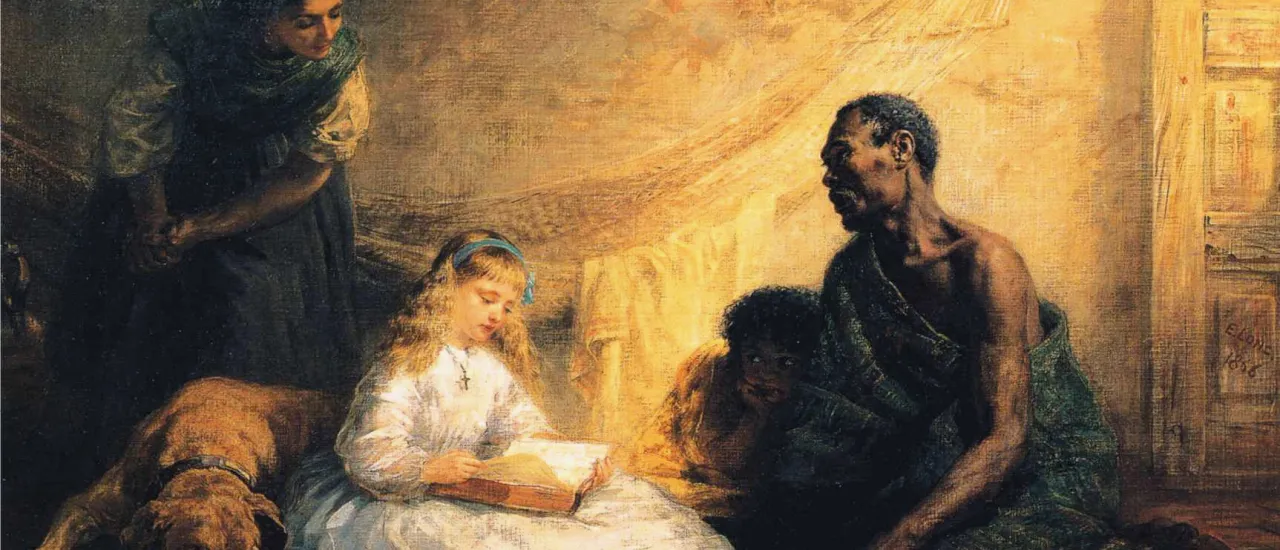
"Uncle Tom and Little Eva" by Edwin Long
Uncle Tom's Cabin: Pre-Civil War Literature Lesson Plan
A lesson plan for use in middle and high school classrooms.
In 1852, Harriet Beecher Stowe published Uncle Tom’s Cabin; or, Life Among the Lowly in book form. The passage of the 1850 Fugitive Slave Act inspired Stowe to write a novel to persuade Americans against the evils of the institution of slavery. She drew from numerous sources for inspiration, often giving voice to lesser-known accounts from self-emancipated people. The book made many abolitionists and created social inspiration and reaction that pushed the nation closure to Civil War; however, harmful stereotypes proliferated by the work have marred its legacy today.
This Lesson Plan can be used as a prepared resource by following this curriculum plan which aligns to NCSS and Common Core Standards.
This Lesson Plan's assets can also be used on their own as supplemental resources. The display format is prepared for easy access, exploring, and learning.
Civil War Literature Module
Upon completion of this lesson, the students will be able to:
- Knowledge
- Students will be able to understand the role that Uncle Tom’s Cabin and anti-slavery legislation played in antebellum society’s opinion on the institution of slavery.
- Students will also be able to understand the change over time of how impactful the institution of slavery was in contributing to the outbreak of the Civil War.
- Comprehension/Application/Analysis
- Read a summary of Uncle Tom’s Cabin and read an excerpt from the novel; then answer inquiry questions to explore the factual and emotional appeals within the original book.
- Evaluation
- Discuss observations from and about the historic novel and evaluate as a class the book’s impact.
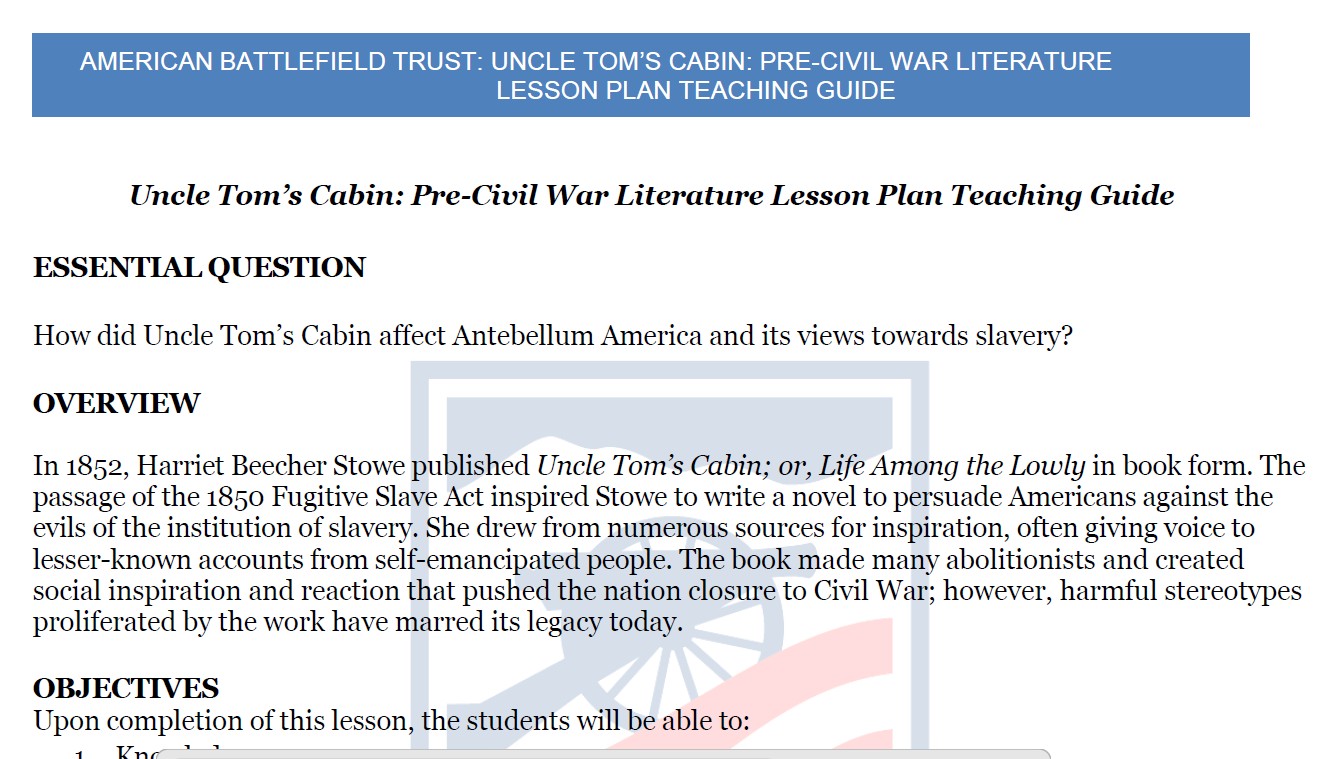
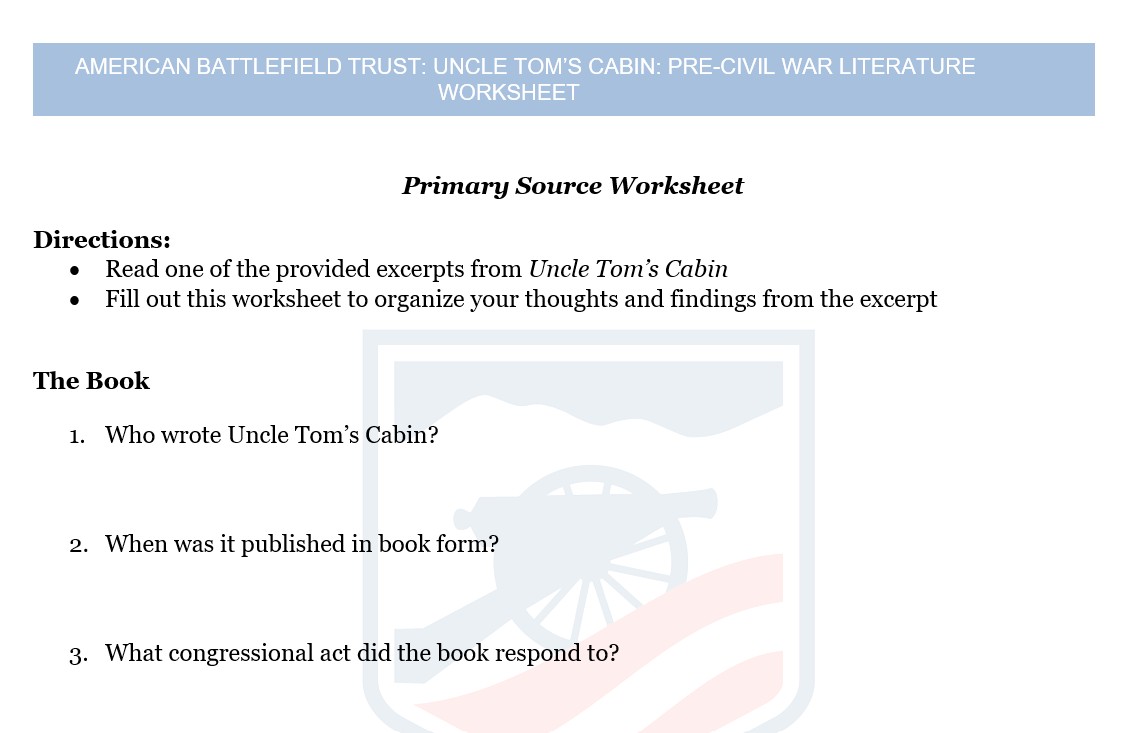
Check out the Lesson Plan Teaching Guide for more instructions on using the prepared Lesson Plan.
Lesson Plan Activity:
- Use the Lesson Plan’s PowerPoint to explore the context and history.
- As a class or in groups read this article Uncle Tom’s Cabin for the story plot and context (paragraph three especially)
- As a class or in groups, read one of the excerpts from Uncle Tom’s Cabin.
- Distribute the primary source worksheet and have students fill out their answers. (Or use the questions for verbal discussion.)
- Encourage a class discussion about Uncle Tom’s Cabin and literature.
- Does this writing influence people?
- What other examples of books or writings can you think of that have shaped society?
- Though Uncle Tom’s Cabin uses language and ethnic dialogue that was acceptable in the 19th Century, some of it is considered stereotypical or racist today. Does this affect the message of the book? Does it impact how we view the book and its historical effects?
Have you heard the phrase “the pen is mightier than the sword”? Do you think that is true with Stowe’s book and other anti-slavery writings?
OPTIONAL HOMEWORK/ASSESSMENT/ADDITIONAL ACTIVITIES:
Option 1: Responding to the Fugitive Slave Act
Read the Fugitive Slave Act, and then read this following excerpt from the last chapter of Uncle Tom’s Cabin. Use the questions for a writing or verbal discussion with your students.
"For many years of her life, the author avoided all reading upon or allusion to the subject of slavery, considering it as too painful to be inquired into, and one which advancing light and civilization would certainly live down. But, since the legislative act of 1850, when she heard, with perfect surprise and consternation, Christian and humane people actually recommending the remanding escaped fugitives into slavery, as a duty binding on good citizens,--when she heard, on all hands, from kind, compassionate and estimable people, in the free states of the North, deliberations and discussions as to what Christian duty could be on this head,--she could only think, These men and Christians cannot know what slavery is; if they did, such a question could never be open for discussion. And from this arose a desire to exhibit it in a living dramatic reality."
Questions:
1. Why does Stowe say she wrote the book? What was she trying to accomplish?
2. How does this statement relate to the Fugitive Slave Act?
3. What does she mean by ‘Christian and humane people’?
4. Why might ‘Christian and humane people’ argue for the capture of people who were enslaved?
5. Why would citizens in non-slave holding states be upset with the Fugitive Slave Act?
6. How could the Fugitive Slave Act and Stowe’s authorship of this narrative put more strain on the country?
Option 2: Abolition Supporters/Anti-Slavery Advocates
Students will conduct research on an individual in American history, finding four sources and then listing information about the historical figure and their ideas. Students will then compare individuals and their ideas.
- Have your students define what abolition is, for example Merriam-Webster defines abolition as, “the act of officially ending or stopping something: the act of abolishing something: the act of officially ending slavery.”
- From that definition, students should conduct research to find antebellum era or earlier American abolitionists who wanted to end the institution of slavery.
- Have your students look for at least two primary sources related to the individual and at least two secondary sources related to the individual.
- Some examples of abolitionists in American history are:
- John Quincy Adams
- Susan B. Anthony
- John Brown
- Levi Coffin
- Frederick Douglass
- William Lloyd Garrison
- Josiah Henson
- Thomas Wentworth Higginson
- Abraham Lincoln
- Lucretia Mott
- William Seward
- Lysander Spooner
- Thaddeus Stevens
- Sojourner Truth
- Harriet Tubman
- Nat Turner
- Students will create a resume detailing their accomplishments, ideas on the institution of slavery, and the main arguments that they used to persuade others to abolish the institution of slavery in America. Use this example of Harriet Beecher Stowe as an example to show the class. (view in the teaching guide under the Classroom Materials Tab above)
Common Core State Standards- ELA & History/Social Studies
Grades 6-8
- Key Ideas and Details:
- CCSS.ELA-LITERACY.RH.6-8.2
- Determine the central ideas or information of a primary or secondary source; provide an accurate summary of the source distinct from prior knowledge or opinions.
- CCSS.ELA-LITERACY.RH.6-8.2
- Craft and Structure:
- CCSS.ELA-LITERACY.RH.6-8.5
- Describe how a text presents information (e.g., sequentially, comparatively, causally).
- CCSS.ELA-LITERACY.RH.6-8.6
- Identify aspects of a text that reveal an author's point of view or purpose (e.g., loaded language, inclusion or avoidance of particular facts).
- CCSS.ELA-LITERACY.RH.6-8.5
Grades 9-10
- Key Ideas and Details:
- CCSS.ELA-LITERACY.RH.9-10.1
- Cite specific textual evidence to support analysis of primary and secondary sources, attending to such features as the date and origin of the information.
- CCSS.ELA-LITERACY.RH.9-10.2
- Determine the central ideas or information of a primary or secondary source; provide an accurate summary of how key events or ideas develop over the course of the text.
- CCSS.ELA-LITERACY.RH.9-10.1
Grades 11-12
- Key Ideas and Details:
- CCSS.ELA-LITERACY.RH.11-12.2
- Determine the central ideas or information of a primary or secondary source; provide an accurate summary that makes clear the relationships among the key details and ideas.
- CCSS.ELA-LITERACY.RH.11-12.3
- Evaluate various explanations for actions or events and determine which explanation best accords with textual evidence, acknowledging where the text leaves matters uncertain.
- CCSS.ELA-LITERACY.RH.11-12.2
- Craft and Structure:
- CCSS.ELA-LITERACY.RH.11-12.5
- Analyze in detail how a complex primary source is structured, including how key sentences, paragraphs, and larger portions of the text contribute to the whole.
- CCSS.ELA-LITERACY.RH.11-12.5
- Integration of Knowledge and Ideas:
- CCSS.ELA-LITERACY.RH.11-12.8
- Evaluate an author's premises, claims, and evidence by corroborating or challenging them with other information.
- CCSS.ELA-LITERACY.RH.11-12.8
Social Studies - National Council for the Social Studies
- Theme 1: Culture
- Theme 2: Time, Continuity, and Change
- Theme 3: People, Places, and Environments
- Theme 4: Individual Development and Identity
This Lesson plan
contains the following:
3 Activities | 21 Resources
Audience: Middle school | High school