Josiah Henson
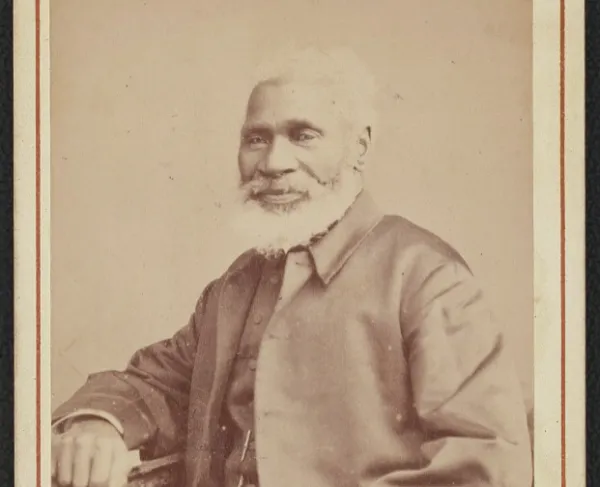
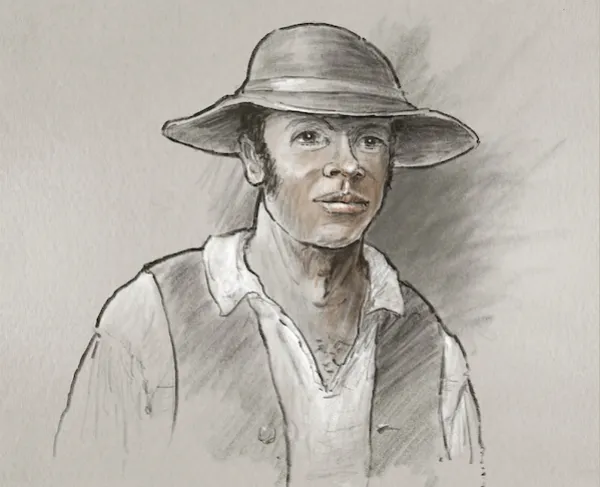
An enslaved man who escaped to freedom, wrote his story, and later became a conductor on the Underground Railroad, Josiah Henson claimed that some of his life experiences informed and inspired incidents in the anti-slavery novel, Uncle Tom’s Cabin.
Born on June 15, 1789, at La Grange in southern Maryland near Port Tobacco, Henson grew up in slavery. He was the youngest of six children. His father was separated from the family and sold to Alabama, leaving Henson’s mother to raise the children on her own. She exemplified and taught Henson about her religious faith, something he would remember for his entire life. The death of their enslaver resulted in the next break in the family and the sale of Henson’s siblings. Over his mother’s desperate pleadings, Henson was nearly sold at age five or six. Eventually, he stayed with his mother, though their new enslaver was described as coarse, vulgar and licentious. Later, in his autobiography, Henson wrote about his youth:
“My earliest employments were, to carry buckets of water to the men at work, to hold a horse-plough, used for weeding between the rows of corn, and as I grew older and taller, to take care of master’s saddle-horse. Then a hoe was put into my hands, and I was soon required to do the day’s work of a man; and it was not long before I could do it, at least as well as my associates in misery.”
In his late teens, Henson met a minister “noted for his detestation of slavery” who led Henson to a religious conversion described as a deliverance and awakening of his soul. Despite his new religious hope, Henson faced abuse from an overseer who beat him so badly that bones broke and Henson could not raise his arms above his head for the rest of his life.
Twenty-two-year-old Henson married a young woman he had met a church; eventually the couple had 12 children of whom 8 survived to adulthood. In the 1820s, Henson gained travel skills, starting with a pass to take produce to markets in Washington D.C. and Georgetown. Next, his financially struggling enslaver ordered him to take a group of enslaved people from Maryland to Kentucky. In the Bluegrass State, Henson attended religious “camp meetings” and in 1828 was welcomed as a preacher by the Conference of the Methodist Episcopal Church. White ministers encouraged him to buy his freedom and offered some assistance.
Henson received manumission papers along with an agreement that he would purchase his freedom. However, his enslaver went back on the promise and tried to sell Henson after a raft trip to New Orleans. Following that experience, Henson was taken back to Kentucky and decided that he would escape slavery and take his family to Canada.
In his escape, Henson led his wife and sons across the river into Indiana, then headed east to Cincinnati where they received some assistance from Methodist friends and later in the lonely wilderness from curious Native Americans. Finally, a helpful boat captain ferried the family along the Lake Erie to Buffalo, New York. Henson and his family then crossed into Canada, landing on October 28, 1830. In his autobiography, he described the moment: “It is not much to be wondered at, that my certainty of being free was not quite a sober one at the first moment; and I hugged and kissed my wife and children all round, with a vivacity which made them laugh as well as myself.” He quickly found employment and small structure which he turned into a home.
Settling in Canada, Henson worked to provide for his family. Then, other freedom finders in his community asked him to start preaching again, which he eventually did. One of Henson’s sons taught him to read. Though he kept the details vague in his autobiography, Henson noted that he made “more than one trip” to Maryland and Kentucky to guide friends to freedom; some sources estimate that he brought approximately 200 people to freedom in Canada.
Building on his beliefs of self-reliance and wanting to encourage education, Henson helped to found the British American Institute of Science and Technology. He worked with Hiram Wilson from Oberlin, Ohio, to create the school. The Dawn Settlement emerged around it, forming a Black community and industry opportunities for newly arrived freedom seekers. Henson traveled into New England and even journeyed to Great Britian to raise support for Dawn, speak about his escape from slavery and promote his book.
In 1849, he published The Life of Josiah Henson, Formerly a Slave, Now an Inhabitant of Canada, as Narrated by Himself. He visited with white abolitionists and writers, including Henry Wadsworth Longfellow and Harriet Beecher Stowe. Henson later claimed that parts of his life inspired characters in Stowe’s bestselling anti-slavery novel, Uncle Tom’s Cabin. While Stowe did not publicly state that Henson’s autobiography gave her a model for her fictional character Uncle Tom, she also did not counter Henson’s claim, and she supportively penned a foreword for reprints of his autobiography.
Henson remained active in the abolitionist community and guiding the Dawn Settlement until his death in 1883.