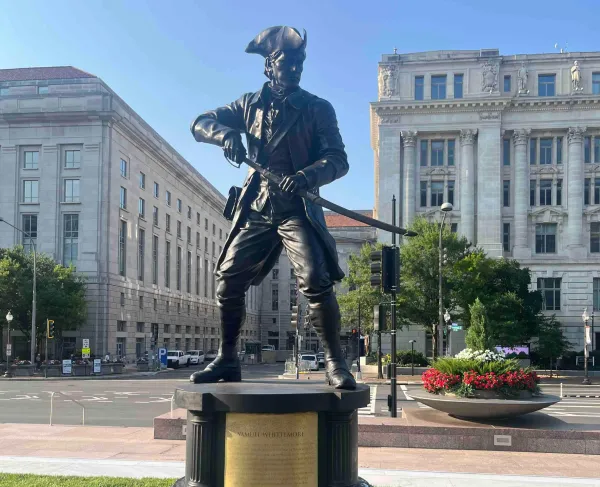
Joseph Plumb Martin

According to his own autobiography, Joseph Plumb Martin was born on November 21, 1760 in Massachusetts before moving to Milford, Connecticut to live with his grandparents. As a young teenager, Joseph learned of the first shots of the American Revolution at Lexington and Concord, and joined the Connecticut Militia in 1776. Joseph Plumb Martin saw service in many of the key battles of the war.
Martin first saw service at the Battle of Long Island on August 27, 1776, a Patriot defeat. He was present for the equally disastrous American performance at Kip’s Bay in September, but he was also involved in the Battle of Harlem Heights on September 16, 1776, a Patriot victory against the British. Martin took part in the inconclusive Battle of White Plains in October, and then returned home at the end of his enlistment in December 1776, missing out on the crossing of the Delaware and the Battle of Trenton.
Martin then enlisted in the Continental Army, this time for the duration of the war, in April 1777. He received an inoculation against smallpox, like the rest of the Continental Army in the spring of 1777, and then took part in the Battle of Germantown in October 1777. Martin was among the soldiers garrisoning Fort Mifflin, enduring a British siege until they were evacuated in November 1777. From there, Martin moved with the rest of the army into the winter camp at Valley Forge. Martin also experienced the particularly harsh winter of 1779-1780 at Morristown.
Martin was promoted to the rank of sergeant in the newly formed Corps of Sappers and Miners, a unit of engineers. This unit helped to dig the American siege lines outside Yorktown. On the evening of October 14, 1781, Martin was among the Americans who cleared away the obstacles in front of the British Redoubt Number 10, allowing infantry led by Alexander Hamilton to storm the position. He remained in the Continental Army until his discharge in 1783, as part of the gradual disbanding of the army.
Martin married and moved to modern-day Maine, where he held numerous public offices. However, his economic situation deteriorated. He lost most of his land in a legal dispute with Henry Knox, the former chief of artillery for the Continental Army. In 1818, when he applied for a pension for his service in the war, he claimed to have no property or income. He was awarded a pension of $96 a year.
In 1830, Joseph Plumb Martin published “A narrative of some of the adventures, dangers and sufferings of a revolutionary soldier; interspersed with anecdotes of incidents that occurred within his own observation.” When he died in 1850, his tombstone named him as “A Soldier of the Revolution.” Martin’s memoir was not widely read until it was republished as Private Yankee Doodle in 1962, giving historians a rare view into the common soldier’s experience of the war.