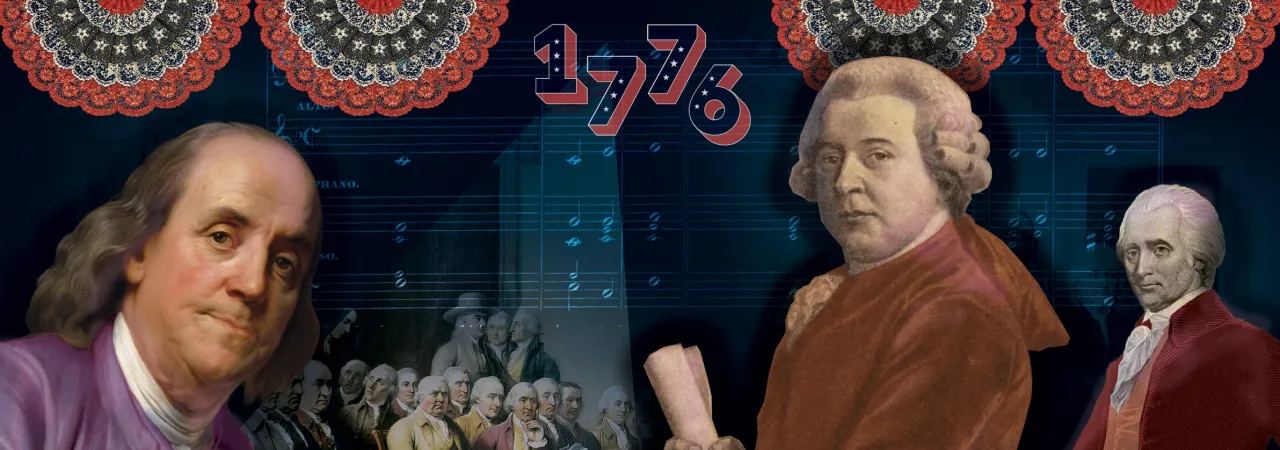
Have you seen a lot of singing and dancing Founding Fathers lately? Like, more than normal? No, we don’t mean Alexander Hamilton (no offense, Lin Manuel, we love you!). We’re talking about the O.G. Founding Fathers Musical—1776. If you haven’t seen the stage play or the cinematic adaptation, we courteous-LEE request that you fix this oversight. Immediate-LEE. It’s the semiquincentennial after all, and the events depicted in the musical unfolded exactly 250 years ago.
Picture the scene.
The date: Summer, 1776.
The place: “Foul, fetid, fuming, foggy, filthy” Philadelphia.
The problem: Massachusetts Delegate John Adams (who is obnoxious and disliked) has just about had it with his fellow delegates, who piddle around Philadelphia not acknowledging the reality of what the men assembled need to consider: the question of independence.
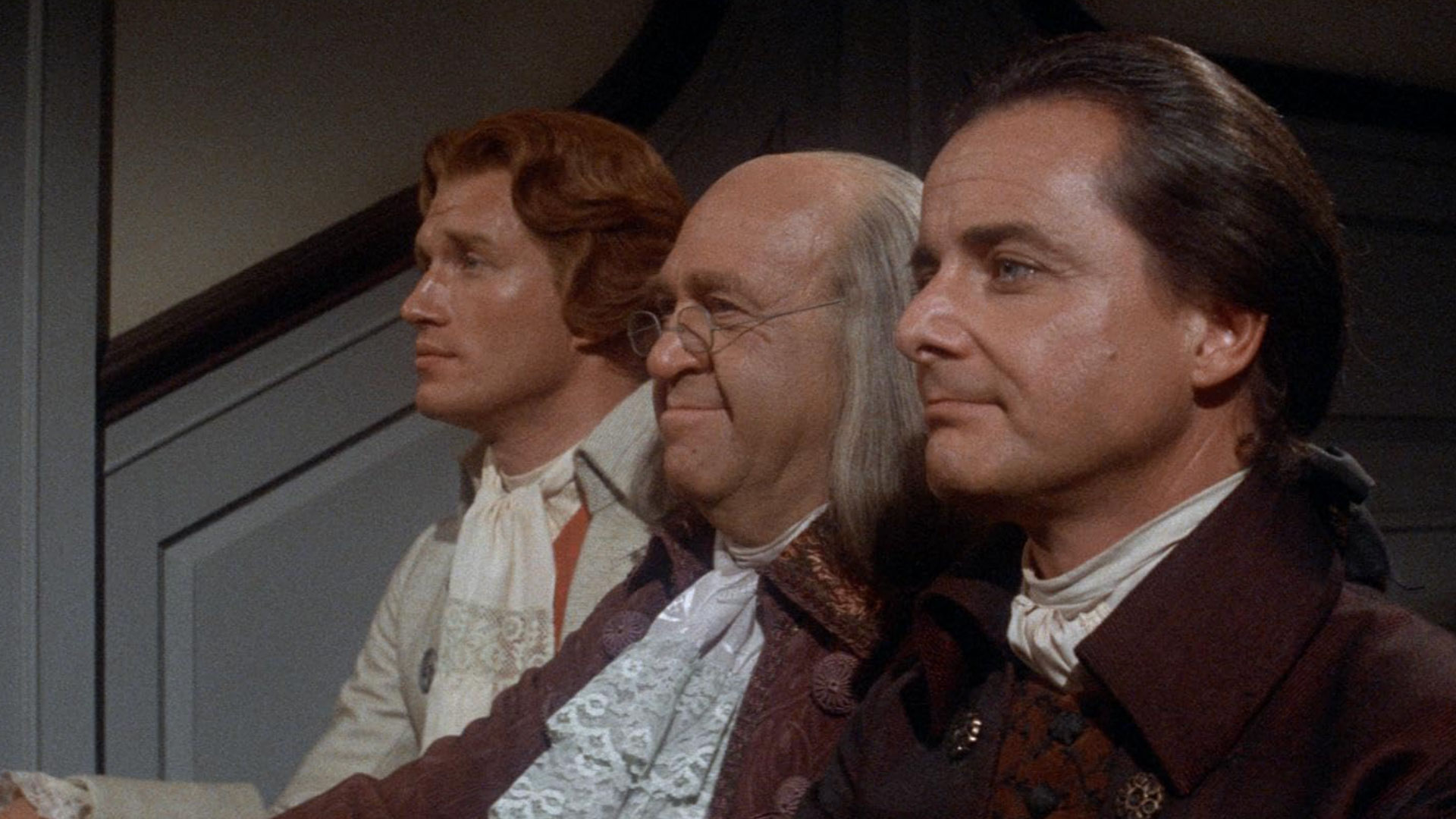
Musical numbers explore the group project that was the drafting of the Declaration of Independence (wherein Thomas Jefferson gets stuck quite literally holding the quill), the Triangle Trade (as Edward Rutledge argues against an anti-slavery clause in the document draft), and even how Adams, T.J., and Ben Franklin felt about the responsibility of birthing a new nation (an “eaglet,” metaphorically speaking). And who could forget Adams, Franklin, and Richard Henry Lee galloping around a Philadelphia water feature singing the praises and merits of “the Lees of old Virginia.” (Another incentive to watch the film: yes, that’s the same fountain as the Friends opening credits!)
The whole idea of seeing these Founding Fathers singing and dancing to whip the Second Continental Congress into an independence-voting frenzy might seem a bit head-tilting (even if Hamilton brought this back into style in more recent years). But that’s just what audiences adored when the show premiered on Broadway in March 1969. The New York Times lauded it as “striking” and “gripping.” The show won three Tony Awards, including Best New Musical. The movie came out in 1972. Back then, it served as much a prologue to America’s bicentennial as it did a contrast to the Vietnam War and the Summer of Love.
“Sit Down, John!” from 1776 (1972) | © Columbia Pictures. Used for purposes of commentary and criticism.
But it’s not all song and dance. There’s real history here. A heartbreaking moment occurs when a young postrider, clad in the unform of a Patriot soldier, delivers to the Continental Congress dispatches from the frontlines of the Revolutionary War. In a moment of weary reflection on the real cost of the Revolution, he sings the song, “Mama, Look Sharp,” imagining the last moments of a young Patriot dying on the battlefield, and the mother who finds him.
The musical moment, while fictional, is grounded in fact. Both state troops and the Continental Army saw enlistees as young as 15 years old — and those who served in other capacities, like fifers and drummers, might be much younger, spending the whole of their formative years in the Continental Army. Joseph Plumb Martin first joined the Connecticut Militia when he was just 15 years old and enlisted in the Continental Army a year later. He served throughout the war, enduring intense engagements at the Battle of Monmouth and the Siege of Yorktown before his discharge at just 23 years old.
“Mama Look Sharp” from 1776 (1972)
© Columbia Pictures. Used for purposes of commentary and criticism.And while General George Washington, Commander-in-Chief of the Continental Army, isn’t a character you meet on stage in the musical 1776, he has quite a presence through the dispatches he sends to the Second Continental Congress from the front lines of the Revolutionary War. Those words definitely have main character energy. In the musical, we hear Washington’s reports to Congress spoken by Secretary Charles Thomson who reads them aloud to a room of tired, hot, and irritated delegates.
In both the musical and in the real historic record, Washington painted a picture of uncertainty and despair in the Patriot army. In the musical, Adams accuses Washington of “exaggerating the situation” to get a rise out of Congress. During the events of the musical in June and July of 1776, Washington was situated in New York, having moved his Continental Army there to keep the British out of that city after Washington’s army expelled the British from Boston. Washington wrote of the lack of arms, and soldiers close to mutiny over not getting paid. In fact, the real-life Washington himself even told Congress,
“...few people know the predicament we are in... I have often thought how much happier I would have been if, instead of accepting a command under such circumstances...I had retired to the backcountry.”
Washington wasn’t able to keep the British at bay very long. None of the Founding Fathers — either in the musical or real life, could know it yet, but a month after Congress adopted the Declaration of Independence in Philadelphia, Washington lost the Battle of Brooklyn, including some 2,000 Patriot casualties. The Continental Congress had declared independence, but the Continental Army still had to win the war.
“He Plays the Violin” from 1776 (1972)
© Columbia Pictures. Used for purposes of commentary and criticism.Yes, 1776 is the O.G. Dancing Founding Fathers Musical. And it’s also rooted in a lot of real history too, making it a perfect way to understand and appreciate the real personalities of Founding Fathers on and off the battlefield during the American Revolution. As America celebrates the semiquincentennial—the 250th anniversary of the signing of the Declaration of Independence – professional and community theaters all around the country are celebrating with new and reimagined productions of the musical. And you can always stream the movie or borrow it from your local library. And whether you organize a group outing to see it in person or stream it on movie night, we have your Reel-to-Real 1776 watch guide to help you dig further into the real history, and make the whole experience just a little bit less head-tilting.