Edward Rutledge
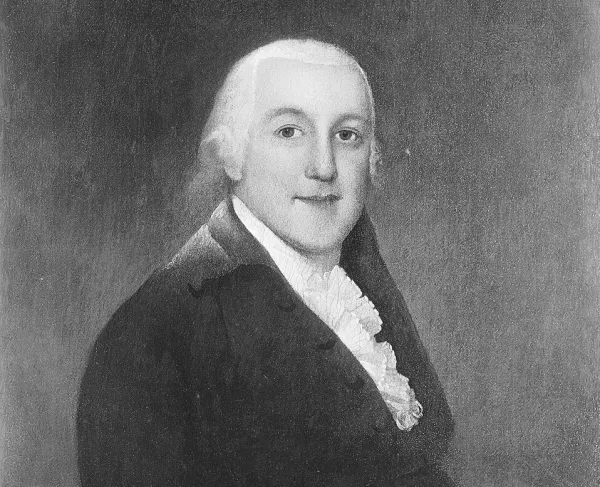
Edward Rutledge signed the Declaration of Independence and was the youngest Continental Congress delegate to add his signature to that now-famous document!
Born on November 23, 1749, Edward was the fifth son and youngest child of John and Sarah Rutledge. His father, Dr. Rutledge, had immigrated from Ireland and was one of the first physicians in Christ Church Parish in South Carolina. His mother was granddaughter of Major Boone and part of the prominent family of Boone Hall Plantation.
Edward Rutledge grew up on his parents’ plantation near Mount Pleasant, South Carolina. For his formal education, he studied in England at the Inns of Court, like his oldest brother John Rutledge. He graduated in 1772 and returned to Charleston, South Carolina, to practice with his law partner, Charles Pickney. Among his first cases, Rutledge won Thomas Powell’s release after the newspaper printer had been imprisoned for criticizing the British colonial legislature. Whig political party leaders in South Carolina noticed Rutledge, and in 1774, they sent him to the First Continental Congress with four other delegates (including his older brother, John Rutledge). Also in 1774, he acquired a plantation where 50 enslaved people labored, and Rutledge married Henrietta Middleton. The couple had three children: Henry, Edward and Sarah.
Returning from the First Continental Congress, Rutledge served in two provincial congresses in South Carolina as the Whigs navigated local tensions and news of war in Massachusetts. He returned to the Second Continental Congress. In the absence of his brother on state business and the illness of other older delegates, Rutledge led the South Carolina delegation. For a time, he anticipated a reconciliation with Britain that would respect, restore and possibly expand colonial rights. John Adams discussed independence with him, and permission arrived from the South Carolina provincial congress that the delegates could vote for independence. Rutledge seemed undecided, though.
Following Richard Henry Lee’s resolution on June 7, 1776, which called for independence, Rutledge helped moderates in congress to delay a vote. He supported the idea of independence, but believed that the colonies needed to more formally united together and forge some foreign alliances before declaring separation from Britain. Under his influence, South Carolina actually voted against independence on July 1, 1776. Nine other colonies voted in favor of independence, prompting Rutledge to call for another vote the next day. Then, he convinced the other South Carolina delegates to reverse their initial vote and go with the majority to help show stronger consensus for independence in July 1776, rather than waiting for the more ideal circumstances he had originally hoped for. South Carolina voted for independence on July 2, 1776, and when the Declaration of Independence was signed, Edward Rutledge added his name. Alongside his brother and two other South Carolinians, he joined the pledge of “our Lives, our Fortunes and our sacred Honor."
Though voting and signing the Declaration of Independence were his most memorable actions in the Continental Congress, Rutledge also joined the committee to prepare early drafts of a constitution or governing articles. He worried that too much power would be given to the New England states. He tried to find ways to protect interests of the southern states, including attempts to defend the practice to slavery. In a different congressional measure, Rutledge unsuccessfully tried to prevent Black soldiers from serving in the Continental Amy.
In November 1776, Rutledge returned to South Carolina and served in the state’s General Assembly. He joined the South Carolina militia and became an artillery captain, seeing action at the Battle of Beaufort in 1779. During the Siege of Charleston in 1780, Rutledge and several other signers were captured, and the British took them to St. Augustine in Florida. Finally, in July 1781, he was exchanged.
In 1782, Rutledge returned to the state legislature and held a seat there until 1798, often working to improve the state’s economy. The Revolutionary War ended in 1783, and by 1789, the new nation had ratified the U.S. Constitution to establish a new form of government and law of the land. Rutledge encouraged South Carolina’s ratification of the Constitution, though he hoped for the amendments which were shortly added as the Bill of Rights.
Rutledge leaned toward the Federalist Party, preferring their more conservative politics as the 1790s unfolded. He helped write South Carolina’s state constitution in 1790, and the following year presented legislation that ended the law of primogeniture in the state. Henrietta Rutledge died in 1792, and a few months later, he married widow Mary Shubrick Eveleigh. Twice, President Washington asked to appoint Rutledge as an Associate Justice of the United States Supreme Court, but Rutledge declined. He was elected to the state senate in 1796, then two years later won election to become governor. Edward Rutledge died on January 23, 1800, while still in office. St. Philip’s Episcopal Church in Charleston is his final resting place.

Related Battles
5,506
258