Newtown | Aug 29, 1779
The Opportunity
Here, in August 1779, the Revolutionary War took on a very different character. At Newtown, more than 3,000 Continental troops under General John Sullivan advanced against a much smaller force of Native warriors, Loyalists, and British regulars. The Patriots broke apart organized resistance to Sullivan’s campaign and contributed further to the displacement of the Haudenosaunee (Iroquois).
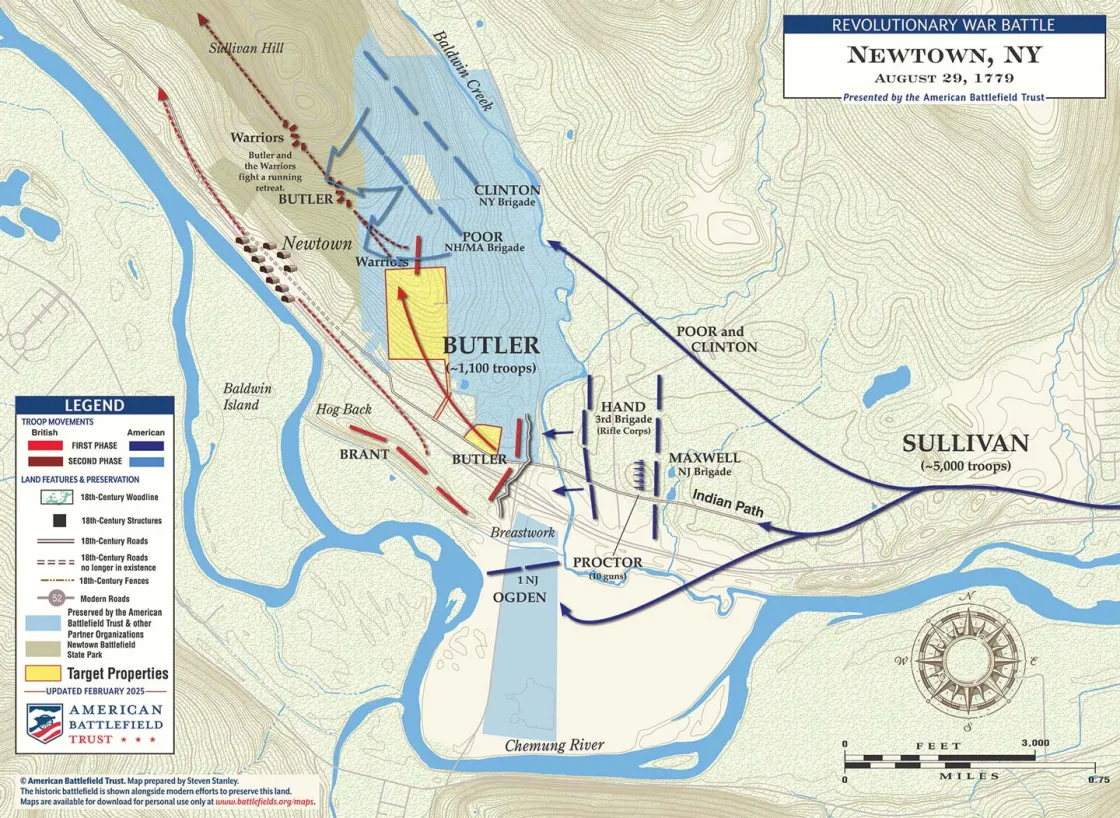
Today, we have an opportunity to save 33 acres immediately behind the log breastworks constructed by the defending forces. These acres form a conspicuous gap — a “doughnut hole” — in the midst of land that has already been protected.
Want to learn more? Visit this page for more information and history related to this campaign.
The History
Following the American victory at Saratoga in 1777, the British began to shift their war efforts to the south. This change alleviated some of the pressure on Continental forces in the north, granting George Washington a much-needed reprieve to deal with Native American and Loyalist raids along the frontier, particularly in western Pennsylvania and in New York.
The American Revolution divided the Iroquois Confederacy, prompting the Mohawks, Cayugas, Onondagas, and Senecas to ally themselves with the British, while the Oneidas and Tuscaroras chose to support the rebels. This division transformed the frontier into a war zone, riddled with vicious raids undertaken by both sides. To break the deadlock, Washington ordered Gen. John Sullivan west in the summer of 1779 to subdue the Iroquois.
Sullivan’s Expedition was tasked with stopping and ultimately eliminating the Iroquois threat. To achieve this, Sullivan employed a scorched-earth tactic, destroying villages and crops throughout the region. The Iroquois Chiefs, supported by limited numbers of British and Loyalist troops, avoided pitched battles wherever possible. As a result, most of the Expedition’s clashes included small skirmishes or ambushes, with one exception at Newtown, New York.
Situated near the New York-Pennsylvania border along a bend in the Chemung River, Newtown’s location played a pivotal role in the ensuing battle. The terrain at Newton favored a defensive position and ambush. A hill, flanked by marshy areas and a creek, commanded the road. The landscape prompted the 1,000 Iroquois and 200 Loyalist militiamen to construct an earthwork along the slope of the hill. Sayenqueraghta, the Iroquois leader, hoped to stop the Continental expedition here and protect the towns further along the river.
Sullivan’s column left Fort Sullivan on August 26, 1779, and slowly proceeded up the Cayuga River. Around noon, the Patriot troops discovered the hidden breastworks and reported to Gen. Edward Hand, who deployed his light infantry to fire into the earthworks. The defenders tried repeatedly, though unsuccessfully, to lure the Continentals into an ambush before a lull fell over the field.
Sullivan called a council of war, which decided to pursue a complex double envelopment attack on the earthworks. To hold the enemy in place, one unit would feint in the center. Ten artillery pieces would bombard the earthworks and signal the general assault. Once the flanking units engaged, the feint would turn into a full assault.
The plan was complex but skillfully executed by Sullivan’s well-trained troops. A brief counterattack by Joseph Brant almost cut off a portion of the American force. By nightfall, the battle was over, and the Patriot forces won the day. Sullivan operated virtually unopposed for the next month, allowing him to complete his expedition and end the Iroquois threat.
Related Battles
43
34