Boston | Apr 19, 1775 - Mar 17, 1776
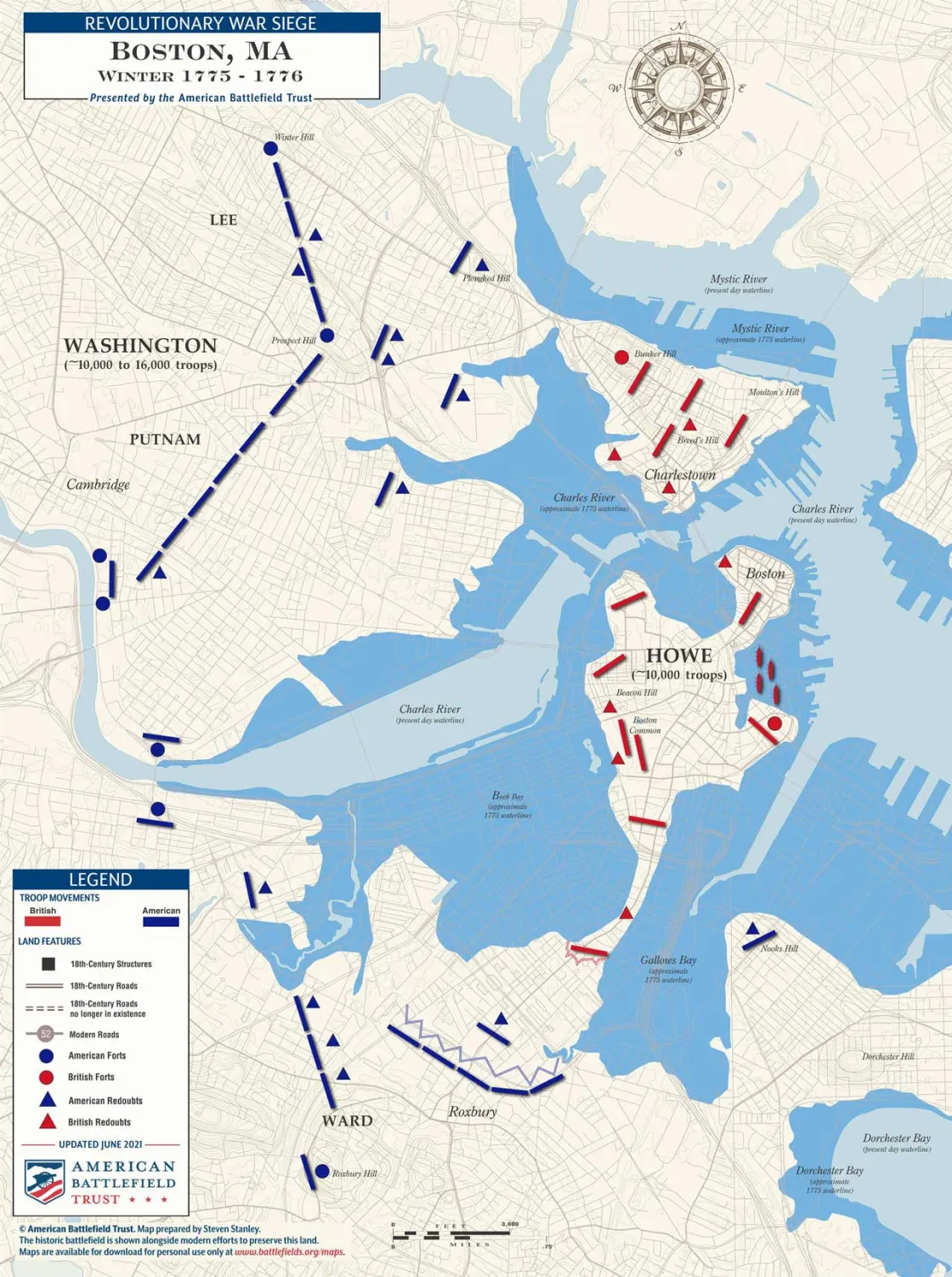
Following the debacle at Lexington and Concord, the British army took positions in and around Boston. The true strength of British arms lay in Boston Harbor with the ships of the Royal Navy. As thousands of militiamen flocked to Boston from the countryside and nearby colonies, Thomas Gage and his soldiers, sailors, and marines always had a means of escape—the sea—even if they could not break out of Boston via a land route.
Meantime, the Continental Congress met in Philadelphia in an effort to assess the situation and to put the colonies on a war footing. Money was borrowed, powder was purchased, and on June 15, a Virginia planter named George Washington was promoted to the rank of general and given “command [of] all the continental forces, raised, or to be raised, for the defense of American liberty.” In New York and Massachusetts, events were picking up speed.
The Americans controlled the land approaches to Boston—Charlestown Neck and Boston Neck—but lacking a navy, were unable to blockade the harbor. In May, Allen and Arnold’s force of militia seized Fort Ticonderoga and its arsenal of weapons.
By June, the British had received enough reinforcements to attempt a breakout from Boston. Their plan was to occupy Bunker Hill to the north and Dorchester Heights to the south, using both as a base of operations against the American fortifications—resulting in the Pyrrhic British victory at the Battle of Bunker Hill.
Between his lackluster administration of the Massachusetts Colony and his failure to quell the rebellion, Gage was relieved of command, and he departed for England in October of 1775. Gage was replaced by Gen. William Howe (later Sir William Howe).
On July 2, Washington arrived and assumed command of the American forces, now officially dubbed the Continental Army. American reinforcements also arrived from New England, the Middle Colonies, and Virginia. Washington, however, lacked heavy artillery, and could neither dislodge the British nor risk the losses of a direct assault. The British likewise could not attack the American position without risking heavy losses. Washington feared that inaction would lead to the wholesale desertion of the militia gathered for the siege.
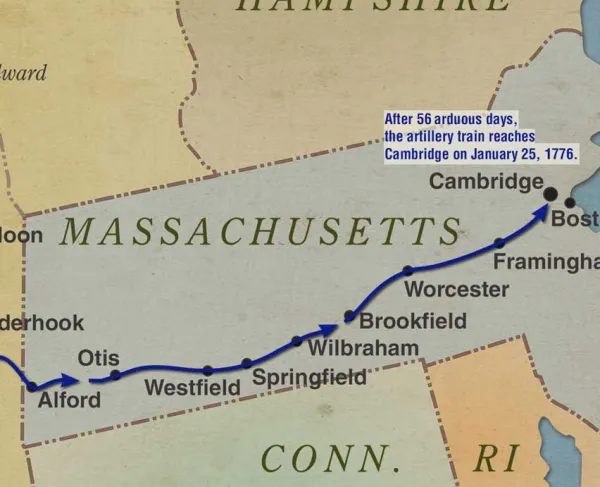
On the waters, American privateers harassed British traffic in and out of Boston, threatening Gage’s lifeline. On land, Washington bolstered his firepower. He ordered Col. Henry Knox to retrieve the guns captured at Fort Ticonderoga and bring them to Boston. By March, these cannon were in position on the heights around the besieged city.
On March 2, the Americans began their cannonade, with the British responding in kind. On the night of March 4, Washington made the critical decision to fortify Dorchester Heights. With cannon frowning down on them, and with backing from the cabinet, Howe decided to abandon Boston.
His soldiers stripped the city of any war materials that would benefit the rebels, and he even went so far as authorizing the burning of the city. It did not come to that, and the British withdrew to Halifax, Nova Scotia, on March 17.
Boston remained in American hands for the rest of the war, as Washington prepared to move south and defend the next logical target, New York City.
Related Battles
19
79