Jack Jouett

Historians know little about Jack Jouett’s early life before his “midnight ride” during the American Revolution. He was born in Virginia in 1754, and his father operated Swan Tavern in Charlottesville.
Charlottesville became a target for British forces in June of 1781. The Virginia General Assembly and Governor Thomas Jefferson had been meeting in Charlottesville after the British Army drove them out of the state capital at Richmond. . British Lt. Col. Banastre Tarleton pursued Jefferson and the Assembly, hoping their capture would be a fatal blow to Patriot morale and hasten a surrender. By June 3, Tarleton and his men had reached Louisa County.
As the British rode through Louisa County, they passed Cuckoo’s Tavern, where 26-year-old Jack Jouett was spending the evening. Jouett saw the men and correctly surmised that they were headed for Jefferson and the Assemblymen. Losing no time, he mounted his best horse and rode 40 miles through the Virginia backroads to Charlottesville. In the early hours of June 4, he arrived at Thomas Jefferson’s home at Monticello.
Despite the early hour, Jouett found Jefferson in his garden and delivered the warning. Jefferson, still believing the British to be a few hours away, stayed and breakfasted with his family and the Assemblymen staying with him at Monticello. After breakfast he sent his family away in a carriage, but stayed behind himself to pack and hide his papers. The sound of the British and their forces told Jefferson he had lingered too long, and he only just escaped as they entered his home.
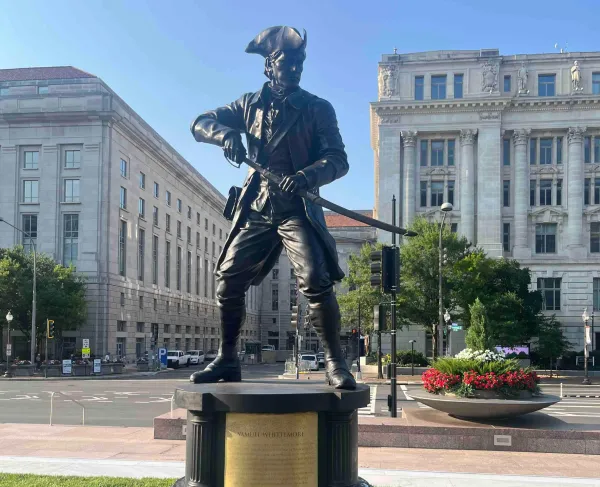
After stopping at Monticello, Jouett rode into town to warn the other Assemblymen of the British arrival. His warning helped Virginians such as Patrick Henry, Benjamin Harrison, Archibald Cary, and Richard Henry Lee escape the British. Jouett also aided the escape of Gen. Edward Stevens, a member of the Virginia Senate. That day, Stevens was dressed plainly and rode a plain horse while Jouett wore a scarlet coat and a fine, eye-catching hat. Jouett also happened to be riding a good-looking, fast horse, whom he had picked so he could deliver his warnings in time. Tarleton’s men incorrectly guessed that Jouett in his finery was the high-ranking Gen. Stevens, and pursued him instead. Jouett’s fast horse allowed him to easily outrun the British, while Stevens successfully escaped.
After the war ended, Jouett moved to the Kentucky district of Virginia and represented Mercer County for two terms in the Virginia Assembly. He became a strong supporter of Kentucky statehood, and in 1788 served as a delegate at a convention in Danville advocating for Kentucky’s separation from Virginia. When Kentucky became its own state, Jouett served in the state’s House of Representatives from 1792 to 1797. In 1797, he built a house outside of Lexington where he lived with his wife and 12 children. He died in 1822 and is buried in Old Tanyard Cemetery in Owingsville, Kentucky. Though Jouett’s “midnight ride” is not as widely remembered as Paul Revere’s, his warnings saved the lives of some of the most important Patriot leaders in Virginia and the United States.