Samuel Whittemore
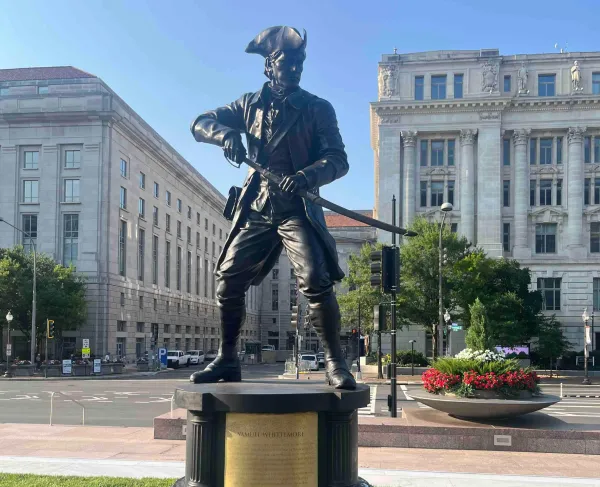
When Samuel Whittemore was born in 1696 in Charleston, Massachusetts, his family had been living in the colony for over 60 years. His primary occupation was farming, but he also served as an officer in the British Royal Dragoons during King George’s War in New England (1744-48). Like many other colonists, Whittemore grew angry with the Crown during the 1760s and 1770s. He joined committees opposing the Stamp Act, protested the Townshend Acts, and joined his community’s Committee of Correspondence.
Following the first shots of the American Revolution, Whittemore - at 78 years old - risked his life to stand against the Crown. On the afternoon of August 19, 1775, the British were retreating to Boston after being defeated at Lexington and Concord. On their retreat, they burned homes, shot citizens, and pillaged towns. Word of the British rampage spread to Whittemore’s home in Menotomy (now present-day Arlington, Massachusetts). Upon hearing the news, Samuel Whittemore gathered his weapons and positioned himself behind a low stone wall, awaiting the British arrival.
As he saw five British grenadiers approach, he rose and shot one with a musket, scared one away, and shot a third with one of his horse pistols. He charged at the remaining British, but the grenadiers stopped him and shot him in the face. After he fell, they attacked him with the butts of their muskets and stabbed him with their bayonets. They assumed they had left the elderly Whittemore for dead. But four hours later, Whittemore was conscious and still attempting to load his musket when the townspeople found him.
The local doctor thought he would not survive his injuries, but Whittemore’s family demanded that he be treated. Though heavily scarred, Whittemore did survive and actually lived another 18 years to the age of 96. In the late 19th century, a marker was erected in Arlington, Massachusetts that commemorates Whittemore’s bravery. It currently stands in Arlington’s Whittemore Park.
Related Battles
93
300