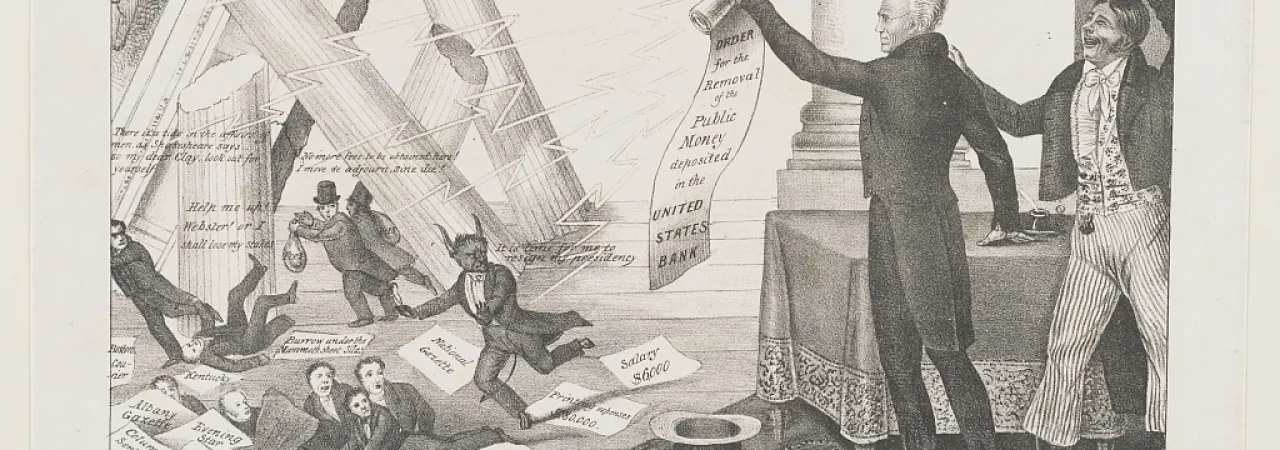
The Downfall of Mother Bank, published by Henry R. Robinson, 1833. The pro-Jackson political cartoon celebrates President Andrew Jackson’s removal of federal deposits from the Second Bank of the United States.
From the early days of the young republic, American leaders and politicians have disagreed over the merits and potential powers of a national banking system. A debate that ignited in the 1790s, 1810s, and most fiercely in the 1830s, the fight over the Bank of the United States inspired some of the fiercest partisanship in American history.
The First Bank of the United States
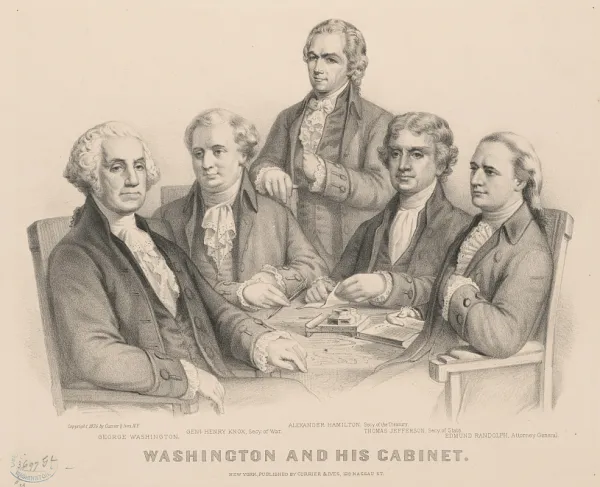
During the Revolutionary War, the thirteen states accrued much debt, and the Continental Dollar rapidly depreciated in value. Crushed under debt and with worthless currency, something needed to be done to revive the American economy. Alexander Hamilton, as the first Secretary of the Treasury, advocated for the creation of a Bank of the United States (BUS). Aside from wanting the federal government to assume state debts, mint currency, and impose excise taxes, Hamilton wanted a central bank to act as a federal tax depository and to issue credit for economic development. In 1790, he officially proposed his plan for the BUS, which would be created through the sale of ten million in stock, of which two million would be sold to the federal government and the rest available to the public, both domestic and international. Unlike today’s Federal Reserve, the BUS could not to set monetary policy. To maintain its independence, the Bank was forbidden from buying government bonds or incurring more debt than its actual capital. Its directors had to regularly rotate, and the Secretary of the Treasury held the right of inspection.
Hamilton’s BUS plan encountered immediate resistance from many leaders, most prominently Thomas Jefferson and James Madison. The two claimed that since the Constitution did not authorize Congress to charter a bank, the move was unconstitutional. Hamilton countered that since the Constitution did not forbid it, the bank was constitutional. The debate over the Bank, then, is one of the earliest instances where closed and open Constitutional interpretations butted heads. Jefferson and Madison also contended that the BUS was only in the interest of the commercial North, not the agricultural South.
Despite deep protests, President George Washington signed the Bank Bill on February 25, 1791, chartering the BUS for twenty years with Thomas Willing as its president. However, when rechartering was up for debate once again in 1811, Congress killed the Bank by a single vote in both houses.
The Second Bank of the United States
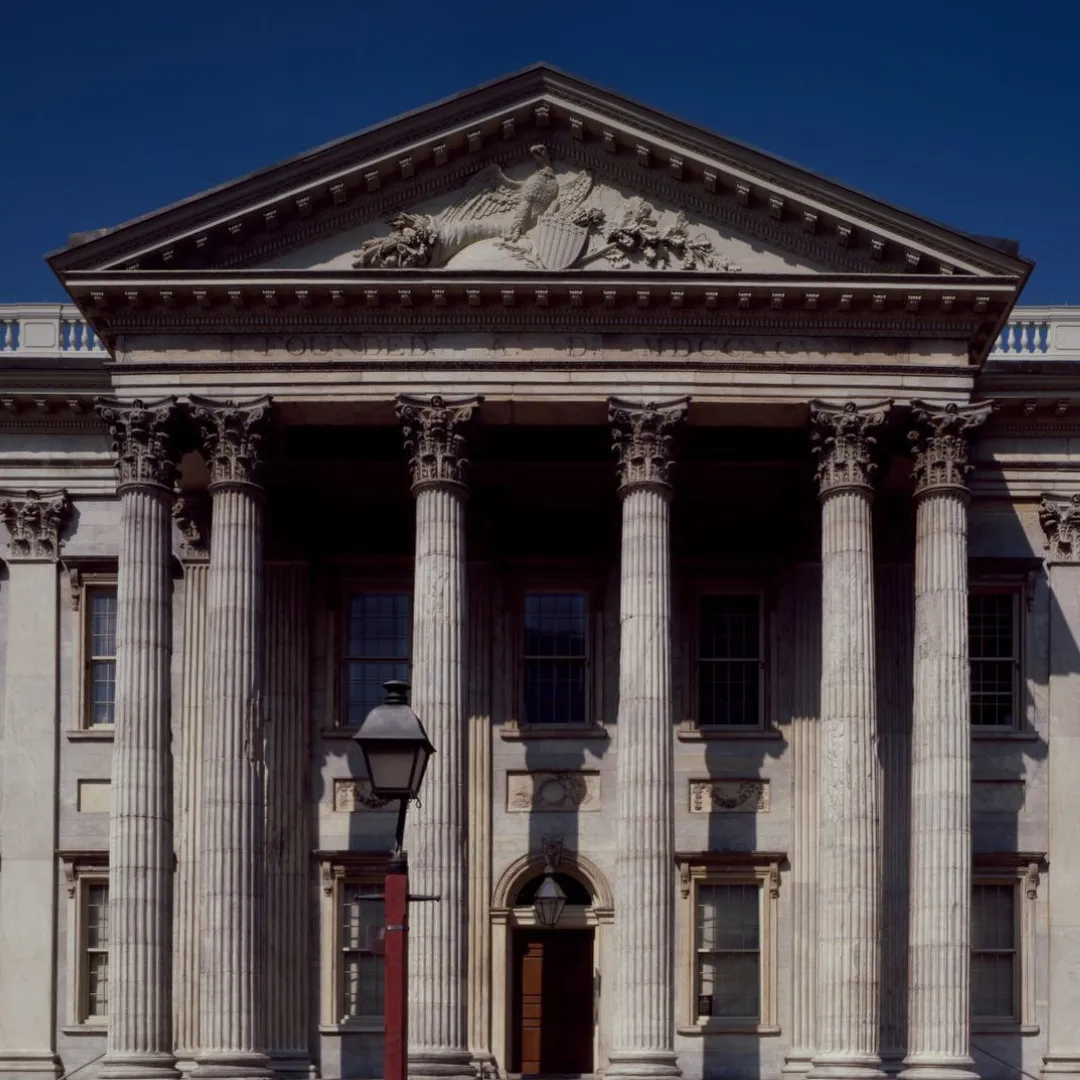
As the nation began rapidly industrializing and expanding after the War of 1812, the need for a centralized planning and funding system became clear. Thus, rechartering the BUS returned to the national forefront. With support from Henry Clay, John C. Calhoun, and, perhaps surprisingly, President Madison himself, the chartering of a Second BUS for another twenty years was signed into law on April 10, 1816. Like the First BUS, the Second Bank of the United States was headquartered in Philadelphia, and the federal government controlled a fifth of its stock.
In McCullough v. Maryland in 1819, the Supreme Court ruled that the BUS was constitutional and states cannot tax it, giving it much legitimacy. But while the officials continued supporting the BUS, many people started resenting it. The Panic of 1819, the first modern financial depression, was partially fueled by the BUS’s contraction of credit and money supply, which devalued banknotes. Affected by the Panic, many people grew worried about the Bank and its power. Famously, writer William M. Gouge noted that “the Bank was saved and the people were ruined.”
Andrew Jackson’s election to the White House ushered in a new, fatal era for the bank. Initially indifferent, Jackson’s rhetoric slowly became overwhelmingly negative starting in 1829. In his State of the Union address, he derided the Bank, evening reraising the question of constitutionality despite protests from its president, Nicholas Biddle.
The Bank War
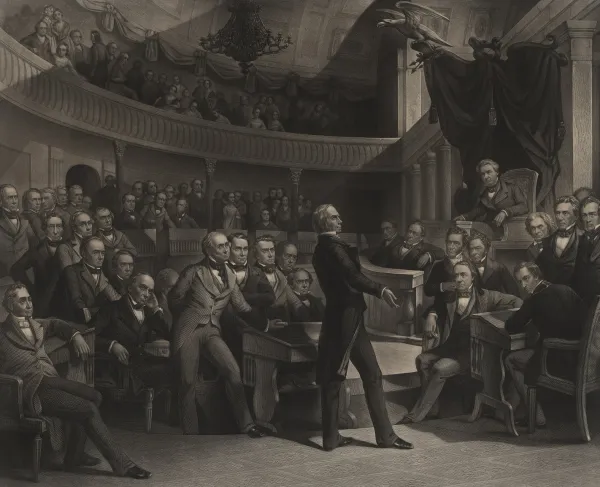
The charter was not to expire until 1836, but as the National Republicans mobilized for the 1832 election, they decided to make the BUS their central issue. Party leaders Henry Clay and Daniel Webster believed most people disagreed with Jackson’s extreme rhetoric about the BUS and would want to defend it. They thought this could be the issue that would unseat Old Hickory, so in early 1832, Henry Clay decided to introduce rechartering bills in both houses of Congress. In his mind, either Jackson had to sign the recharter bill–guaranteeing the Bank’s continuation–or veto it and anger the people. Nicholas Biddle, less sure in the plan, reluctantly joined Clay and Webster in their rechartering campaign.
Clay and Biddle’s alliance provoked a strong anti-BUS response from Jackson and his allies. Many Northern Democrats defected to support rechartering, helping the bill easily pass in both houses of Congress. However, on July 10, 1832, President Jackson vetoed the rechartering, delivering a now-famous justification. He argued that just because the Supreme Court declared the BUS constitutional does not mean the people agreed. Jackson was particularly upset that the Bank’s stockholders were mostly elites or foreigners, who he believed subverted the will of the people. For the first time in American history, a veto was justified using the people’s interest, not just legal theory and constitutionality. Clay and Webster were horrified, claiming that Jackson was trying to start a class war and misusing veto power.
Just as the National Republicans wanted, the rechartering of the BUS became the major issue of the 1832 election. They focused on ‘King Andrew’s’ despotic veto power while Jackson and the Democrats framed the debate as a chance for the people to fight against an encroaching aristocracy. The National Republicans miscalculated, and the people elected Jackson by a landslide. Taking his victory as a political mandate, Jackson became determined to eliminate the BUS before its charter expired in 1836. He did so by pulling all federal money from the Bank, a fifth of its funds, and depositing it instead in loyal local and state banks. This plan was highly controversial. When his current Secretary of the Treasury refused to act, Jackson fired him and replaced him with a loyal anti-BUSer, future Chief Justice Roger B. Taney. Together, they began moving funds to the “pet banks” while Congress was in turmoil over what to do.
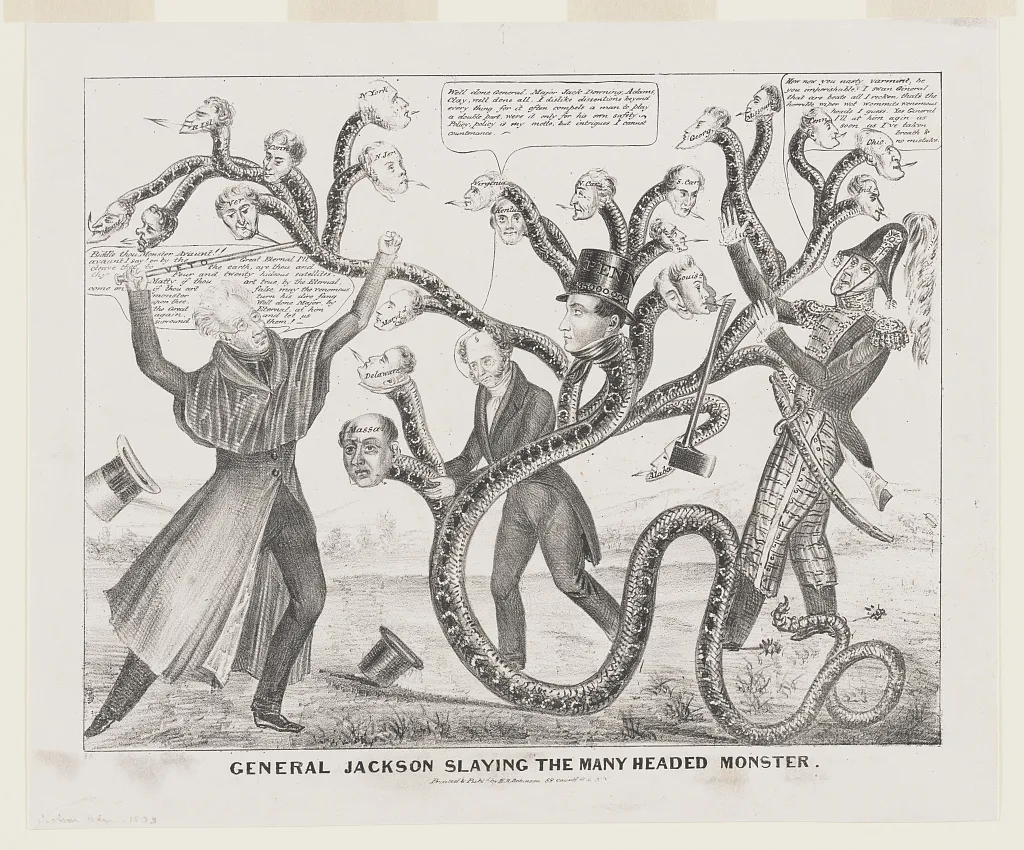
General Jackson Slaying the Many Headed Monster, by Henry R. Robinson, 1836. The political cartoon satirizes President Andrew Jackson’s campaign against the Second Bank of the United States, represented as a many-headed serpent.
Library of CongressIn a desperate attempt to revive respect for the importance of the BUS, Biddle raised its interest rates and called in loans to fuel a financial crisis. When petitions started flooding in, asking Jackson to recharter the bank and stop the crisis, he simply redirected them to Biddle. Slowly, public opinion turned even further against the bank.
Sparked by opposition to Jackson’s Bank War, a coalition of National Republicans, Anti-Masons, and pro-BUS Democrats formed the Whig Party in the spring of 1834. To show their disapproval, Senate Whigs censured Jackson for violating the Constitution by removing the BUS’s funds on March 28, 1834. In June, they refused to confirm Taney as secretary of the treasury, marking the first time Congress blocked a cabinet nomination. But it was too late. In February 1836, the charter officially expired, and the Second Bank of the United States was dissolved. With a new Democratic majority in the 25th Congress, Jackson’s censure was expunged in January 1837. Operating as a private corporation for a few more years, the Bank officially closed its doors on April 4, 1841.
The Panic of 1837 is often blamed on the death of the BUS. No longer under the BUS’s regulation, and with a growing supply of gold and silver, state and local banks rapidly increased the volume of notes in circulation and invested in riskier ventures. By 1842, 194 banks out of the 729 country’s chartered banks and eight states and the Florida territory all defaulted on their debts.
Of course, the debate over a central bank would not end there. The Whigs, until their collapse in the mid-1850s, never gave up hope of resurrecting the BUS. Two attempts in 1841 were vetoed by John Tyler, leading to nearly his entire cabinet’s resignation and his expulsion from the Whigs. A centralized banking system would not return to the United States until the establishment of the Federal Reserve in 1913.