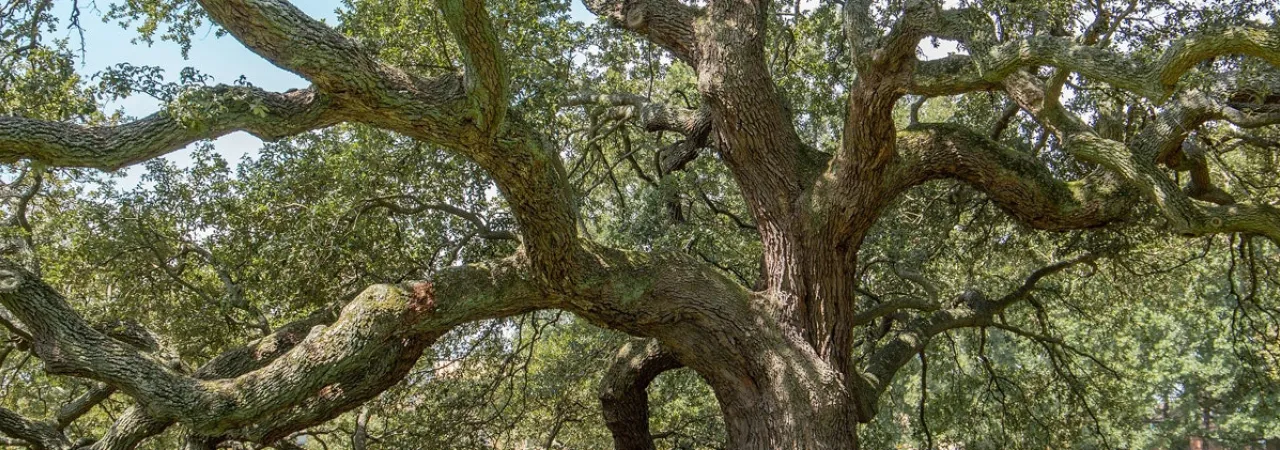
Emancipation Oak
In January 1863, members of the Hampton community, mostly enslaved people who ran to Union lines at Fort Monroe, gathered at the foot of a commanding oak tree to hear a reading of President Abraham Lincoln’s Emancipation Proclamation. These listeners, learning of their new freedom, stood at the very spot where the first enslaved Africans arrived in Virginia nearly 250 years prior. The history of Hampton, Virginia, then, is also the history of the United States and slavery–as encapsulated in the story of a tree.
Hampton is the oldest continuously occupied English settlement in the modern United States, established in 1610. Three years earlier, Captain Christopher Newport identified the tip of the Virginia Peninsula as a highly strategic location. He called this area, sitting at the mouth of both the Chesapeake Bay and Hampton Roads (the confluence of the Elizabeth, Nansemond, and James Rivers), Point Comfort. While the original settlers built their fort twenty-five miles north of Point Comfort at Jamestown, the latter’s significance was not forgotten. In October 1609, Jamestown colonists under Captain John Ratcliffe and Captain John Martin built Fort Algernon at Point Comfort. Simultaneously, the First Anglo-Powhatan War started after a Powhatan party killed thirty-three colonists, including Ratcliffe, who were attempting to buy corn. During this war, Fort Algernon was used to attack the Powhatan village of Kecoughtan. On July 9, 1610, the colonists seized the village and built an Anglican church on its site. The church, now known as St. John’s Episcopal Church, is the oldest English-speaking congregation in the United States. The new English settlement was incorporated as Elizabeth City in 1619 before being renamed in the 1690s to Hampton, after Henry Wriothesley, 3rd Earl of Southampton, an important leader of the Virginia Company. Hampton’s founding was the first instance of violent Indian removal, a practice that would define the United States for centuries.
In late August 1619, the English privateer John Colyn Jope, sailing under a Dutch letter of marque, brought “20 and odd” Africans to Point Comfort, selling them to the colonists. These men and women came from Angola aboard a Portuguese slave ship before being taken by Jope. The White Lion’s arrival in Hampton marked the first record of enslaved Africans in the thirteen colonies. Two of these initial twenty Africans, Isabella and Anthony Tucker, had a son in 1624 named William Tucker, the first child of African decedent born in English North America.
Throughout the colonial period, Hampton was the main port for tobacco exportation from the James River plantations. Various forts would occupy the site of Fort Algernon, including Fort Old Point Comfort, built in 1632, and Fort George, built in 1728. One of the early engagements of the American Revolution south of Massachusetts also occurred in Hampton on October 26, 1775. A refusal to return property from a beached British ship and demands to return runaway slaves created tension between the colonists and British forces. In response, the British planned an amphibious attack to regain control of Hampton. Their assault was thwarted by Virginia militia under William Woodford, marking an early patriot victory against Great Britain. According to Thomas Jefferson, the Battle of Hampton galvanized early support for independence in Virginia.
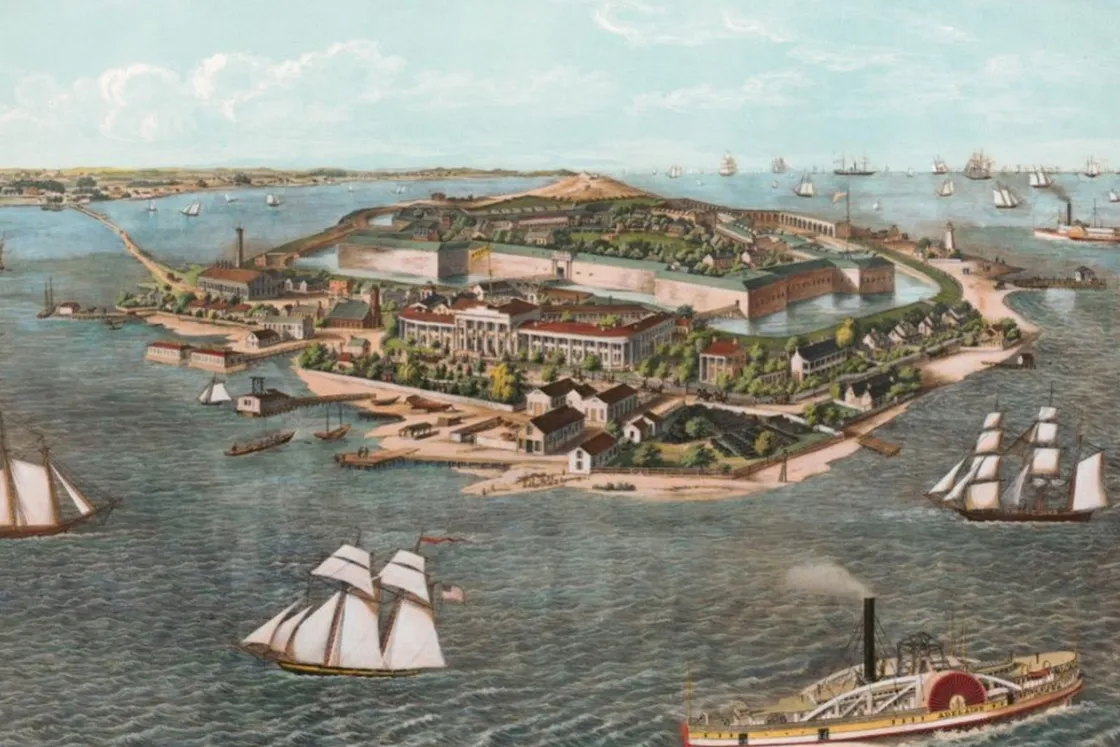
Fortress Monroe, Old Point Comfort, and Hygeia Hotel, Va.
Library of CongressA more consequential raid occurred during the War of 1812, when the British returned. Beginning in February 1813, a British fleet under Admiral Sir George Cockburn blockaded the Chesapeake Bay, but a failed invasion of Norfolk led to an attack on Hampton. On June 25, 1813, 2,000 British troops defeated the Virginia militia under Major Stapleton Crutchfield and occupied Hampton. During the ‘Sack of Hampton,’ the British captured guns, ammunition, horses, and foodstuffs, with some reports claiming worse horrors. By the end of the month, British forces left Hampton to concentrate their forces elsewhere in the Chesapeake.
The War of 1812’s destructive effect on the Chesapeake region motivated President James Monroe to build up defenses. In 1819, he authorized the building of a fort at Hampton, and three years later, construction began on Fort Monroe. Enslaved people and military convicts mostly built the fort. Finished in 1834, Fort Monroe became the largest fort ever built in the United States, holding approximately 400 guns and up to 2,600 soldiers, and housing the Artillery School of Practice. Along with Fort Calhoun (later renamed Fort Wool) on an artificial island nearby, Fort Monroe defended the entrance to Hampton Roads and the Chesapeake Bay.
A new era for Hampton began in May 1861, when Virginia seceded from the Union. Fort Monroe, however, was kept under Union control because President Lincoln quickly sent reinforcements to secure it. When three slaves ran away to seek protection at the fort a few days later, Major General Benjamin Butler decided to shelter them. Considering them contraband of war, Butler reasoned they did not need to be returned to their enslavers. Becoming contraband did not mean full freedom, but it was, of course, preferable to enslavement. By the end of the war, tens of thousands of slaves were freed from the fort, earning it the nickname “Freedom’s Fort.” On August 6, Lincoln signed the Confiscation Act of 1861, which legally authorized the seizure of all Confederate property, including slaves. Learning of the new law and fearing an inundation of runaway slaves, Confederate Brigadier General John B. Magruder ordered the burning of Hampton the following day.
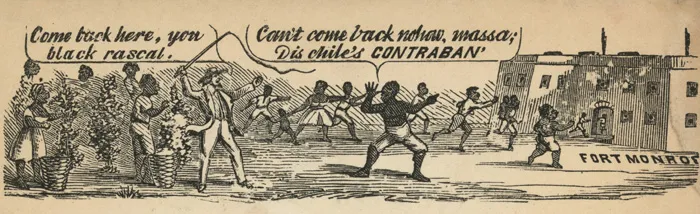
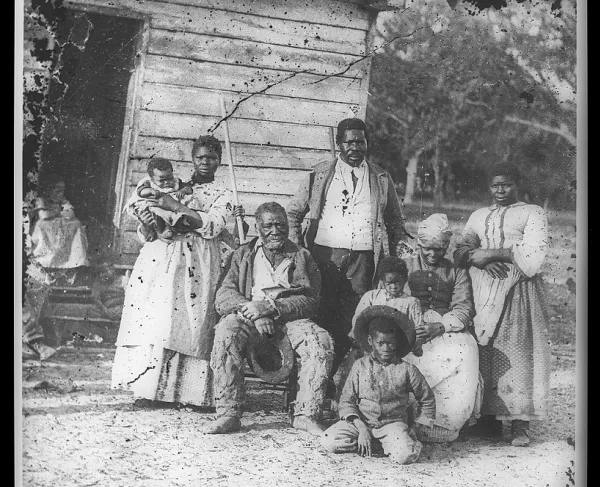
With an ever-growing number of runaways at Fort Monroe, former slaves decided to build their own settlement in the ruins of Hampton. The Great Contraband Camp became the first self-contained African-American community in the United States. It housed as many as 10,000 people. Near the walls of Fort Monroe, under a tall oak tree, Mary Smith Peake began teaching these former slaves (both children and adults) how to read and write. In November 1861, she became the first Black teacher of the American Missionary Association. Soon thereafter, the AMA sponsored the building of Brown Cottage near the tree, where Peake founded the first school for black students in Hampton.
Two years later, the very same tree was used as the landmark from which the contraband slaves learned of the Emancipation Proclamation, and their freedom. Therefore, the tree became known as the Emancipation Oak. Mary Peake’s small cottage became the Butler School in 1863 and the Hampton Normal and Agricultural School in 1868. To this day, the Emancipation Oak is a reminder of the history of Hampton and the United States writ large, with its many contradictions: it is Powhatan and English, American and British, Union and Confederate, Enslaved and, perhaps most importantly of all, Freed.