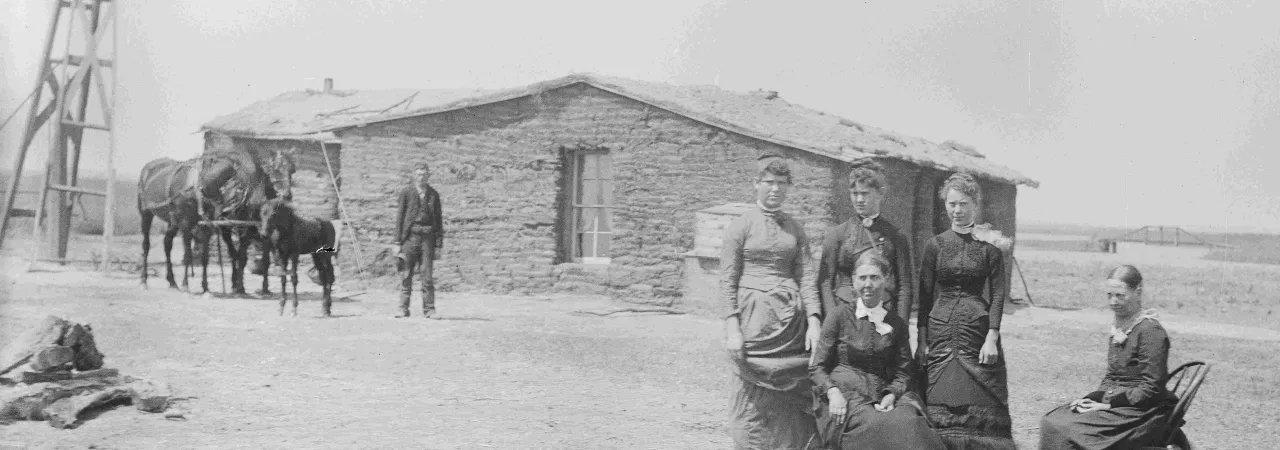
Pioneer women near Ansley, Custer County, Nebraska, 1886
The Civil War created death and destruction on levels never seen in American history, with both southern and northern women enduring heavily. Many women who saw the fight on their front doorsteps could not sit idly by and forced themselves into the war effort as nurses, volunteers, and spies. Following reunification in 1865 Americans continued westward seeking to move on from the prior dark years. For the women who had stepped up so bravely during the war, they would not simply return to a subservient lifestyle in their new homes.
Despite the traditional portrayal, women in the American frontier were not relegated to the backseat of history. In fact, they were essential partners in survival amongst the prairies and mountains of the West. The 1862 Homestead Act opened settlement to individuals over the age of 21, male or female. By the 1880s increasing numbers of married and single women were taking advantage of this and filing homestead claims across the country.
Women played an integral role in developing homesteads for several reasons. They predominantly worked as domestic caretakers, particularly on farms. They tended to the gardens and livestock while cooking, cleaning, mending, and washing clothes. They additionally raised children alongside these duties. Farming demanded constant attention, and women tended to the fields as needed. Beyond domestic labor, they also engaged in economic and public life in ways that challenged the status quo. While most women’s contributions remained rooted in domestic and economic labor, some frontier women gained public attention by stepping outside these traditional roles.
One of the most adventurous women of the West was Martha Jane Canary, affectionately known as Calamity Jane. A true frontier celebrity, she became infamous for her storytelling, sharpshooting, and drinking. After forming a close friendship with Wild Bill Hickok, Calamity Jane toured the Midwest with Buffalo Bill and his crew of cowboys.
A strong entrepreneurial spirit led women to find opportunities, even in a restrictive society. They often owned and operated boarding houses, bakeries, laundromats, and hotels. Teaching also provided a stable way of life for single females on the frontier as they typically made more than their eastern counterparts due to high demand. However, this position would often have to be given up in exchange for marriage. While these economic roles provided financial stability, women’s influence in frontier society also grew through community and religious organizations that shaped social life.
Life and religion were closely woven together for the pioneers of the late 19th century. The social pulse of women often revolved around the church, and this is where many organizations and social groups formed. Ladies Aid Societies were among the most prominent church groups. Originally formed during the Civil War to aid and supply soldiers, others continued or formed in the decades after as a way for women to remain involved in their communities and fundraise. Another extremely popular organization was the Woman's Christian Temperance Union (WCTU) which originated in Ohio in 1874.
A significant concern for many women in the American West was the rampant occurrence of alcoholism. Transients and young single men filled the frontier and commonly found trouble in saloons. Because alcoholism and abuse had become such a widespread problem, women became advocates for themselves and rallied together to put an end to what they saw as an epidemic. The WCTU acted as an organizing force for women to campaign and make tangible change in their lives. Alcohol and domestic abuse also had impacts on society’s views towards marriage and divorce.
Divorce rates were higher in the American West than in the rest of the nation, likely indicating two things: the increasingly liberal and often sympathetic divorce laws toward women in frontier territories and the growing mindset of self-determination of pioneer women. The data suggests that divorce in the late 1800s was not as taboo or uncommon as traditional interpretations suggest. This point is further reinforced by the growing political activism of women in the frontier.
At the time the WCTU was fighting for temperance, women of the National Woman Suffrage Association (NWSA) and the American Woman Suffrage Association (AWSA) were also lobbying for women’s suffrage. Though independent of one another, they often worked in tandem to achieve similar goals and frequently saw membership overlap. The mobilization and structure of the NWSA and AWSA advanced the suffrage movement. The frontier became a proving ground for women’s political activism, where looser social structures allowed suffrage movements to gain traction more quickly than in the East.
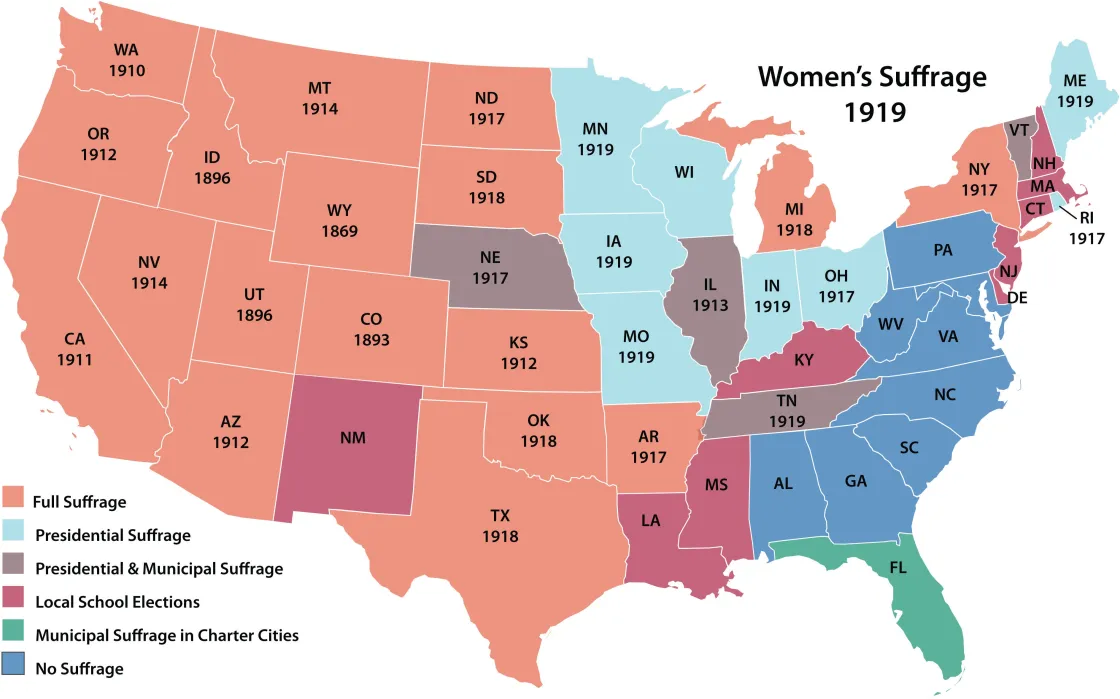
In contrast to the Eastern United States, most of the West offered full suffrage to women by 1919.
United States History, Volume 2 (CC BY-NC-SA 3.0)Women in the frontier began to use clever tactics to lobby for voting rights. Rather than arguing that they were equal to men, which was often met with resistance, suffragists would often rely on a tactic referred to as “expediency arguments.” This reasoning leaned on the belief that women had “motherly” insights and “nurturing qualities” which were benefits to democracy. Women maneuvered this to advance their causes without alienating men’s traditional beliefs to considerable success.
Wyoming could be considered the beacon for women’s equality in the West during the period. Despite not yet earning statehood, the territory granted women the right to vote in 1869, making it the first in the nation. In a watershed move, Wyoming further guaranteed equal pay for female teachers and protections over property rights. Wyoming’s lawmakers provided opportunities for women like Esther Hobart Morris who was appointed the country’s first female Justice of the Peace in 1870.
Anglo-Americans were not the only group present west of the Mississippi, however. African Americans, though in smaller numbers relative to white settlers, were present everywhere from Texas and the Dakotas to California. Clara Brown, Mary Ellen Pleasant, and Mary Fields were all Black pioneers with unique stories worth exploring. Fields, who was born into slavery in Tennessee, found work as a servant and handywoman after the Civil War. Thanks to her grit, by 1895 she earned the title as one of America’s first Black postwomen while living in Montana’s frontier.
Native American and Hispanic women also shaped the frontier in distinct ways, often drawing on existing cultural traditions that granted them economic or social authority. However, westward expansion frequently disrupted these systems, complicating their experiences in ways that differed from those of white settlers.
Women on the frontier bore hardships equal to, and often exceeding, those of men, while maintaining composure in the face of relentless demands. Straddling the divide between traditionally “masculine” labor and the expectations of femininity, pioneer women redefined both. In doing so, they carved out meaningful agency in the American West, helping lay the groundwork for broader advances in women’s rights nationwide.
Further Reading:
- Letters of a Woman Homesteader: Elinore Pruitt Stewart
- Pioneer Women: Voices from the Kansas Frontier: Joanna Stratton
- Pioneer Girl: The Annotated Biography: Laura Ingalls Wilder & Pamela Smith Hill
- Women on the Prairie: Stories of Grit, Survival, and Unbroken Spirit on the American Frontier: Ward McLendon
- The Concise History of Woman Suffrage: Selections from History of Woman Suffrage: Mari Jo Buhle
- Well-Tempered Women: Nineteenth-Century Temperance Rhetoric: Carol Mattingly