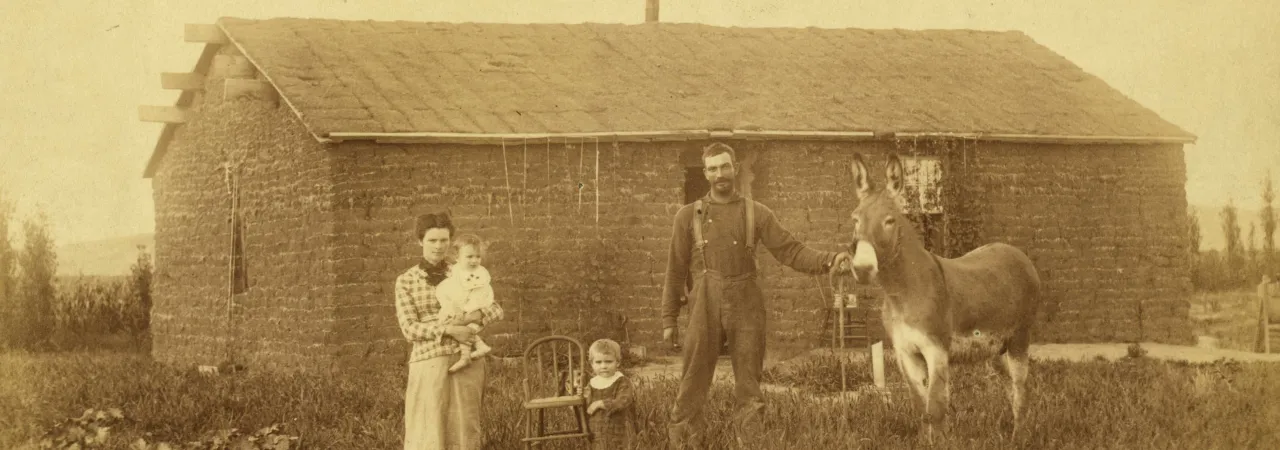
J.D. Semler, near Woods Park, Custer County, Nebraska
Westward migration accelerated in the wake of the American Civil War as thousands of settlers crossed the Mississippi River in search of new land. The introduction of the Homestead Act, along with numerous treaties, conflicts, and removals of Indigenous tribes, opened the vast expanse of prairie and plains to U.S. settlement. The Anglo-Americans, freed African Americans, European and Chinese immigrants, who descended upon the frontier all faced one similar challenge. In a time of great danger and opportunity, the pioneers of America’s West had to contend with Mother Nature and built its new civilization from the ground up.
Shelters during westward expansion varied greatly and often depended on one’s environment. For those settling in the vast forests of the Pacific Northwest or Northern Great Lakes, trees provided an essential resource. However, settlers on the plains and prairies were not afforded the luxury of wood unless they had access to imported lumber along rail lines. Because of these environmental factors, they had to be creative with their shelters and often created temporary houses to start.
Lean-tos and Temporary Shelters
When deciding on shelter during travel, protection from the elements was the single most important factor. Pioneers often utilized their covered wagons, sleeping underneath them at night during rainstorms. They also utilized the lean-to, which was a primitive structure typically comprised of branches, leaves, and animal hides. The lean-to could be set up along a tree or bank to provide stability. Despite being an open-air structure, it would protect against wind and rain with settlers constructing a fire near the entrance to provide additional warmth.
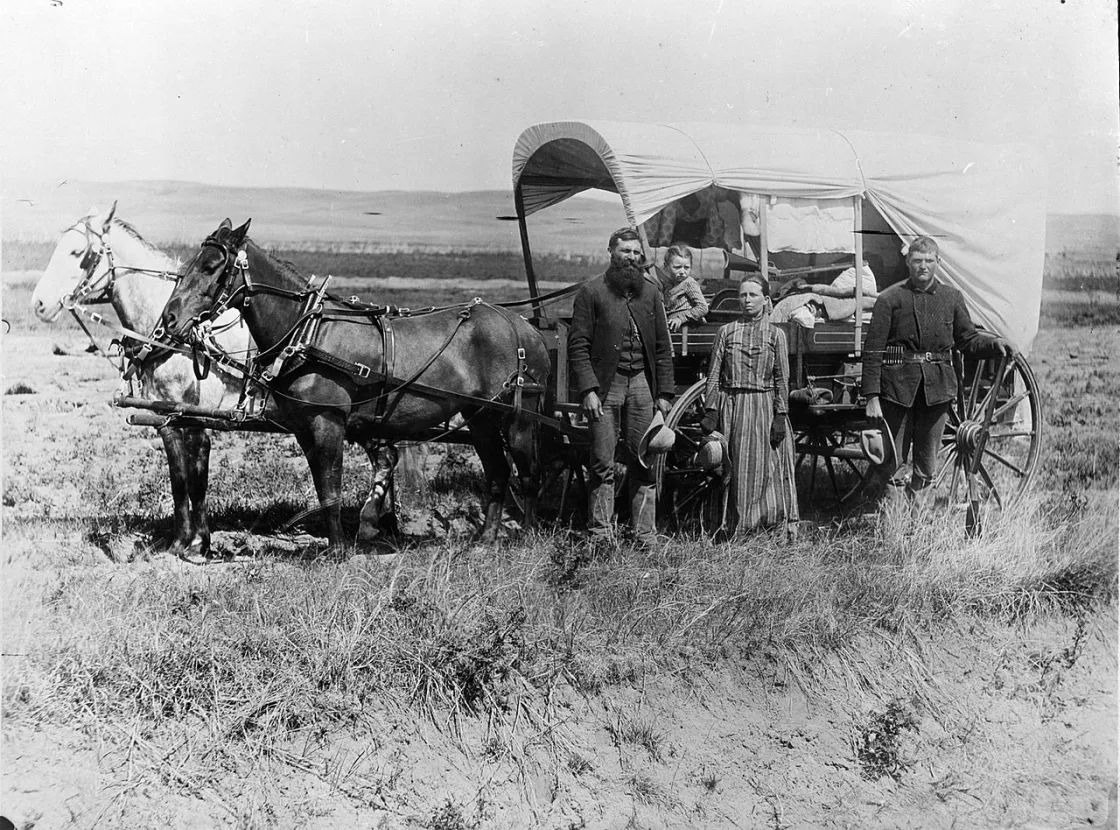
A Pioneer Family with Their Covered Wagon near Loup Valley, Nebraska, 1886
National ArchivesDugouts
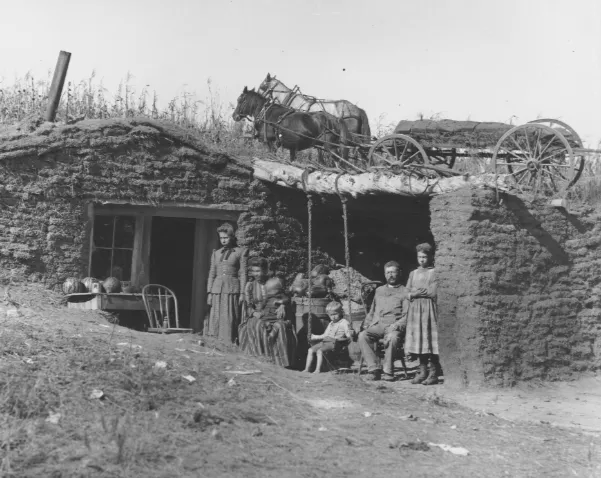
The next step up from a lean-to would’ve been the dugout home. These structures are named after the process in which they are built. Homesteaders along hillsides and banks could utilize the soil and dig their home into the ground. They would then reinforce the home with sod and branches to seal any cracks. The dugout proved to be an effective shelter year-round, and it was an adequate insulator in the cold of the winter and the extreme heat of the summer season. Dugouts, however, were limited in size, often only one or two rooms and, although more durable than lean-tos, were often intended to be occupied for a couple of years while a permanent home could be built.
Sod Houses
Homesteaders who did not have access to inclines, particularly along the flat plains of the Central United States, could build sod houses. Sod houses, often referred to as “soddies,” were extremely similar to dugouts, however they would be built with strips of sod from the ground up, rather than dug into the soil. A well-built “soddie” could prove to be just as effective as a dugout, with one advantage. Unlike most dugouts, sod houses could be built larger with multiple rooms, and in rare instances, multiple floors.
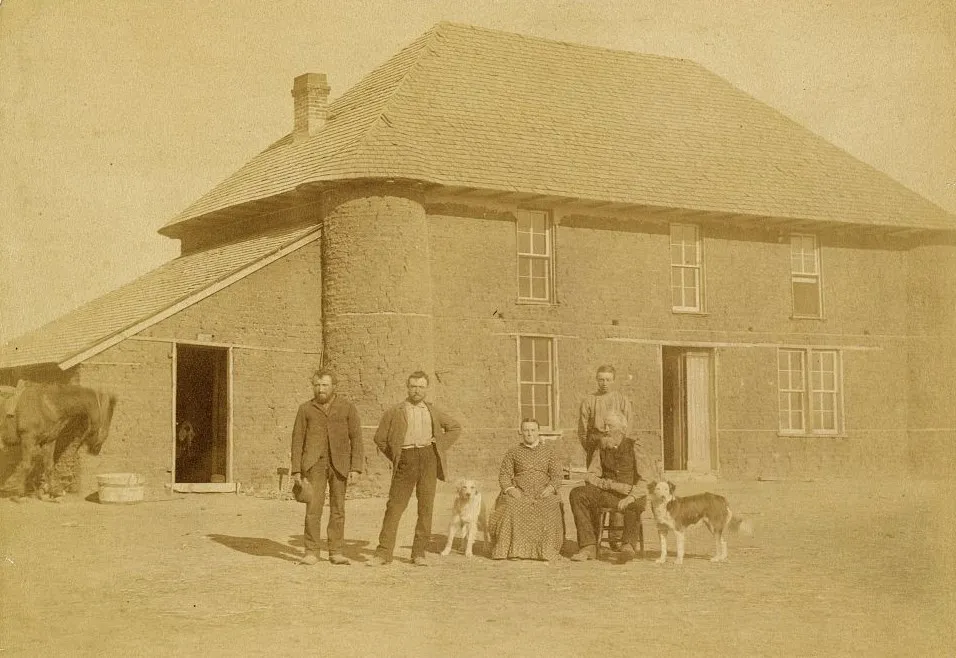
Isadore Haumont and Family in Front of a Two-Story Sod House, photographed by Solomon D. Butcher, 1886. The photograph documents frontier homesteading life near Broken Bow in Custer County, Nebraska.
Library of CongressLog Cabins
One of the more iconic structures amongst the American West was the log cabin. Although log cabins have been built for thousands of years, the basic concept has remained the same. Pioneers would cut down trees, often strip the bark, and cut out notches on each end. They then would stack these logs parallel to one another and then use a technique called “chinking” to seal any exposed cracks. Early settlers could use several materials to create chinking, including clay, mud, oakum, grass, and even hair.
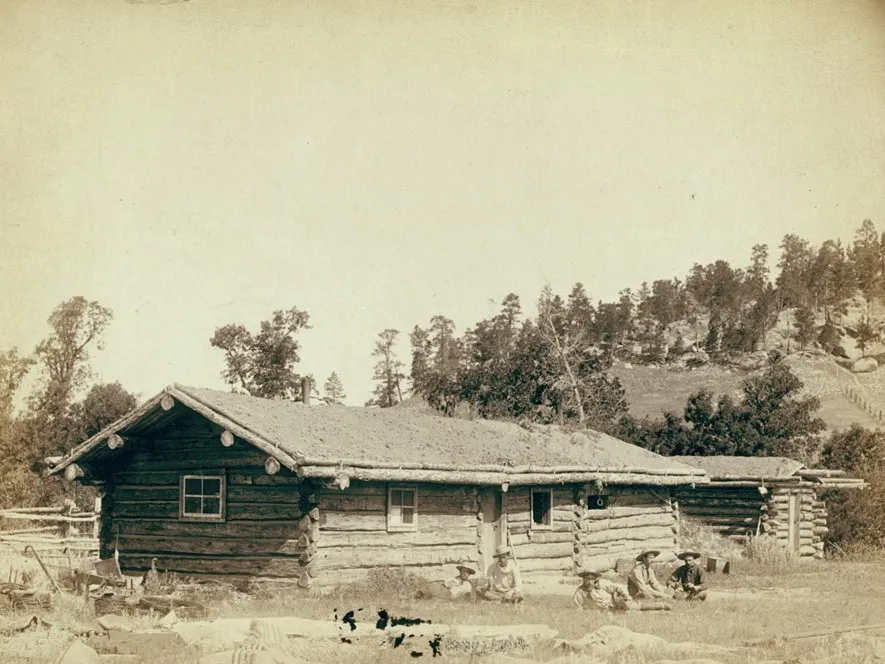
The Old Cabin Home, photographed by John C. H. Grabill, c. 1887–1892. Five men sit outside a log cabin in South Dakota.
Library of CongressFrame Houses
As the West developed into the 1880s and 1890s, so too did the complexity of pioneer homes. When the railroad expansions reached the frontier, people had greater access to building materials and tools. Booming towns and homes began to grow along rail lines where empty land once stood. These new homes utilized quality lumber, including glass windows and shingled roofs, and were painted. As settlers built larger homes, they now had more space to acquire goods, and vice versa. By the 20th century houses could be ordered via catalog, shipped to a location, and assembled on the spot.
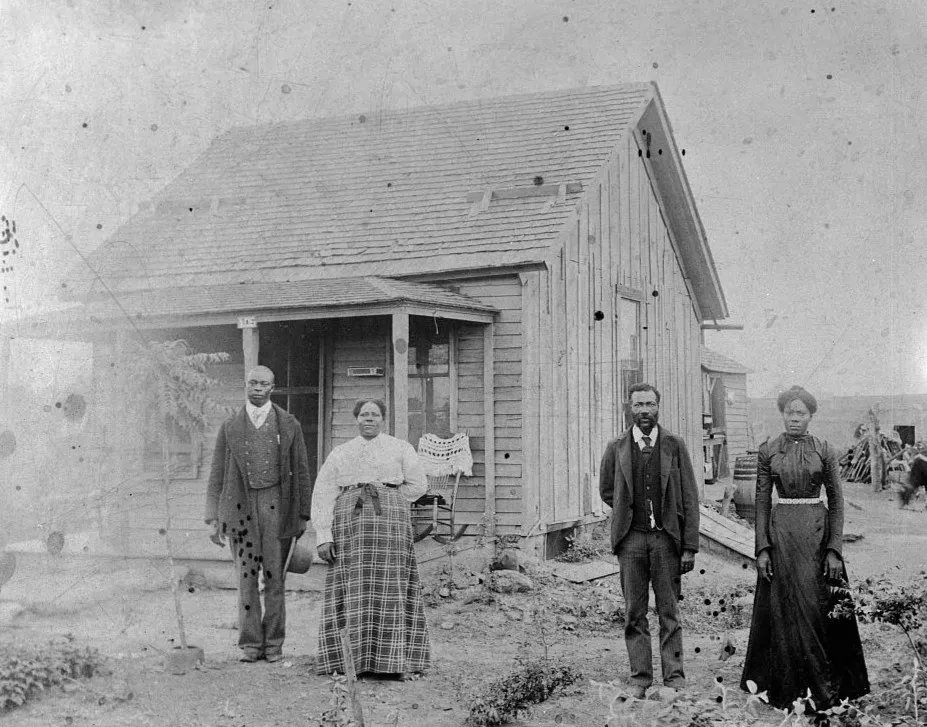
Early homestead near Nicodemus, Kansas, ca. late 19th-century
Library of CongressBoarding Houses and Hotels
When the influx of migrants traveling across the country grew, the demand for temporary housing did too. Throughout the frontier towns, small boarding houses and hotels began to sprout up to shelter people. Boarding houses offered longer stays where meals would be provided while hotel occupants mainly stayed briefly before moving on. Single men were the primary patrons of frontier hotels and were comprised largely of railroad laborers, prospectors, or individuals looking for work. Many frontier hotels, however, were not like modern hotels with amenities. They often included a couple of rooms with bunks that were shared by multiple travelers, especially in early “boomtowns”. It was also common for guests to share beds, sleeping head to toe in these cramped rooms.
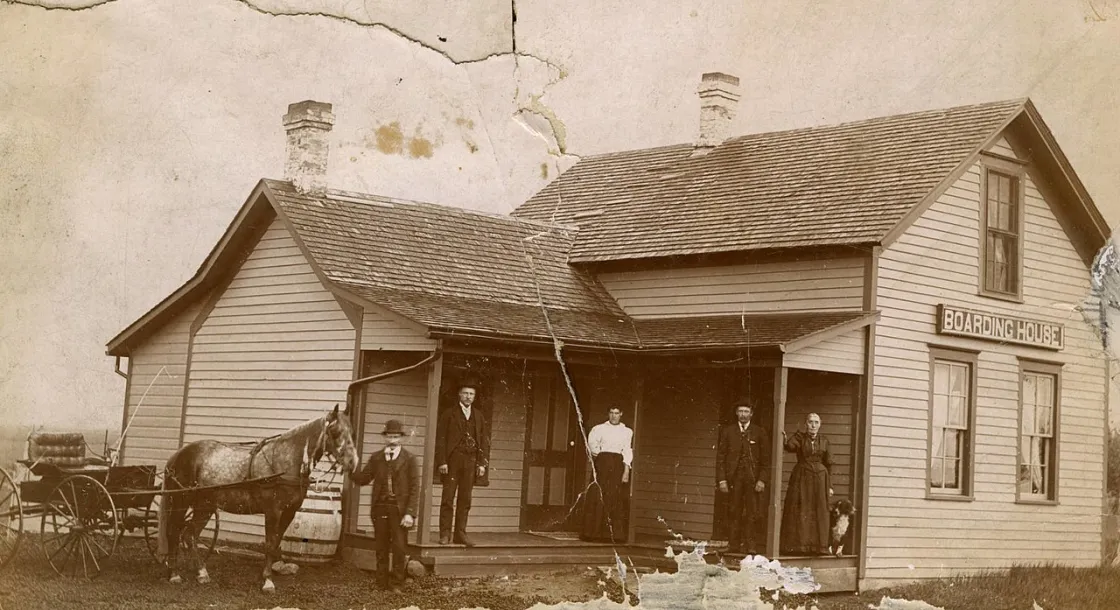
Boarding House in DeLamere, North Dakota, photographer unknown, c. 1890s.
Courtesy of Digital Horizons (North Dakota Memories Collection, ND State Library)
Further Reading:
- Giants in the Earth: O.E. Rølvaag
- Little House Book Series: Laura Ingalls Wilder
- True Stories of Nebraska Pioneers: Daughters of the American Revolution of Nebraska
- Pioneer Women: Voices from the Kansas Frontier: Joanna L. Stratton
- Bad Land: An American Romance: Jonathan Raban
- Prairie Fires: The American Dreams of Laura Ingalls Wilder: Caroline Fraser