Laura Ingalls Wilder
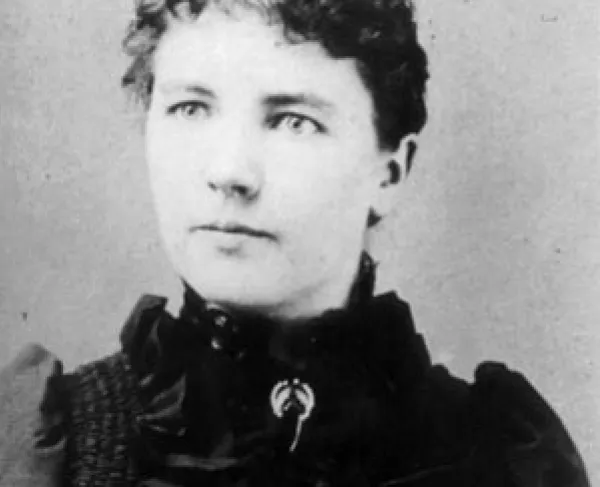
Laura Ingalls Wilder is often considered one of America’s most beloved authors, renowned for documenting the American frontier through her Little House book series. Her writings can be considered some of the best fictional works exemplifying the post–Civil War period of the United States in history. Born near Pepin, Wisconsin, on February 7, 1867, to Caroline and Charles Ingalls, Laura was the second oldest of four daughters who survived infancy. In 1869, at the age of two, Laura, Charles, Caroline, and her oldest sister Mary moved to Kansas near modern-day Independence.
This period of her life is documented in the book Little House on the Prairie. Although the family believed this area was open to white settlement, they were occupying Osage reservation land and were under threat of eviction from the United States government. Carrie Ingalls, the first of Laura’s younger sisters, was born here on August 3, 1870. The family would spend just two years in Kansas before moving back to the big woods of Pepin in 1871.
Looking to make a living as a farmer, Charles Ingalls once again packed up the family and headed west from Pepin in a covered wagon to Minnesota in early 1874. This time they settled along the banks of Plum Creek about 1.5 miles north of Walnut Grove, Minnesota. For the first few months, the family stayed inside a sod dugout along the banks of the creek. In Walnut Grove, the family endured financial hardships, losing crops twice during the locust plagues of the 1870s, which struck the Midwest, and battled prairie fires that nearly took their home.
After being offered an opportunity to run a hotel in Burr Oak, Iowa, the family decided to leave Walnut Grove for a year. During this period, the family also welcomed a baby boy named Charles Frederick, nicknamed Freddie, on November 1, 1875. Tragically, Freddie became gravely ill along the way to Iowa and passed away on August 27, 1876, at less than a year old.
The family’s time in Burr Oak is often referred to as the “missing link,” as Laura’s Little House series does not include the location. This is likely due to the rough times the family encountered and the relatively brief period they remained there. She does cover this period of her life in her manuscript Pioneer Girl, including the birth of her youngest sister, Grace, on May 23, 1877.
By 1877, the family returned to Walnut Grove, where they lived on land rented by William J. Masters. Adjacent to their home was the Masters Store and Hall, where Laura worked and attended church services. She credits reading the New York Ledger, a tabloid newspaper, during her time working there as being one of the inspirations for her writing.
In 1878, the family once again decided to move west along the railroad, which was rapidly expanding into South Dakota. Charles Ingalls, finding work as a bookkeeper with the Chicago and Northwestern Railroad, moved the family to De Smet, South Dakota. While in De Smet, the family endured the harrowing Hard Winter (or Long Winter) of 1880–1881, which saw historic blizzards across the Great Plains that blocked railroads and led to starvation in some cases.
Education remained an important aspect of the Ingalls’ upbringing, as Caroline Ingalls had been a schoolteacher prior to marrying Charles. In 1882, Laura followed in her mother’s footsteps and obtained her teaching license at the age of 15, a norm for the period. Although her passion for reading and writing remained strong, Laura did not enjoy teaching but felt obligated to continue. Luckily for Laura, this career would not last long, as she began courting a young man named Almanzo Wilder.
“Bessie” and “Manly,” as the two referred to one another, married on August 25, 1885, in De Smet. A little over a year later, Laura gave birth to her only surviving child, Rose Wilder, on December 5, 1886. The first years of their marriage were faced with hardships, including a house fire accidentally caused by Rose and Almanzo suffering a major stroke in 1888. Looking for a fresh start, the young family left De Smet behind for good and moved south to Mansfield, Missouri, in 1894.
They named their new home Rocky Ridge Farm and made a living off the land. As Rose grew older, she aspired to write and moved to San Francisco in 1908. Over the next two decades, she carved out a path as a respected author and journalist, writing for publications such as The Saturday Evening Post, Good Housekeeping, Harper's, Ladies' Home Journal, and Sunset. When Laura began writing local articles for the Missouri Ruralist, her daughter began encouraging her to continue.
Inspired by the stories of her father, Laura began to document her own experiences on the American frontier. With Rose as her primary editor, the two attempted to publish this manuscript, titled Pioneer Girl. Unfortunately for Laura, the nation was still reeling from the economic crash of 1929, and publishers were apprehensive. This was until the idea of turning the adult-themed manuscript into a children's book was raised. In 1932, Laura Ingalls Wilder’s first book, based upon her childhood in Pepin, Wisconsin, was published. Titled Little House in the Big Woods, the novel was met with praise from young children across the country. Realizing the potential, publisher Harper & Brothers ordered a second book to be written. Released in 1933, Farmer Boy details the childhood of Laura’s husband, Almanzo Wilder.
In total, eight books in the Little House series were published in Laura’s lifetime, with one released posthumously (nine in total). Laura Ingalls Wilder passed away at Rocky Ridge Farm on February 10, 1957, at the age of 90. She is buried in Mansfield, Missouri, alongside Almanzo.
Further Reading:
- Pioneer Girl: The Annotated Autobiography: Laura Ingalls Wilder and Pamela Smith Hill
- The Selected Letters of Laura Ingalls Wilder: Laura Ingalls Wilder and William Anderson
- Laura Ingalls Wilder: A Biography: William Anderson
- The World of Laura Ingalls Wilder: The Frontier Landscapes that Inspired the Little House Books: Marta McDowell
- Laura Ingalls Wilder: A Writer's Life: Pamela Smith Hill
- Little House in the Big Woods: Laura Ingalls Wilder