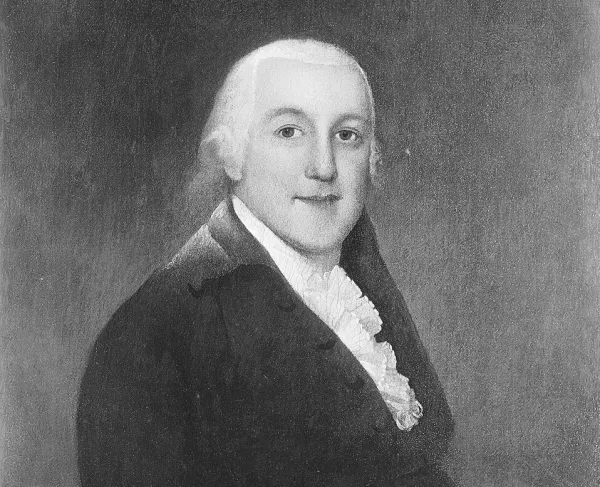
Richard Stockton
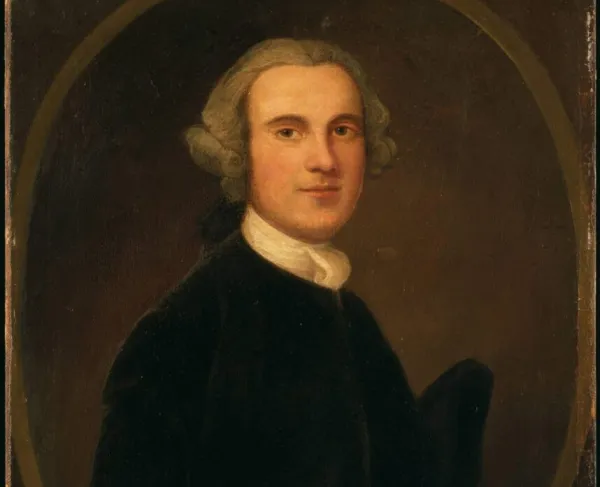
“The public is generally unthankful, and I never will become a Servant of it, till I am convinced that by neglecting my own affairs I am doing more acceptable service to God and Man,” Richard Stockton declared. Guided by his Quaker faith, Stockton hesitated to serve in public or elected office, but when he did, his wisdom and ideas carried influence. He was one of five signers of the Declaration of Independence from New Jersey.
Born on October 1, 1730, in Princeton, New Jersey, Richard Stockton was the eldest child of John and Hannah Stockton. His grandfather had arrived in the colonies in 1696 and settled on a large tract of land in the vicinity of the later-town of Princeton, New Jersey. Young Stockton’s father had inherited some of the land and the house called Morven; he served as judge of the court of common pleas and generously supported the College of New Jersey (which eventually moved to Princeton and was renamed Princeton University).
Through his father’s prominence and influence, Stockton studied at an academy in Maryland and then attended the College of New Jersey, a member of the first graduating class in 1748. After studying law with a prominent attorney, Stockton passed the bar at age 24 and began his practice in 1754. He gained a reputation throughout the colonies as a skillful and well-spoken attorney. In 1757, Stockton was elected a trustee of his alma mater, the first alumni invited to the board.
In 1757, he married Annis Boudinot, the daughter of prominent merchant, silversmith and postmaster in Princeton. They had six children, and in time, their eldest daughter married Benjamin Rush. Annis Boudinot Stockton was well-educated and a poet with more than 120 recognized published works; she was a praised participant in the literary scene of the colonies and early U.S. republic. The growing family lived at Morven which Stockton had inherited after his father’s death, along with land and enslaved people.
In 1766, Stockton journeyed across the Atlantic and spent time in England, Scotland and Ireland. Popular with British aristocrats, he attended at the royal court and was presented to King George III. He received a personal coat of arms and adopted a motto “Omnia Deo Pendent” (all depends on God).
Through initially hesitant to hold public office, in 1768 Stockton had a seat in New Jersey’s Provincial Council and in 1774 presided as a judge of the colony’s supreme court. Protests and tensions in the colonies convinced him that a compromise between Britian and the colonies was necessary. He drafted a self-government plan which he sent to Lord Dartmouth in 1774. Stockton proposed that the colonies would be independent of Parliament but retain their loyalty to the king, staying part of the British empire. He informed Lord Dartmouth that if a solution could not be found war would likely begin.
In June 1776, Stockton traveled to Philadelphia, Pennsylvania, to join the Continental Congress as a delegate from New Jersey. He first arrived on July 1, delayed by a storm, and missed John Adams’s speech in favor of independence. He asked Adams to repeat the speech, and Stockton judged that the other delegates were on the brink of voting in favor of independence. He became the first New Jersey signer of the Declaration of Independence.
Believing his place for public service was in the Continental Congress, Stockton declined the office of Governor of New Jersey and also the position of Chief Justice of New Jersey. Re-elected to the Continental Congress, he stepped into a new role, traveling to the Continental Army to assess the need for supplies. Stockton found American soldiers barefoot and felt overwhelmed by the scarcity of clothing, shoes and food. He wrote to a fellow delegate that he would have purchased supplies with his own money if the needed items could have been found.
He returned to New Jersey in November 1776 as British troops approached Princeton. Stockton took his family to a friends home in Monmouth County. The British soldiers plundered Morven, ransacking Stocketon’s library and furnishings and taking the livestock and food crops. An estimate in that era placed the damages at 5,000 pounds. Meanwhile, at his friend’s home, Stockton was betrayed by Loyalists, and British soldiers captured him. Taken to Perth Amboy, and then to the Provost Jail in New York, Stockton suffered harsh treatment for weeks. The Continental Congress advocated and remonstrated for his release, and he was eventually set free on January 3, 1777. Controversially, Stockton may have been forced to sign an oath of allegiance to King George III. Later in 1777, Stockton insisted that he canceled that oath by signing allegiance oaths from the New Jersey legislature to prove his devotion to the independence cause and his state.
Imprisonment destroyed his health and the British raid had damaged his home and fortune. Unable to physically continue his duties and needing to care for his family, Stockton resigned from the Continental Congress. He tried to resume his law practice. However, facial cancer plagued Stockton and spread to his throat, causing the last months of his life to be harsh and painful. He died on February 28, 1781, and did not live to see the end of the Revolutionary War and the security of the United States’ independence. Respected by his peers, Richard Stockton was eulogized by fellow patriots and academics from the College of New Jersey. He is buried at the Stony Brook Meeting House, a Quaker burial ground.