Caesar Rodney
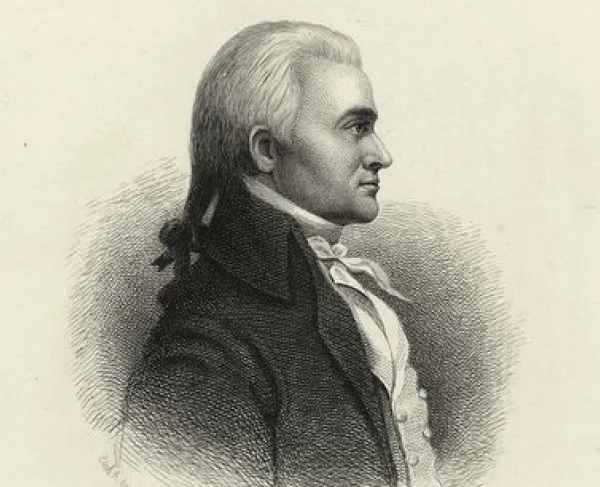
A signer of the Declaration of Independence, Caesar Rodney is most-remembered for his hurried return to Philadelphia in 1776 to cast his vote for independence.
Born on October 7, 1728, Caesar Rodney was the eldest son of Caesar and Elizabeth Crawford Rodney. His family’s plantation called Byfield was near Dover, Delaware, and had been established about four decades earlier, passing generationally in the family. Rodney’s family roots traced back to Scotland and England, including a distant relation to Jane Seymour who had been one of Henry VIII’s wives. He was sent to the Latin School in Philadelphia, Pennsylvania, for formal education. At age 17, Rodney took over the management of Byfield and the care of his mother and younger siblings after his father’s death. The family plantation spread across about 1,000 acres, and approximately 200 men, women and children were enslaved and worked on the property.
Throughout his life, Rodney held many appointed and elected offices. From 1755-1758, he served as high sheriff of Kent County in Delaware. He also was a justice of the peace and judge of all lower courts in this period of his life. He became captain of the Kent County Militia in 1756. Moving higher into colonial government positions, Rodney superintended the printing of Delaware’s currency in 1759, helped to revise and reprint the colony’s laws in 1762, and was an elected member of the Colonial Legislature assembly between 1762 and 1769. In the position of Speaker of the Assembly, Rodney brought forward a bill in 1766, prohibiting the importation of slaves into Delaware. He served as an associate justice in colony’s supreme court from 1769 to 1777.
Rodney courted several women but did not marry; he does not have any known descendants. His character and temperament were described as calm and considerate, and fellow delegates remembered as someone who tried to bring unity and was generally well-liked. He suffered from poor physical health during his life, troubled with asthma and suffering from a type of facial cancer. There was no cure for either at the time, but Rodney endured painful medical treatments and pushed on with his duties and elected offices.
His home county leaned loyal to the British King and Parliament during the rising tensions and the Revolutionary War. However, respected by fellow citizens, Rodney was elected to the Stamp Act Congress in 1765, an early example of colonial delegates gathering to discuss taxation, political representation and the colonial situations. Over the next nine years, Rodney continued in his elected and appointed offices. The Intolerable Acts closed Boston's port in 1774, following the Boston Tea Party. The news prompted Rodney to call a special session of Delaware’s assembly to sign Articles of Association, which gave support to Boston and protested the British actions. Also in 1774, Delawareans appointed Rodney to the First Continental Congress. The following year he returned to the Second Continental Congress, and signed the Olive Branch Petition, an attempt to reconciliation with King George III.
Armed conflict started in Massachusetts in the spring of 1775. Across the colonies, militias rallied and hurried to Boston, eventually forming the Continental Army under General George Washington’s command. Rodney’s duties increased during the Revolutionary War. He continued serving in the Delaware assembly, guiding the colony toward independence, and helped organize militia and supplies for the military cause. He continued to represent Delaware in the Continental Congress.
In spring 1776, Delaware had three delegates in the Continental Congress: Thomas McKean, George Read and Ceasar Rodney. A Virginia delegate, Richard Henry Lee, introduced a resolution on June 7, proposing that the colonies should declare independence. For several weeks, delegates debated and looked to the assemblies in their home colonies for direction. The Delaware Assembly instructed its three delegates to vote individually. McKean supported independence, Read stood against it. When the Continental Congress returned to session on July 1, Rodney was still in Delaware, helping to organize militia troops and dealing with local Loyalists. McKean sent a messenger to Rodney, advising him of the vote tie of the Delaware delegates.
Rodney departed and headed to Philadelphia immediately. He journeyed by carriage or horseback (or possibly both) in a hasty effort to reach Congress and cast his vote. After covering 80 miles in 18 hours, Rodney arrived and stood wet, muddy and ill to cast his vote for independence. His vote broke Delaware’s tie, allowing that state to join the tally in favor of independence. When signing the Declaration of Independence, Rodney and his two delegate colleagues all signed.
To defend the declared independence, Rodney served as a brigadier general and later became a major general in the Delaware Militia. He recruited troops to join the Continental Army and sometimes paid his own money to supply and equip new soldiers. General Washington recognized Rodney’s challenges and efforts, and Washington specifically asked him to take a field command in 1777 as the British occupied part of the state.
Delawareans elected Rodney as the state’s president in 1778, and during his term, he helped to guide the state’s ratification of the Articles of Confederation. In the early 1780s, he was elected to the Confederation Congress, but his failing physical health prevented him from taking his seat. He lived to see the end of the Revolutionary War in 1783 and the Treaty of Paris which secured the independence of the United States. Caesar Rodney died on June 26, 1784, at the age of 56 at his home on the Byfield plantation. He left most of his estate to his nephew, and in his will, ordered gradual emancipation for the enslaved people at Byfield. Rodney was originally buried on the plantation; he may have been reinterred at Christ Episcopal Church in Dover, Delaware in 1888 and a large monument stands there in his honor.
In the early 20th Century, Delaware placed a statue of Caesar Rodney in the U.S. Capitol’s Statuary Hall. Other monuments and tributes, both in his home state and across the nation, pay tribute Rodney and often memorialize his long ride to cast a vote for independence.