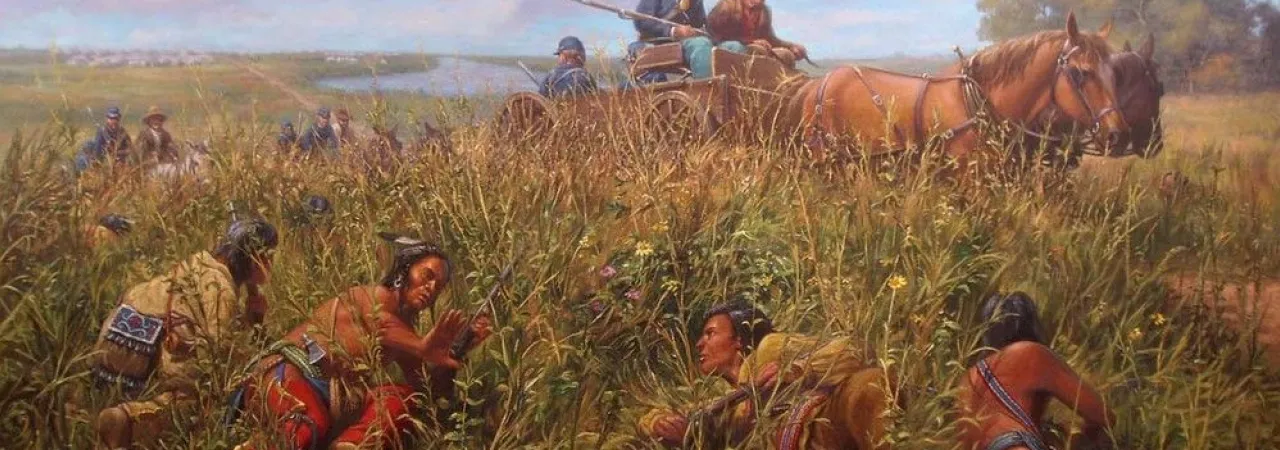
"Surprise at Wood Lake" by David Geister
The United States-Dakota War of 1862 remains one of the most complicated and underdiscussed conflicts in American history. Fueled by late annuity payments, starvation, and broken treaties, the conflict saw members of the Santee Sioux attack white civilian populations along the Minnesota frontier. The aftermath of the war led to mass internment, disease, and the exodus of the Dakota from Minnesota. As the United States waged war against the Confederacy, separate yet equally dark events were unfolding to the north.
The Santee Dakota, the eastern tribe of the larger Dakota nation, have considered the region around Minnesota their ancestral homeland for centuries. The name Minnesota is an English translation of the Dakota phrase Mni Sota Makoce, which means “the land where the water reflects the skies.” By the 1700s, the Santee Dakota lost large portions of their land after conflict with the Ojibwe. When the United States began to expand into the region in the 1800s, U.S. officials further pressured the Dakota into signing land treaties that further ceded portions of their territory to the American government.
The 1851 Treaties of Traverse des Sioux and Mendota gave 21 million acres of Dakota land to the United States. Consequently, the Dakota lost most of their territory in Minnesota and were confined to two reservations along the Minnesota River. The Treaty of Traverse des Sioux remains much debated today, as many believe the United States government was dishonest in its dealings with the Dakota. Modern translations from English to Dakota show discrepancies in the agreements, further contributing to contention between the two parties. The Dakota also became frustrated with the United States, which would often negotiate with tribes separately despite multiple bands utilizing the same tracts of land.
Another issue with the 1851 treaty was that, although defined, the United States failed to enforce the treaty’s boundaries and settlers often encroached on reservation land. In 1858, the Dakota ceded further land north of the Minnesota River to the United States in return for additional annuities and more clearly defined borders. Both the 1851 and 1858 treaties proved to be incredibly disadvantageous to the Dakota. Under the agreements, the United States government promised to provide payments to the Dakota; however, it withheld large portions of those payments. The government kept much of the money to repay alleged debts that the Dakota owed to traders.
“... by 1851 the traders had on their books debts amounting to almost half a million dollars. The fur trade was declining, and, without other means of getting their money, the traders looked to the funds the Indians would receive for their lands after signing the treaties. When the call for the treaty went out, traders flocked from posts near and far to Traverse des Sioux and Mendota to push the negotiations.” — Annual Report of the Commissioner of Indian Affairs, 1851
By 1862, the Eastern Dakota faced the threat of starvation after a poor crop yield, a brutal winter, and a sparse hunting season. Repeated tensions with white settlers further aggravated the situation, many of whom had just arrived from Europe as immigrants. The final straw came in August 1862, when the United States was two months late in delivering annuity payments to the Dakota. Marred by already existing corruption and embezzlement by Indian Affairs agents, the government was also occupied with the ongoing Civil War and failed to deliver on its agreement with the Dakota.
On August 4, 1862, roughly 800 Dakota men arrived at the Upper Sioux Agency, where they stormed a warehouse and retrieved sacks of flour. A deployment of volunteer Minnesota infantry attempted to halt the Dakota, and a short scuffle ensued, although no one was harmed. The Dakota and the U.S. agreed to a meeting between leaders to obtain desperately needed food on August 5, 1862. It was here that Andrew Myrick, a government trader, in response to the Dakota, uttered the words: “So far as I am concerned, if they are hungry let them eat grass or their own dung.” This statement became one of the catalysts for the events that unfolded twelve days later.
Four Dakota men embarked on a hunting expedition on August 17, 1862, where they encountered five white settlers near Acton Township in Meeker County. In this interaction the Dakota men murdered the group of settlers which included two women and a young girl. Realizing the severity of their actions, the men fled to a local village at Rice Creek, where they confessed to their elders. Expecting retaliation, a group of Dakota leaders gathered at the home of Little Crow (Thaóyate Dúta) to determine their next steps.
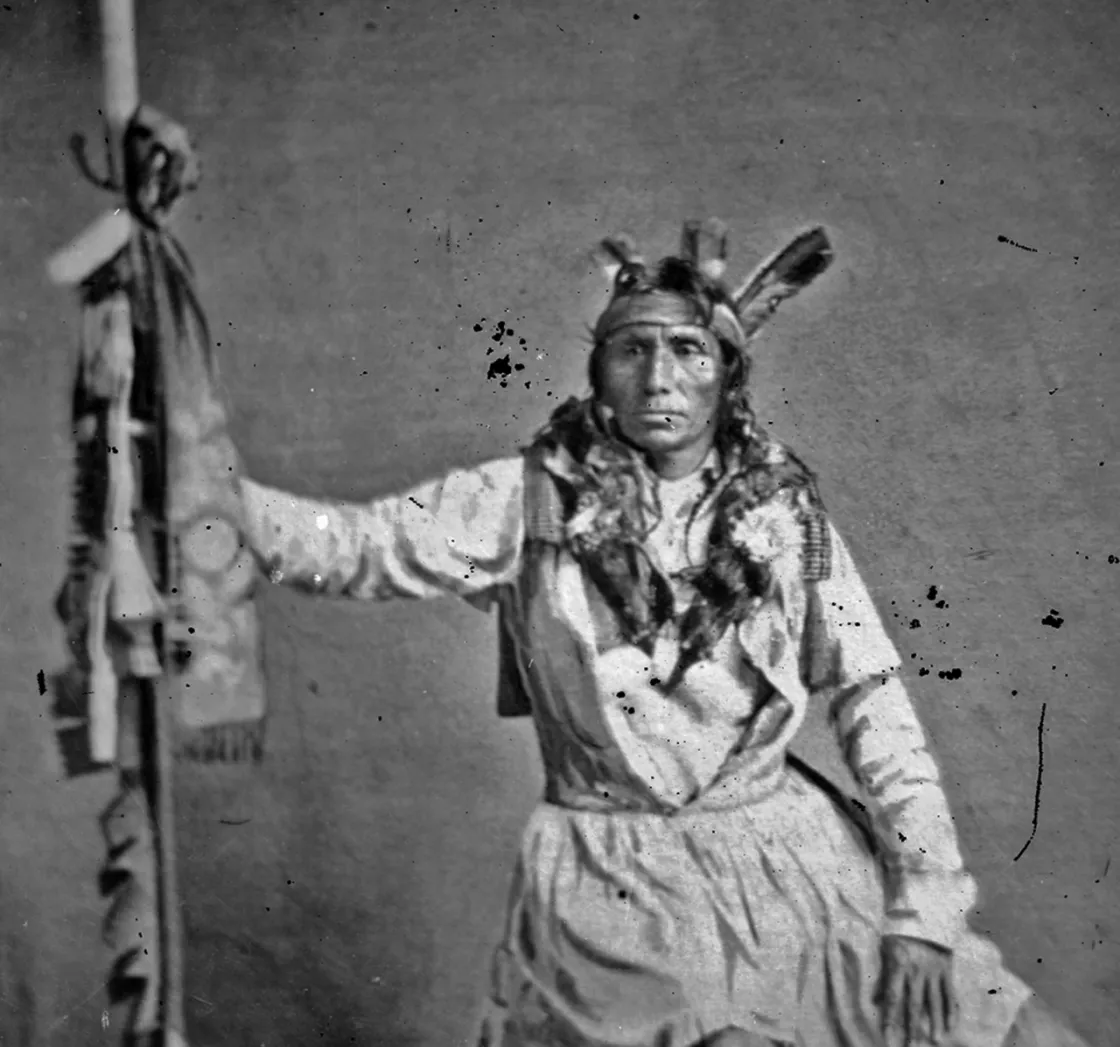
Little Crow, a chief of the Mdewakantonwan Dakota, became the leader of this war party. He initially believed that any retaliation against white settlers would be futile and argued that they must negotiate a truce. In the end, however, he was swayed and opted to lead an attack on the Lower Sioux Agency on August 18, 1862.
On the morning of the 18th, the Dakota war party converged on the agency, where they attacked its occupants, including Andrew Myrick. Myrick’s decapitated head was later found in a nearby field with grass stuffed in his mouth. Under the direction of Little Crow, the warriors raided the agency’s supplies of food, weapons, and clothing while continuing the massacre. By the end of the day, thirteen whites lay dead at the Lower Sioux Agency, with a further seven killed while attempting to flee to Fort Ridgely, roughly fourteen miles to the southeast. Ten settlers were also taken captive in the aftermath.
Little Crow’s men often exercised discretion regarding those they killed or captured, sometimes sparing individuals who had treated them well while inflicting harsh punishment on others they did not favor. As the attacks continued, Dakota leadership lost more control over the men, leading to more brutal acts against settlers. Accounts of sexual assault against captured women were reported, although only two Dakota men were ever convicted of these crimes. Despite these atrocities, many Santee tribal elders denounced the violence, and some Dakota even put their own safety at risk to protect settlers.
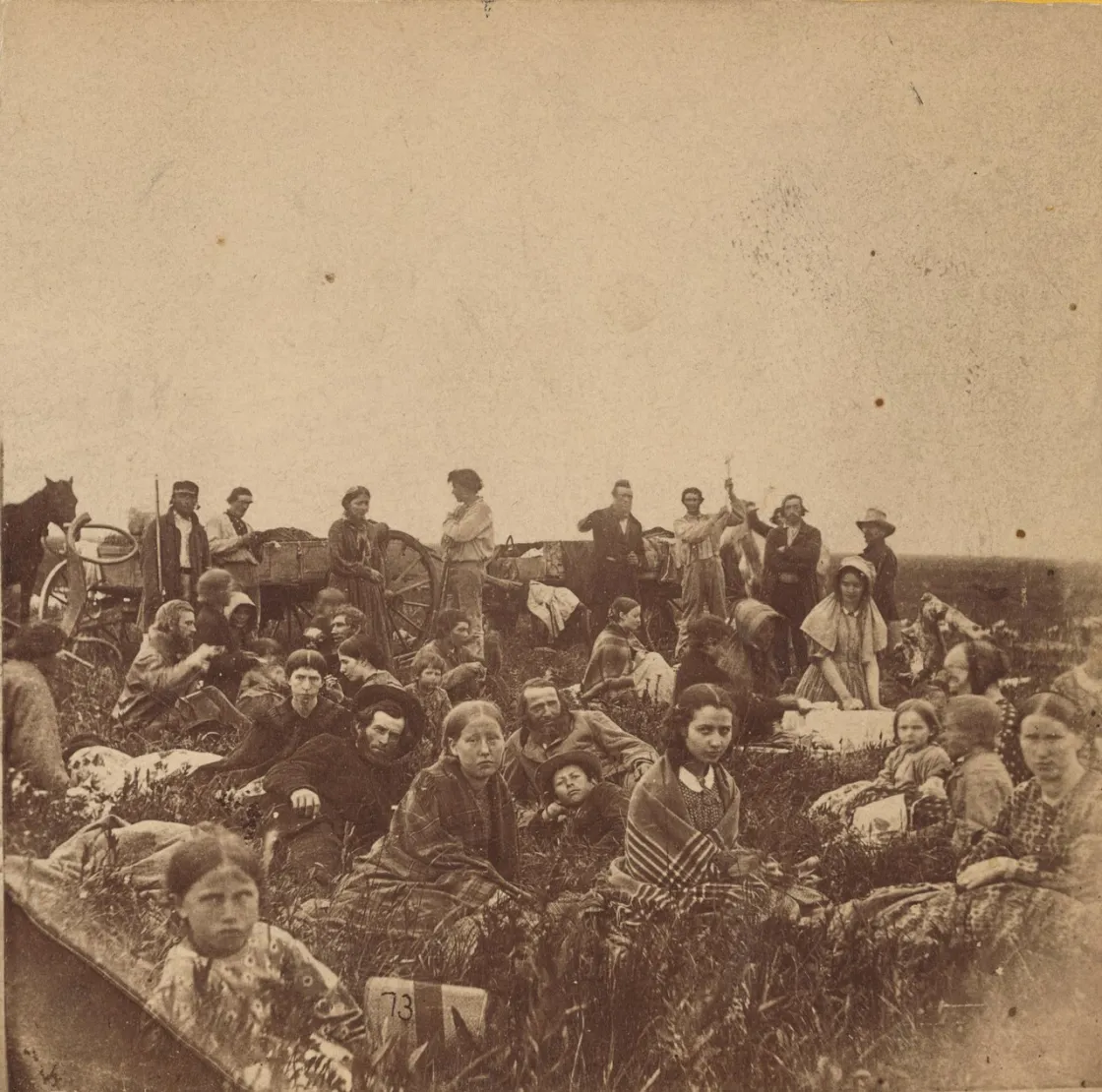
People Escaping from the Indian Massacre of 1862 in Minnesota, at Dinner on a Prairie, photographed by Adrian John Ebell, 1862. The photograph depicts refugees gathered for a meal during the U.S.–Dakota War of 1862.
Library of CongressThat same day, a detachment of B Company of the 5th Minnesota Infantry Regiment left Fort Ridgely to investigate the attack on the Lower Sioux Agency. The Dakota located and ambushed the unit at the Battle of Redwood Ferry. The force, led by White Dog (Sun'ka Ska), killed 24 of the company’s 47 men; an additional man drowned, and five more were wounded. The remaining survivors fled back to the safety of Fort Ridgely.
From the Lower Sioux Agency, the Dakota moved southeast to the town of New Ulm, attacking white settlements along the way. Families, including women and children, were brutally murdered in their rural homes until the war party reached New Ulm on August 19. A militia organized by the town’s citizens, as well as two companies of the 5th Minnesota Infantry Regiment, drove off the Dakota attack, although a portion of the village was burned.
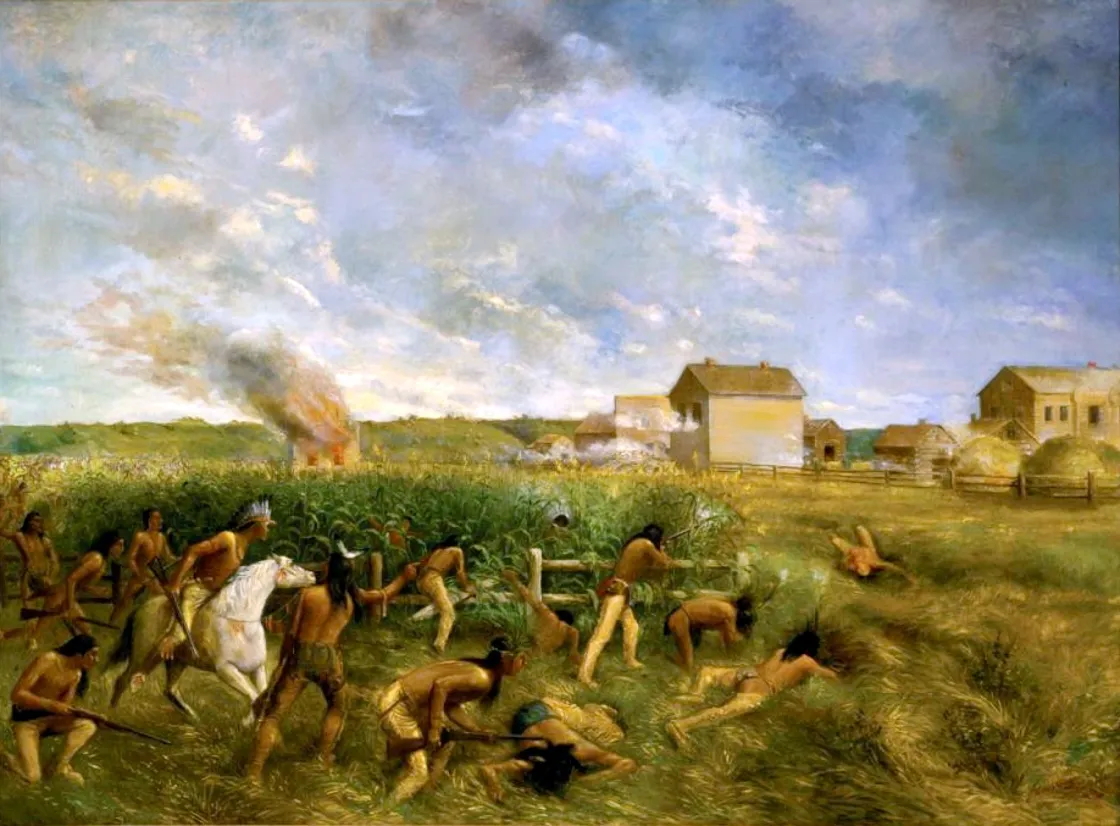
Attack on New Ulm, by Anton Gág, 1904. The painting depicts the Dakota attacks on New Ulm, Minnesota, in August 1862, during the U.S.–Dakota War.
Public DomainA day later, on August 20, 1862, Little Crow, along with 400–600 men, launched an attack on the United States’ 210-strong military outpost at Fort Ridgely. Riding out into the open, Little Crow created a brief diversion while his men opened fire from a ravine north of the fort. The Americans utilized artillery to prevent penetration by the Dakota, and by the end of the first day, the fort remained in their possession. The Dakota initiated a final attack on the 22nd, which forced the occupants to burn a portion of the fort to prevent access. The Americans repelled this assault, just as the first had been, and the Dakota abandoned attempts to capture Fort Ridgely.
Following the defeat at Redwood Ferry, the U.S. sent an expedition out on August 31 to investigate the site and recover the bodies for burial. By the evening of September 1, the burial party recovered the remains of around 75 individuals who had been slain. That night, they decided to set up camp on an open prairie referred to as Birch Coulee. The position was tactically unsafe, as it left virtually no cover from attack. Soon, a force of 200 Dakota led by Gray Bird (Zitka Ta Hota), Mankato, Big Eagle (Waŋbdí Táŋka), and Red Legs (Hu Shasha) located and encircled the camp. The battle commenced under cover of night and devolved into a 30-hour siege in which the settlers desperately fought to avoid being overrun.
Finally, on September 3, Colonel Henry Sibley, accompanied by artillery and 240 troops, arrived at the encampment to lift the siege. The Dakota had planned a final assault; however, American artillery forced them to disperse and retreat. By the end of the days-long battle, 13 men and 90 horses lay dead, with over 40 more seriously wounded. Birch Coulee marked the bloodiest engagement of the war for the American military.
For several weeks, Dakota warriors continued to roam the region, carrying out assaults into Dakota Territory and along the Iowa border. Seeking to retake control of the region, the 3rd, 6th, and 7th Minnesota Infantry Regiments, under the command of Colonel Sibley, left Fort Ridgely for the Upper Sioux Agency on September 19, 1862. The force, ranging from 1,450 to 1,619 soldiers, reached Lone Tree Lake three days later, on September 22. By the time Sibley set up camp near Lone Tree Lake, Little Crow had already received word of their movements and planned an ambush for the following day.
On the morning of September 23, members of the 3rd Infantry Regiment broke off from the main force to forage potatoes. Unbeknownst to them, they were heading directly into Dakota lines. The concealed Dakota, moments away from being run over, opened fire on the American wagons. Thus, the Battle of Wood Lake—something of a misnomer, as the combat took place closer to Lone Tree Lake—commenced. The ambush alerted the larger American force to the Dakota position, and the element of surprise was unintentionally lost.
For the next two hours, the Dakota and Americans engaged in combat, each attempting to flank the other along the plains and ravines around Lone Tree Lake. The deciding factor in the battle was American artillery, which neutralized Dakota positions and killed Chief Mankato. Accounts from Chief Big Eagle also reveal that many Dakota were positioned too far from the action to effectively repel American charges. The fighting killed seven Americans and between 14 and 30 Dakota with the larger Dakota force being compelled to retreat. The Battle of Wood Lake effectively shattered the Dakota's military organization and signaled the end of attacks in Minnesota.
On September 26, 1862, the Dakota surrendered and transferred 269 white and “mixed-blood” prisoners to Colonel Sibley at Camp Release, marking the conclusion of the conflict. Shortly after the surrender, Colonel Henry Sibley organized a military tribunal which was tasked with determining which Dakota had participated in the murders of roughly 100 white settlers. The trials began on September 28, 1862, and continued until November 3. Out of roughly 400 Dakota men brought to trial, 303 were convicted of war crimes and sentenced to hanging. Historians have since questioned the validity of many convictions because the Dakota largely lacked proper legal representation and were often not fluent in English.
President Abraham Lincoln reviewed these cases before commuting all but 38 of the sentences. On December 26, 1862, U.S. authorities hanged these 38 men at Mankato, marking the largest mass execution in United States history. Two additional men were later captured and likewise executed. On July 3, 1863, Little Crow, who had been in exile since the end of the war, was killed by Nathan Lamson after a gunfight near Hutchinson, Minnesota. He was identified by a coat that had belonged to a white settler who was murdered days earlier. The settlers then scalped and mutilated his body before placing his remains on public display, where they remained for over 50 years.
Following the surrender and trials, roughly 1,600 to 2,000 Dakota were detained and held in an internment camp located below Fort Snelling. Authorities imprisoned nearly the entire Dakota population of Minnesota, most of whom had not participated in the conflict. Conditions at Fort Snelling were treacherous, as the Dakota endured the harsh winter of 1862–1863. An outbreak of measles within the camp further exacerbated the humanitarian crisis. From November 1862 to May 1863, an estimated 130–300 Dakota, or 6–18% of those detained, died at Fort Snelling.
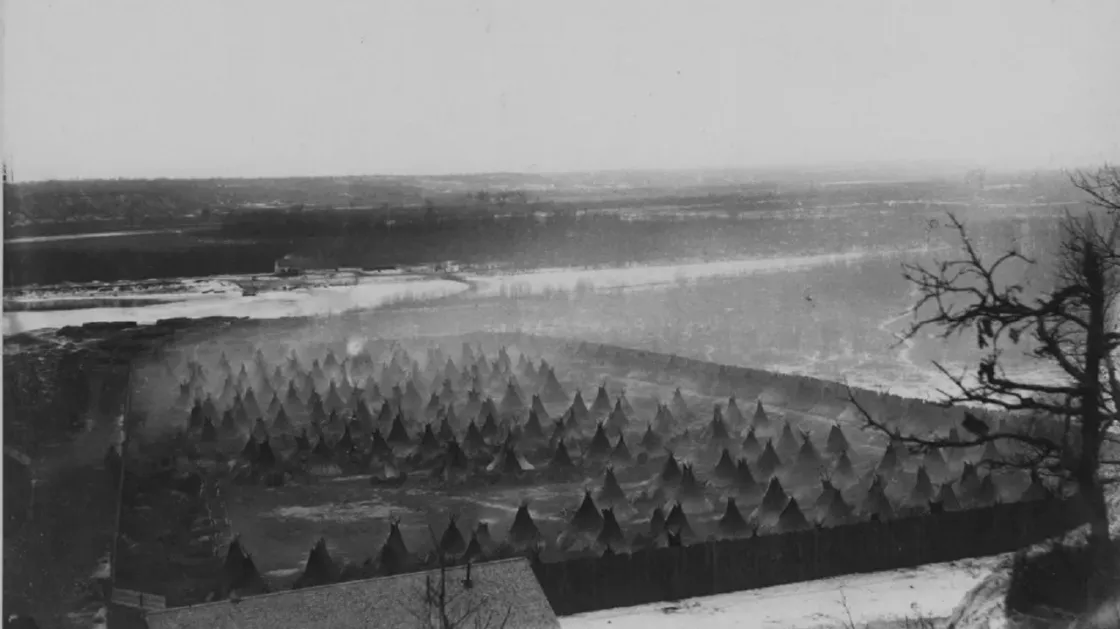
Captured Sioux Indians in Fenced Enclosure on Minnesota River Below Fort Snelling, photographed by Benjamin Franklin Upton, 1862–1863. The photograph depicts Dakota people confined at an internment camp near Fort Snelling, Minnesota, following the U.S.–Dakota War of 1862.
Minnesota Historical SocietyThe United States government voided all treaties with the Dakota and Ho-Chunk peoples in Minnesota in early 1863. On March 3, 1863, Congress passed the Sioux-Dakota Removal Act, which banished the Sisseton, Wahpaton, Medawakanton, and Walhpakoota bands from Minnesota. The Ho-Chunk, who occupied the Blue Earth Reservation, had not participated in the war but were located on valuable agricultural land and therefore removed as well. That summer, on July 4, 1863, Governor Alexander Ramsey issued General Orders No. 41, which placed bounties on Dakota men in Minnesota. This order was later amended to specify “hostile” men.
With the removal of the Dakota and Ho-Chunk, the war opened vast sections of fertile land in Minnesota to white settlers. The 1860 Minnesota census recorded 172,000 people in the state. Roughly one-third of the population was foreign-born, and only 1% was considered Native American. By 1870, the population had ballooned to over 439,000, a 150% increase. Census records indicate that only about 700–800 Native Americans remained in the state in 1870, compared to over 2,300 in 1860.
Further Reading:
- Through Dakota Eyes: Narrative Accounts Of The Minnesota Indian War Of 1862: Fred Anderson: Gary Clayton Anderson and Alan R. Woolworth
- Mni Sota Makoce: The Land of the Dakota: Gwen Westerman and Bruce White
- Dakota Prisoner of War Letters: Dakota Kaskapi Okicize Wowapi: Clifford Canku and Michael Simon
- Massacre in Minnesota: Gary Clayton Anderson
- The Dakota War of 1862: Minnesota's Other Civil War: Kenneth Carley
- Little Crow/Taoyateduta: Leader of the Dakota: Gwenyth Swain

Related Battles
41
15