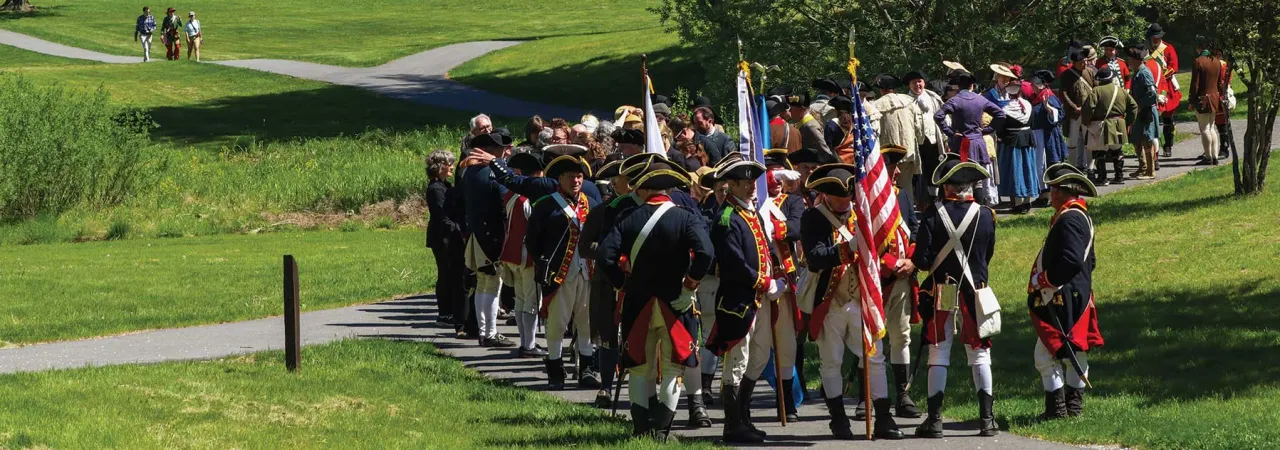
A procession makes its way to the Repose of the Fallen memorial, where the remains of 44 individuals would be laid to rest more than two centuries after their deaths.
It was late morning on Friday, May 22, the start of Memorial Day weekend, when visitors and residents gathered atop a hill in New York’s Lake George Battlefield Park. Below them, four small, pinewood caskets were placed gently under the shade of a tree. Behind the caskets, more than 80 people mingled, most dressed as colonial- era Revolutionary War reenactors, and others solemnly in black with green ribbons pinned to their chests.
All were awaiting cannon fire from nearby Fort William Henry to signal the start of a procession to the new Repose of the Fallen memorial. The caskets — three draped in the Grand Union Flag (the first recognized flag of the United States), the last in a bright teal banner of the First Pennsylvania Battalion — held the remains of the final four individuals to be ceremonially reinterred in its individual niches.
The recent journey of those individuals honored by the memorial — 44 in all, thought to be Continental Army soldiers or associated personnel — began in February 2019, when unmarked graves were discovered during a construction project on Courtland Street in Lake George, N.Y. But in another sense, their story can truly be traced back to 1775.
The Quebec Campaign was the newly formed Continental Army’s attempt to capture the French-speaking city to entice those colonies ceded by France during the Seven Years’ War to join the American Revolution. It was a disaster: After a perilous journey through the wilderness, the Continentals suffered a resounding defeat at the city gates on December 31, 1775, including the death of General Richard Montgomery. The chaos of the retreat back to Fort Ticonderoga was compounded by a smallpox outbreak.
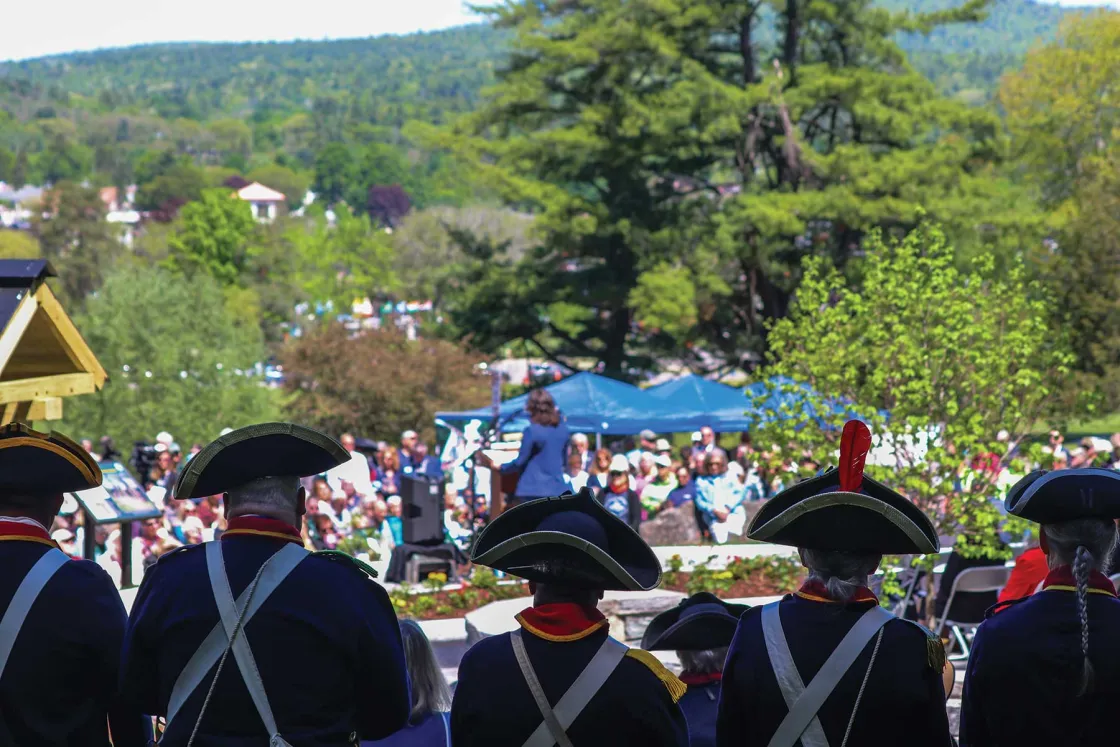
Visitors gather at Lake George Battlefield State Park for the reinterment ceremony honoring 44 individuals whose remains were discovered nearby.
Fatima Esquivel BenjaminOn July 7, 1776, just days after the Declaration of Independence was formally adopted about 300 miles to the south, a military hospital was established at Fort George, on the southern end of Lake George, in an attempt to control the disease’s spread. Boats of sick soldiers were sent south to the new hospital. According to a late August journal entry by Dr. Lewis Beebe, who had seen the misery of the soldiers in the throes of the disease in Quebec, “Visited the hospital found the number of sick to be about 700, viewed the burying place counted upwards of 300 graves … the appearance of which was melancholy indeed, to see such desolation made in our army.”
It took nearly 250 years for some of those graves to be accounted for. Seven years ago, the accidental discovery of skeletal remains halted the Courtland Street construction project. Additional intact graves were located on the site, and several more sets of remains were identified within earth that had recently been excavated. What followed was an epic collaboration that took two years and hundreds of volunteers sifting through the soil to recover and catalog the remains.
Additional intact graves were located on the site, and several more sets of remains were identified within earth that had recently been excavated. What followed was an epic collaboration that took two years and hundreds of volunteers sifting through the soil to recover and catalog the remains.
Lisa Anderson, a bioarchaeologist at the New York State Museum, ultimately identified at least 44 distinct individuals from the disturbed resting place now referred to as the Courtland Street Burying Ground. The remains stayed with Anderson and her team in Albany as they learned all they could from the bones and prepared them to be reinterred.
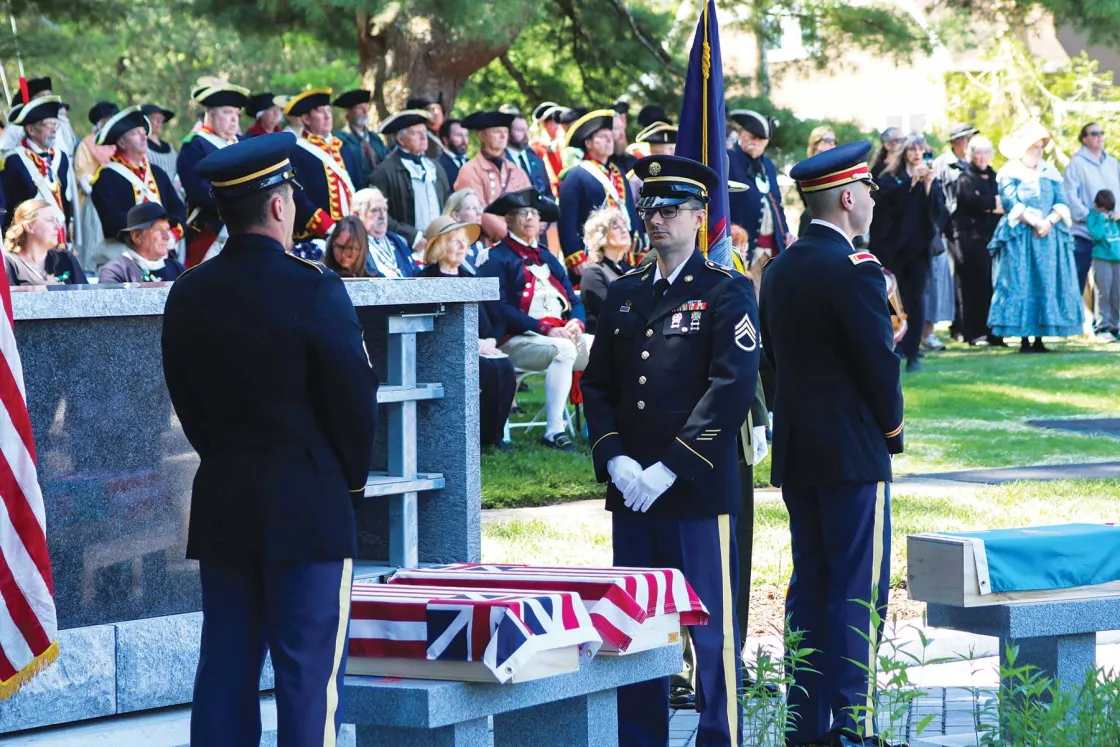
Pine caskets containing the final remains to be waiting to be reinterred at the Repose of the Fallen memorial at Lake George Battlefield State Park, N.Y.
Fatima Esquivel BenjaminAlthough the specific identities of those now reinterred remain unknown, the archaeological evidence — including the location of the burial ground, the age and condition of the remains and the presence of uniform buttons from the First Pennsylvania Battalion (a unit that fought in the Quebec Campaign) — indicates that these individuals were likely soldiers and military personnel associated with the 1776 Fort George military hospital. At least one of the individuals was a woman, another a child.
Once it was known the remains were mostly soldiers, planning for a memorial to honor them was swift. A committee was formed to coordinate its design to ensure it would blend in with the surroundings of Lake George Battlefield State Park, which includes the archaeological remains of Fort George and the hospital, as well as the site of a 1755 battle during the French and Indian War. The Repose of the Fallen memorial was designed to offer dignity to those whose identities may be forever unknown but whose sacrifice will never be forgotten.
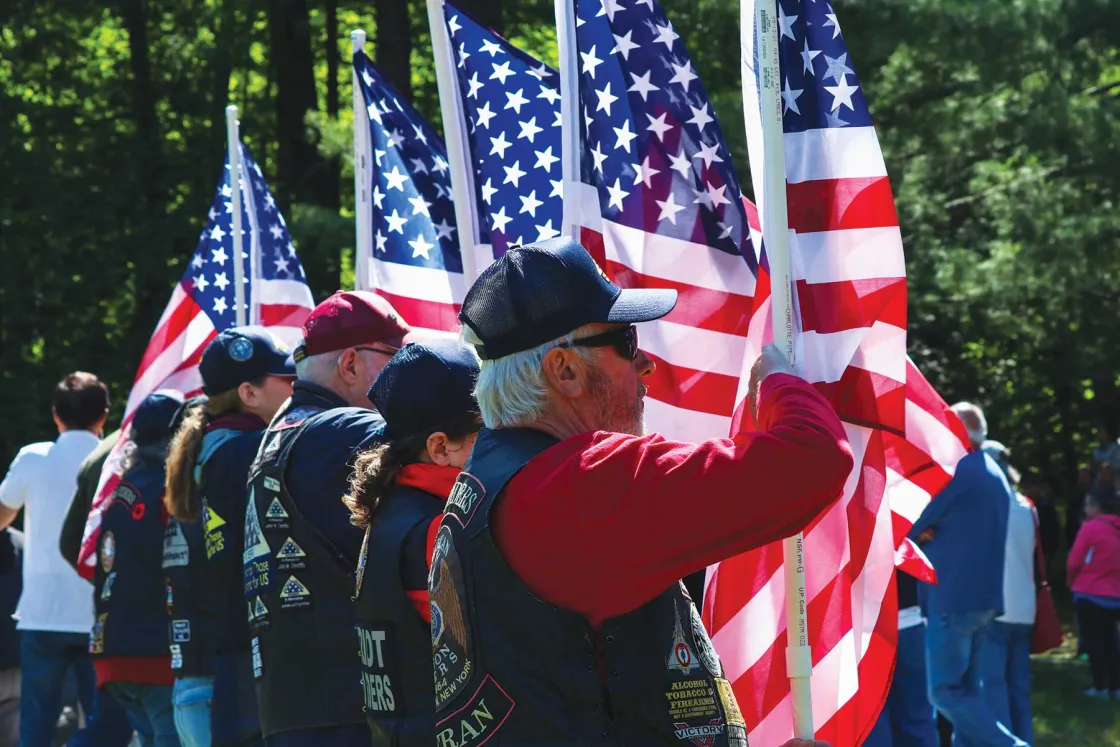
Veterans stand with American flags during the solemn reinterment ceremony at Lake George Battlefield State Park, where the remains of 44 individuals were laid to rest.
Fatima Esquivel BenjaminIts burial niches, interpretive panels and peaceful gathering space create a permanent place for visitors to honor and remember those lost during the founding of our country — and in the 250 years since — making the Memorial Day Weekend dedication most fitting.
Days before the ceremonial reinterment, a two-hour procession led by New York State Police, NY-PENN Military Vehicle Collectors and the Patriot Guard Riders brought the remains back to Lake George. Most were reinterred immediately, but four were kept under vigil at a nearby church for the dedication itself.
The ceremony took place under brilliant blue skies, with Lake George sparkling in the sun. Many of the attendees, including those who carried the remains across the battlefield park on the final leg of their journey, wore green ribbons to identify that they were volunteers involved in the recovery at Courtland Street.
“It’s kind of overwhelming … it’s been a long time coming. We’ve been working pretty much nonstop on this, but knew that this day would come,” said archaeologist Anderson, her own green ribbon pinned to her lapel. “It’s been an honor.”