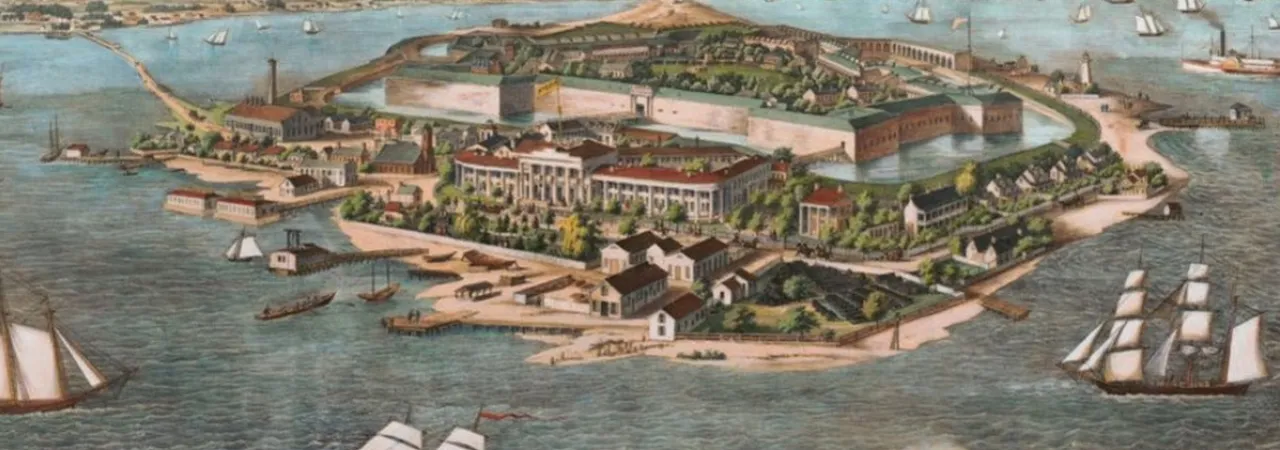
Fortress Monroe, Old Point Comfort, and Hygeia Hotel, Va.
Fort Monroe was a crucial fort throughout American history for its strategic location at the mouth of both Hampton Roads and the Chesapeake Bay. The largest military fort in the United States, it has served various integral functions for the nation.
The edge of the Virginia Peninsula, known as Old Point Comfort, was first scoped out by John Smith and the Jamestown colonists. In 1609, they recognized the area for its strategic value and established Fort Algernon on the grounds where Fort Monroe would later stand. Ten years later, the Jamestown colonists bought twenty enslaved Africans at Fort Algernon, marking the first case of African chattel slavery in the 13 colonies. Over the years, many forts were established here, including Fort Old Point Comfort in 1632 and Fort George in 1728. After the American Revolution, and with destruction of Fort George by a hurricane, the area remained bare for a few decades.
However, the ease with which the British entered the Chesapeake and burned Washington, DC made the War Department reconsider the importance of coastal defense. President James Monroe directed the construction of forts along the eastern seaboard in 1819 with a principal fort at the strategic Old Point Comfort to command the system. Three years later, the construction of Fort Monroe began. The irregular hexagonal bastion fort was designed by Simon Bernard, brevet Brigadier General in the Engineers and former aide to Napoleon, to be the biggest fort ever constructed in the United States. Surrounded by a moat and holding approximately 400 guns and up to 2,600 soldiers, Fortress Monroe was highly defensible upon its completion in 1834.
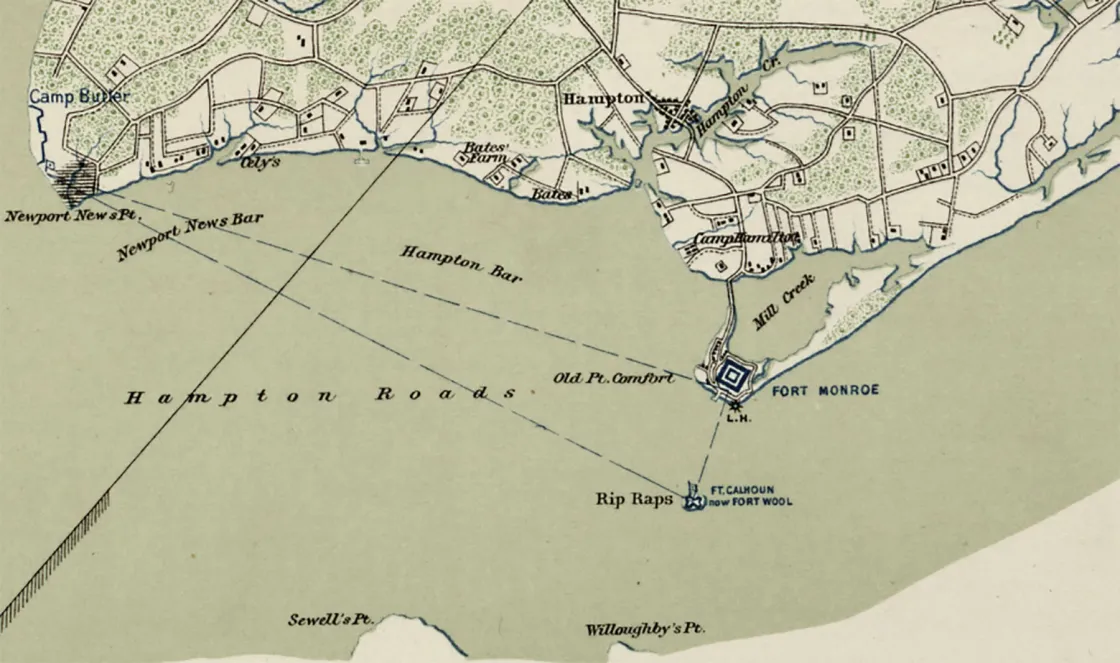
As early as the 1820s, Fort Monroe was used militarily for training and garrisons. The Artillery School of Practice operated in the fort from 1824-1834 and again from 1858-1861. It was also home to proving grounds for testing the artillery. Future Confederate General Robert E. Lee was garrisoned at the fort for three years as a first lieutenant starting in 1831. The young military engineer played a major role in the construction of Fort Monroe and Fort Calhoun, its sister fort across Hampton Roads. While the antebellum years were rather quiet, Chief Black Hawk was detained in Fort Monroe after the 1832 Black Hawk War in a particularly memorable episode.
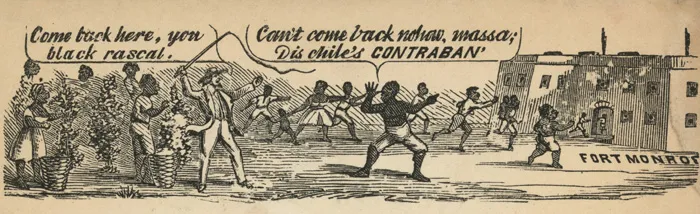
A new era for the fort began after Virginia seceded from the Union in May, 1861. President Abraham Lincoln quickly sent troops to protect Fort Monroe. Despite Virginia’s protestations, the Union kept the fort for the duration of the Civil War, becoming the only bastion of Union control in the tidewater region until the spring of 1862. When three slaves ran away to seek protection at the fort, commanding officer Major General Benjamin Butler decided to shelter them. Issuing the Fort Monroe Doctrine, Butler decreed that enslaved people were considered contraband and thus would not be returned to their enslavers. Within a few weeks, five hundred slaved took the dangerous trek to freedom at Fort Monroe. By the end of the war, tens of thousands of slaves were freed from the fort, earning it the nickname “Freedom’s Fort.”
On March 8, 1862, Fort Monroe witnessed the Battle of Hampton Roads, the first battle between two ironclads. The engagement between the CSS Virginia and the USS Monitor took place right outside the fort which, while inconclusive, marked a new era for naval warfare. Ten days later, Major General George B. McClellan began landing his men at Fort Monroe in preparation for operations against Richmond in the Peninsula Campaign. With 121,500 soldiers, McClellan began marching up the Virginia Peninsula, reaching the gates of Richmond before being forced back in the Seven Days' Battles. On May 6, President Abraham Lincoln arrived at Fort Monroe to plan the capture of Norfolk. During his stay, the first 15-inch Rodman gun was tested, earning it the nickname the “Lincoln Gun.” A few days later, on May 10, General John Woll successfully recaptured Norfolk and with it, full control of Hampton Roads.
Fort Monroe was also critical in the ending of the Civil War. In 1864, Major General Benjamin Butler formed the Army of the James and the Second U.S. Colored Cavalry Regiment, both of which contributed to the Siege of Petersburg. On February 3rd, President Lincoln met Confederate leadership aboard the steamboat River Queen in the unsuccessful Hampton Roads Peace Conference. After the Confederate surrender, Jefferson Davis was arrested and kept in Fort Monroe for two years. In poor health, Davis was released in May 1867.
After the war, the Artillery School of the United States Army was set up inside the fort. Opening in 1867, the school would remain active until 1946 (it was renamed to the Coast Artillery School in 1907). Twenty years later, in 1886, Secretary of War William C. Endicott’s Board of Fortification recommended an improvement plan to Fort Monroe known as the Endicott Program. It replaced the existing weaponry with modern guns and mortars, concrete batteries and controlled minefields. The outbreak of the Spanish-American War and fears of a Spanish invasion motivated the rapid implementation of the plan. Simultaneously, the fort became the headquarters of the Coastal Defenses of Chesapeake Bay of the artillery corps. In 1907, the Jamestown Exposition was held at Hampton Roads, and President Theodore Roosevelt visited to see off the Great White Fleet for its world tour.
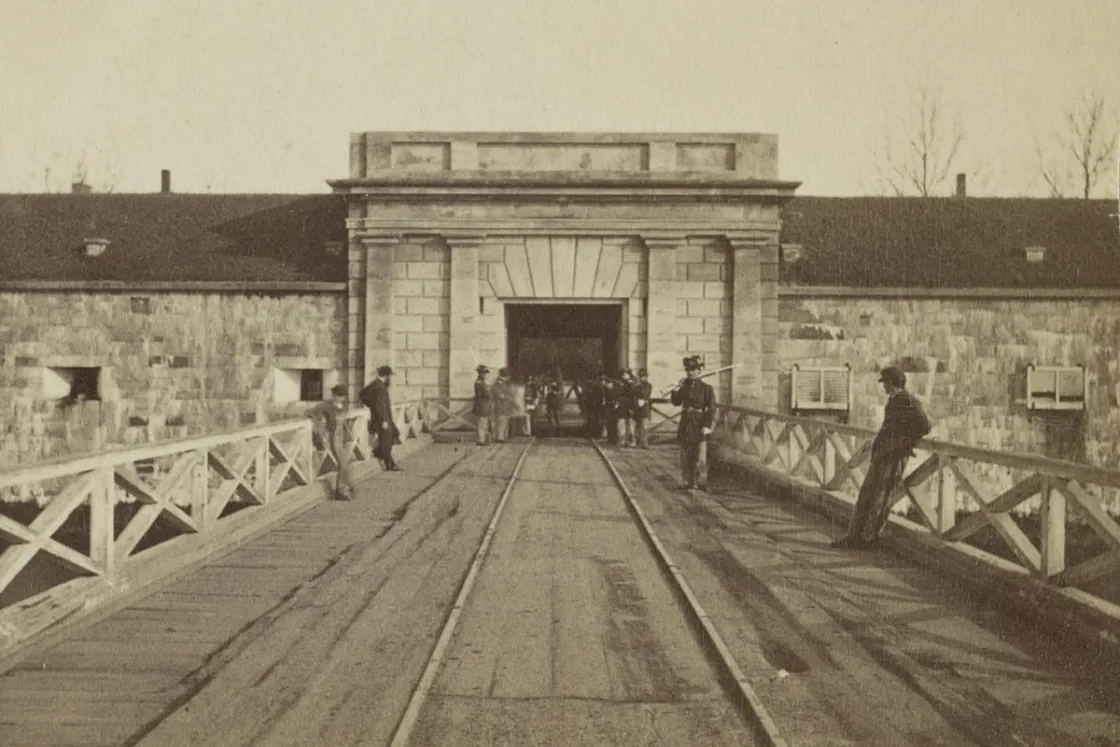
During the Civil War, Fort Monroe was the only Union controlled fortified base in the Upper South and it soon became known as “Freedom's Fortress” by African Americans who sought escape from bondage.
Read more about Fort Monroe.However, the construction of other forts and invention of new technologies made Fort Monroe lose prominence in the 20th century. During World War I, the fort was used to set up submarine nets to protect Hampton Roads and the Chesapeake Bay from German U-Boats. It also served as an important mobilization and training center for the Coastal Artillery Corps shipping off to the Western Front. The construction of Fort Story in Virginia Beach in 1922 lessened the strategic importance of Fort Monroe and consequently, during World War II, guns and ammunition were moved out of the fort. Instead, it acted as a hospital and minelaying depot. At the end of the war, with the invention of new naval aviation and long-range bomber technology, the fort’s traditional coastal defenses became useless.
Fort Monroe eventually became a training camp instead. When the army was reorganized in 1973, the fort was picked as the headquarters of the U.S. Army Training and Doctrine Command. Fort Monroe would remain active until 2011, when it was officially decommissioned. Today, preserved by the National Parks Service, Fort Monroe is a national monument.
Related Battles
369
24