1812: "Fourth of July"
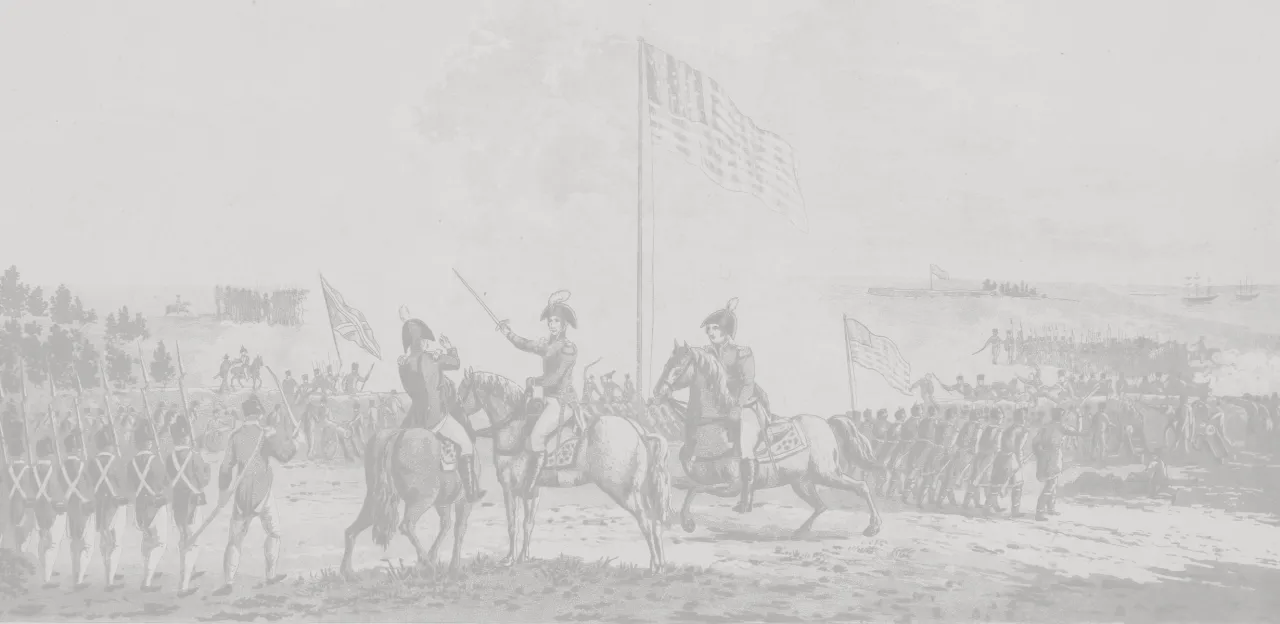
By July 1812, the United States was at war with Great Britian in the War of 1812. The elected officials in the Washington DC still observed and celebrated the Fourth of July with a serious of events described in this newspaper column.
FOR THE NATIONAL INTELLIGENCER
FOURTH OF JULY.
Among the many pleasing events which have recently occurred in our infant Metropolis, we notice with real pride and satisfaction the animated and brilliant celebration of the late Anniversary of our country's Independence.
The day was ushered in by federal salutes at sunrise, the national standard being conspicuously displayed at various places in the city. Detached corps of the Militia of the City and Georgetown were soon after rendezvousing at different points. At half past 9 o'clock A.M. the Secretary of War, accompanied by the Secretary of State, was escorted by Capt. Peter's company of Dragoons, from his house to the Presidents's; from when the Chief Magistrate and his family, accompanied by the Heads of Departments, proceeded, under the same escort, to the Capitol. Here, at about 10 o'clock, they were met by Gen. Van Ness, (who, attended by Maj. Cox, had been prviously escorted thither by Capt. Caldwell's troop of Cavalry) and during a federal salute of 18 guns by a detachment of Lieut. Perkin's artillery, conducted into the Representatives Hall (the House having adjourned to a late hour) where they were recived by the Committee of arrangment who had previously attended judge Duvall and Mr. Rush to that splendid apartment; and where they found a brilliant assemblage of Ladies drawn together for the occasion. The Hall, all the doors of which were now thrown open, was soon filled by public and private gentlemen, and the surrounding crowd of citizens and strangers, and was cheered with some elegant music by the Marine Band. In the course of a few minutes, the audience having become composed, judge Duvall occuied the Speaker's chair, and, soon rising, after a few prefatory remarks, read the Declaration of Independence with a solemnity and dignifty due to the subject and the occasion. After the short interval, which was supplied by music, judge Duvall having left the chair, Mr. Rush ascended and delivered an Oration, whose merit, both in matter and manner, is beyond our eulogy. As we understand the Committee is about to apply to Mr. Rush for a copy for publication, we shall now only express our participation with an applauding audience in the animated expression of their approbation.
Here indeed was a sublime spectacle! On the 36th Anniversary of our political birth, the record of our freedom, containing an inimitable exposition of the principles and causes of the revolution, solemnly read by a venerable patriot of its time; and an elegant address, taking a comparative view of the present and the former crisis of our country, delivered by the son of another patriot of the revolution, in the presence of our constitutional rulers, the sons and disciples of Washington, Franklin, Adams, Hancock, Mercer and the other fathers of the nation, to an audience in fact composed, as it were, of the United States. The public mind was irrestiably led to a retrospect of the heroic times of '76. Every countenance beamed with the most joyful emotions of the freeman's heart, and indicated an emulation to rival, at the present day, the exploits of our immortal ancestors.
The President [James Madison] and the heads of departments and their families soon afterwards returned, escorted by Captains Peters' & Caldwell's horse to the President's House, where an unusually numerous assemblage of ladies and gentlemen, including a large portion of the members of Congress, soon collected to offer and to interchange their personal respects and congratulations upon the highly interesting occasion. In the mean time about 500 of the military of the 1st legion of the militia of the district, principally in uniform and all well armed, exhibiting a very martial appearance, under the command of Col. Smith, were formed in line immediately in front of the President's house where they made a very handsome display, and were reviewed at about one o'clock by Gen. Van Ness, a ceremony in which they are thought to have acquitted themsleves in an excellent style. They then paid to the President, accompanied by the heads of departments, a number of officers of the Army and Navy and an immense concourse of spectators, at his door, a marching salute. The other troops having returned to the field of parade, Captain Stull's company of riflemen performed, immediately in front of the President's Porch, in a masterly manner, a few appropriate maneuvers very much to the satisfaction of all who beheld them. We cannot withold our tribute of approbation of the martial appearance and conduct of the troops generally, both horse and foot; and it gave us real gratification to witness the satisfaction universally felt and expressed in relation to them, by the gentlemen from all parts of the country. The troops being dismissed, the officers and others paid their respects to the head of th enation, their constitutional Commander in Chief, who received them with his usual urbanity.
At about 3 o'clock, the company afte having been agreeably entertained & refreshed, left the President's house. At about 5 o'clock, a very numerous party (about 200 guests) consisting of the heads of Departments, members of both Houses of Congress, citizens and strangers, sat down to an elegant dinner prepared by Mr. Tomlinson. Gen. Van Ness presided, supported by Commodore Tingey, Charles Carroll, James H. Blake and Walter Jones, esqs. as Vice Presidents — an elegant band of music attended and added much to the gaiety and gladness of the scene. The company was, indeed, very numerous and respectable; but we have never seen more order, decorum, and universal good humor and hilarity upon an similar occasion. At about sunset, after having drank the following Toasts, which appeared to be perfectly adapted to the state of public sentiment and feeling, (interspersed with occasional songs) the compay finally dispersed, without the occurrence of a single disagreeable circumstance to mar the enjoyments of the day.
TOASTS
1. The Day — We would not survive that anniversary of it, which should cease to witness our independence ad honor sustained, and vindicated in a spirit worthy the heroic times of times of '76.
2. The Constitution of the United States — Imperishable as the virtue of the Republic.
3. The 12th Congress — Worthy of succeeding to the dangers and the glory of their illustrious predecessors, the immortal founders of the Revolution.
4. The President of the United States — Distinguished in peace by his genius and his enlightened benevolence, war finds him true to his station, in the foremost rank of intrepid and zealous patriots, of wise and energetic statemen.
5. The memory of Washington — His name will ever be to the armies of his country, what his presence was to the armies of the Revolution—a strong incitement to deeds of valor and patriotic ardor.
6. The Tomb of Montgomery — Soon to be decked with the laurels of his countrymen.
7. The memory of Franklin, Warren, Hancock, Green, Adams, and the other heroes and sages of the Revolution.
8. The Army — Every soldier a landholder, and every landholder ready to become a soldier rather than yield his country's rights.
9. The Navy — An infant Hercules, destined, by the presage of early prowess, to extirpate the race of pirates and free-booters.
10. The People of the United States — Once drive by the rival atrocities of mutual foes from the long cherished habits of peace, they will never unbrace [take off] the armour of defence, nor relax the attitude of war, until arms archieve, against every aggressor, all that has been denied to justice.
11. Spanish America — Success to the real Patriots who are struggling for the entire regeneration of their social and political institutions.
12. The Volunteers of America — The men who willinly lad down the implements of their trade, to take up arms in support of their country, frm a sure defence, and are entitled to its warmest gratitude.
13. The Ocean — It belongs to all, and must not be usurped by any.
14. The Union — The bulwark of our safety and our happiness; it will find enought of incorruptible and triumphant defenders in the very quarter where it has been mot assiduously assialed by foreign intrigue.
15. Thomas Jefferson — May he long enjoy, in a chosen and happy retirement, the fame and the gratitude so justly merited by his long and illustrious course of public service.
16. The War — We have selected an adversary without elected an ally. We have taken up arms against the most inveterate and atrocious aggressor, and the most vulnerable to our just resentment, but withhold our friendship from all pretenders, until it be earned by some better atonement than ambiguous delays and hollow truces.
17. The Arts and Sciences — Whist they adorn and elevate the huma mind, they emancipate the human race.
18. The late anniversary of Bunker's Hill — It has solemnly announced another struggle for our rights, and gives a happy omen of the patriot-ardor and self devotion with which our government will be supported in all quarters of the Union.
VOLUNTEERS. [extra toasts?]
The American Fair — May they teach their sons Republicanism and their daughters to imitate their mothers.
The Heads of Departments.
The Orator of the Day.
The venerable and patriotic reader on this day of the Declaration of Independence.
The magnanimous admontion of the departed Warren — "The voice of your fathers' blood cries to you from the ground 'My Sons! in vain we toiled, in vain we fought; we bled in vain, if you, our offspring, want valor to repel the assualts of the invaders of your liberties.'"
Source:
"Fourth of July," National Intelligencer, July 8, 1812, Page 2. Accessed through Newspapers.com